+86 13163919000
 info@xinmeiintelligent.com


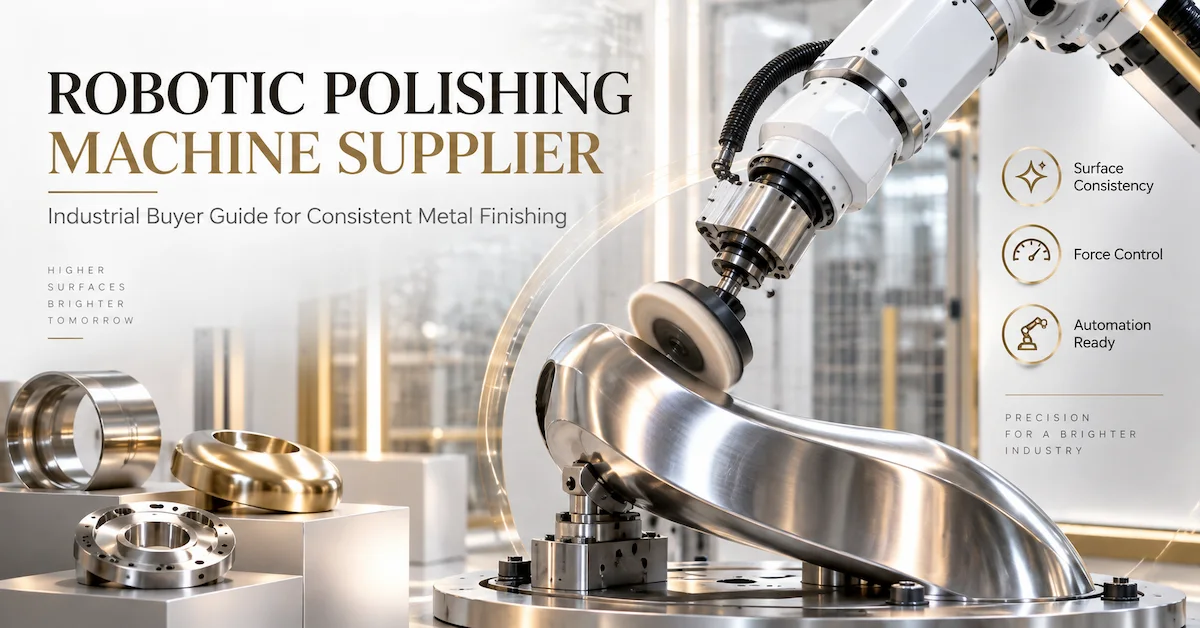
Choosing a robotic grinding machine supplier is not simply a matter of selecting an industrial robot and attaching a grinding tool. For manufacturers processing metal components in large quantities, the real challenge is maintaining consistent surface quality while controlling labor requirements, abrasive consumption, production time, and long-term equipment reliability.
Manual grinding has traditionally depended on experienced operators who adjust tool pressure, grinding angle, movement speed, and abrasive selection based on the condition of each workpiece. That flexibility is valuable, particularly for complex or frequently changing products. However, it becomes difficult to maintain consistent results when a factory must finish hundreds or thousands of similar components every day.
A robotic grinding system can standardize these operations through programmed movement, controlled contact, repeatable workholding, and automated abrasive processing. Yet installing a robot does not automatically create a reliable grinding process.
The most suitable robotic grinding machine supplier is one that can demonstrate acceptable surface quality on your actual workpiece, explain how grinding force and abrasive wear are controlled, and validate the complete automated cycle before delivery.
A robot may repeat its programmed path accurately while still producing inconsistent results if the workpiece dimensions vary, the abrasive belt wears unevenly, or the grinding fixture is unstable.
These differences explain why successful grinding automation requires coordinated mechanical engineering, abrasive technology, robot programming, process development, and quality validation.
This guide examines the technical and commercial factors that industrial buyers should investigate before investing in a robotic grinding machine. It also explains when automated grinding makes economic sense, which machine configuration is appropriate for different applications, and how to prepare a technical inquiry that produces a useful supplier quotation.
What Is a Robotic Grinding Machine?
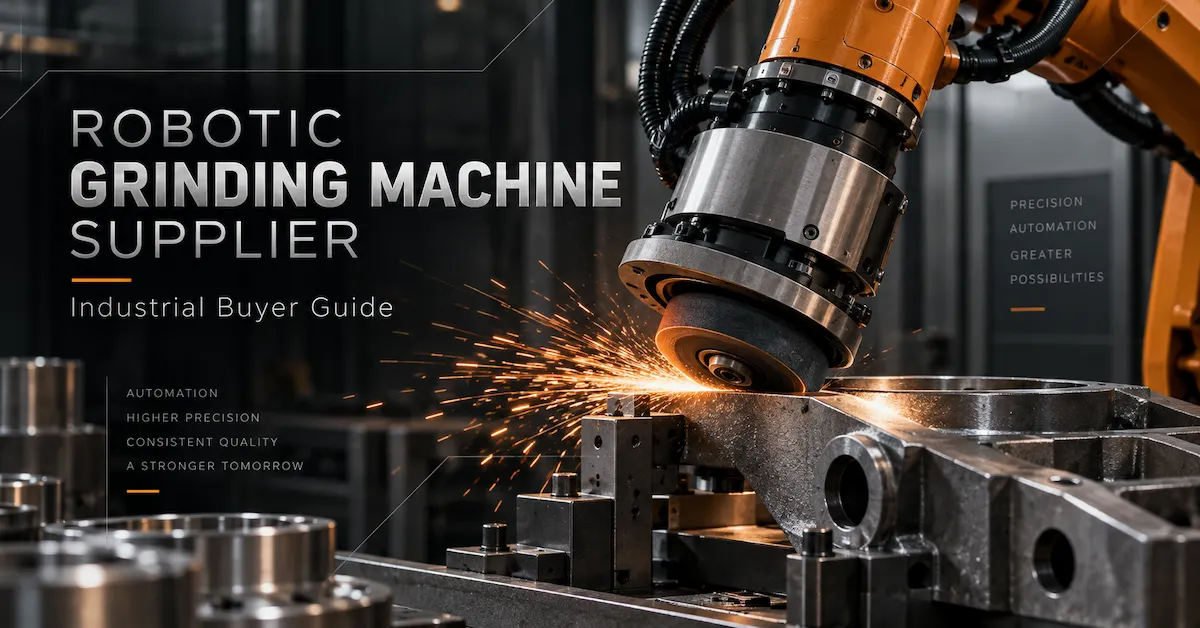
A robotic grinding machine is an automated surface-processing system that combines an industrial robot with grinding equipment, workholding, controls, and safety systems to remove material or modify the surface of a workpiece.
Depending on its configuration, the system may perform:
-
Surface grinding
-
Abrasive belt grinding
-
Weld seam removal
-
Casting flash removal
-
Edge deburring
-
Surface preparation
-
Controlled material removal
-
Surface smoothing
-
Selected grinding and polishing operations
The robot provides controlled movement and positioning. The grinding unit supplies the abrasive action required to remove material.
A complete robotic grinding system normally includes several interconnected elements.
| System Component | Main Function | Why Buyers Should Evaluate It |
|---|---|---|
| Industrial robot | Controls movement and orientation | Determines reach, access, positioning, and movement capability |
| Grinding unit | Performs material removal | Influences rigidity, vibration, and process stability |
| Abrasive belt, wheel, or tool | Contacts and processes the surface | Affects removal rate, finish, and consumable cost |
| Force-control system | Regulates grinding contact | Helps manage workpiece variation and abrasive contact |
| Fixture or gripper | Locates and holds the component | Influences repeatability, deformation, and accessibility |
| Control system | Coordinates equipment operations | Supports programming, monitoring, and process control |
| Safety system | Manages hazardous movement and access | Essential for industrial operation |
| Dust-management system | Controls grinding emissions | Important for worker safety and environmental compliance |
| Loading system | Transfers raw and finished components | Influences labor needs and production throughput |
These components must function as a coordinated production system.
A machine with an excellent robot but an unstable abrasive mechanism may produce unacceptable surfaces. A rigid grinding unit with poor workholding can create inconsistent results. Similarly, an automated cell with inadequate dust-management provisions may be unsuitable for the intended working environment.
When evaluating a supplier, buyers should consider the complete cell rather than treating the robot as the main product.
What Should a Professional Robotic Grinding Machine Supplier Provide?
A qualified robotic grinding machine supplier should understand the relationship between the workpiece, surface requirements, abrasive process, automation system, and production environment.
Its responsibility should extend beyond delivering machinery.
Workpiece and Application Evaluation
The supplier should first examine the actual component.
Relevant information includes the material, dimensions, weight, surface geometry, initial condition, required material removal, and final quality standard.
The supplier should also determine whether the part contains surfaces that must not be ground.
These may include sealing faces, threaded features, locating surfaces, or precision-machined areas.
Grinding Process Development
The supplier should recommend an appropriate grinding method based on the part.
This includes:
-
Grinding tool selection
-
Abrasive specification
-
Contact-pressure strategy
-
Robot movement
-
Grinding sequence
-
Workholding
-
Process monitoring
-
Inspection requirements
Equipment Configuration
The proposed machine should have sufficient structural rigidity, robot reach, tooling access, and processing capability.
A supplier should explain why the selected architecture is appropriate rather than simply offering the largest robot or highest-powered grinding motor.
Production Validation
The proposed process should be evaluated using representative workpieces.
Buyers should request evidence that the system can achieve the required finish, material-removal consistency, and target production cycle.
Installation and Long-Term Support
The supplier should clarify responsibility for commissioning, operator training, maintenance, replacement parts, troubleshooting, and future upgrades.
XINMEI provides robotic grinding and polishing solutions that combine industrial robots, grinding units, fixtures, control systems, and configurable automation modules.
Its published solution approach includes sample testing, process evaluation, technical confirmation, manufacturing, factory commissioning, and installation support.
These are useful capabilities for buyers, but the deliverables and performance of an individual project should still be documented in the purchase agreement.
When Should a Factory Invest in Robotic Grinding?
Robotic grinding generally becomes more attractive when a factory processes repeatable components at medium or high production volumes.
The strongest justification is usually a combination of quality consistency, production stability, labor utilization, and controlled finishing costs.
High-Volume Metal Component Manufacturing
Factories producing the same component repeatedly can benefit from standardized grinding programs.
Once the process is validated, the robot can execute the programmed movement without depending on the manual technique of different operators.
This can make production planning and quality control easier.
Labor-Intensive Grinding Operations
Grinding can require sustained physical effort, repetitive movement, and prolonged exposure to noisy or dusty working conditions.
An automated cell can move operators away from some direct grinding tasks, although it introduces its own safety and maintenance requirements.
Products With Consistent Surface Requirements
Components requiring repeatable appearance, controlled material removal, or consistent edge treatment are suitable candidates for robotic process evaluation.
Examples include metal housings, brackets, automotive components, valves, and industrial hardware.
Production Lines With Stable Product Families
When several related parts share similar geometry, a configurable robotic system may support multiple programs and fixtures.
The economic result depends on how quickly the equipment can change from one product to another.
When Robotic Grinding May Not Be Appropriate
Automated grinding is not automatically the best option for every factory.
Manual or simpler mechanized methods may remain more suitable when:
-
Production volumes are extremely low.
-
Workpiece geometry changes continuously.
-
Each component requires extensive individual judgment.
-
The parts cannot be located consistently.
-
Surface requirements are poorly defined.
-
The process has not been proven technically feasible.
-
Initial investment cannot be justified by expected utilization.
For these applications, process standardization or semi-automatic equipment may be a more sensible first investment.
A reliable supplier should be willing to explain these limitations.
Robotic Grinding vs. Manual Grinding: Which Is Better for Industrial Production?
The key difference is not simply that robotic grinding operates automatically.
It is that an automated system can control and repeat a defined process, while manual grinding relies more heavily on operator judgment and physical technique.
| Evaluation Factor | Manual Grinding | Robotic Grinding |
|---|---|---|
| Initial investment | Usually lower | Higher |
| Process flexibility | High for varied tasks | Depends on programming and fixtures |
| Grinding-path consistency | Operator dependent | Program controlled |
| Contact-force consistency | Operator dependent | Can be controlled through suitable hardware |
| Batch repeatability | Depends on worker skill | Potentially more consistent after validation |
| Direct labor | Usually higher | Can be reduced |
| Changeover | Often straightforward | Requires program and fixture preparation |
| Process data | Often limited | Greater monitoring potential |
| Dust exposure | Operator works near grinding source | Exposure can be reduced through cell design |
| Long-term scalability | Additional labor may be required | Additional cells or stations can be introduced |
Robotic grinding has advantages for repeatable production, but the final result depends on correct process engineering.
For example, an automated system may reduce variation in grinding movement, but it cannot eliminate variation caused by unsuitable raw castings or worn abrasive tools.
Likewise, a programmed cycle is not necessarily faster than a skilled manual operation when the part requires extensive repositioning.
The supplier should establish the expected benefits using a process trial.
For additional technical background, manufacturers can review XINMEI's article on robotic grinding solutions for metal parts.
How Does Robotic Grinding Machine Architecture Affect Performance?
One of the first engineering decisions is whether the robot moves the workpiece or moves the grinding tool.
Both arrangements are used in industrial surface finishing.
Robot Holds the Workpiece
In this configuration, the robot grips the component and presents it to a stationary abrasive belt or grinding unit.
Potential advantages include:
-
A rigidly mounted grinding mechanism
-
Controlled workpiece orientation
-
Access to different surfaces
-
Multiple grinding stations within robot reach
-
A compact arrangement for suitable parts
This architecture is often worth evaluating for components that can be securely gripped and manipulated.
However, the robot must have sufficient payload capacity for the part, gripper, and operating conditions.
Workpiece geometry, gripping security, and tool access become critical.
Robot Holds the Grinding Tool
In another configuration, the workpiece remains fixed while the robot moves a grinding spindle, belt head, or other abrasive tool.
This arrangement can be useful when the workpiece is too large or heavy to manipulate efficiently.
It may also provide greater accessibility around certain geometric features.
However, the complete tool weight, cable routing, hoses, reaction forces, and robot stiffness must be evaluated.
How Should Buyers Choose?
The decision should be based on:
-
Workpiece size and weight
-
Geometry and surface accessibility
-
Required grinding force
-
Number of processing faces
-
Fixture complexity
-
Robot payload and reach
-
Loading method
-
Production cycle
-
Future product variants
A professional supplier should explain the selected architecture and identify the main technical risks before confirming the machine configuration.
Why Constant-Force Control Matters in Robotic Grinding
Contact force is one of the most important process variables in automated grinding.
Unlike a purely geometric positioning operation, abrasive grinding involves continuous interaction between the tool and the surface.
The amount of material removed depends on several factors, including contact pressure, abrasive condition, relative movement, and workpiece material.
If the system follows only a fixed geometric path, variations in the workpiece can change the actual grinding contact.
A casting with slightly more excess material may experience greater pressure than expected. Another casting with less material may receive insufficient grinding.
Both situations can create inconsistent results.
Problems Caused by Excessive Grinding Force
Excessive contact force may cause:
-
Unwanted material removal
-
Edge rounding
-
Surface overheating
-
Abrasive wear
-
Deformation of thin components
-
Uneven surface texture
-
Increased machine loading
Problems Caused by Insufficient Force
Insufficient force may cause:
-
Incomplete burr removal
-
Remaining casting defects
-
Insufficient weld removal
-
Longer processing cycles
-
Unstable appearance
-
Additional rework
Active Force Control vs. Passive Compliance
These two approaches should not be confused.
A passive compliance mechanism can absorb limited positional variation through mechanical movement.
An active force-control system uses feedback and control logic to adjust the process according to measured or estimated contact conditions.
The most appropriate solution depends on workpiece variation, process sensitivity, required removal, and equipment complexity.
XINMEI's robotic grinding and polishing solution describes a constant-force control system with real-time force feedback for responding to geometry and size variation.
Buyers should confirm which force-control hardware and functions are included in the exact equipment configuration being quoted.
Not every robotic grinder automatically includes the same level of force-control capability.
Questions to Ask the Supplier
-
How is grinding force measured or regulated?
-
Can the force target be adjusted for different materials?
-
How does the system respond to unexpected casting variation?
-
Can it detect abnormal contact?
-
How does it handle abrasive wear?
-
Is process data available for troubleshooting?
-
Can force-control performance be demonstrated on our samples?
These questions are often more valuable than simply asking for the robot's nominal positioning repeatability.
Abrasive Belt System: A Critical Part of Grinding Machine Quality
Many robotic grinding systems use abrasive belts because they can provide continuous contact and effective material removal.
However, a belt grinding unit is not just a motor and sanding belt.
Its performance depends on:
-
Mechanical rigidity
-
Belt tension
-
Contact wheel characteristics
-
Tracking stability
-
Abrasive speed
-
Vibration
-
Cooling requirements
-
Belt replacement access
-
Abrasive specifications
A machine with unstable belt tracking may generate inconsistent surface patterns, unnecessary belt wear, or interruptions during operation.
Likewise, vibration in the grinding structure can influence finish quality even when the robot movement is repeatable.
Why Structural Rigidity Matters
Grinding forces pass through the abrasive belt, contact wheel, spindle bearings, machine frame, and workpiece.
Unwanted movement in this system can influence surface consistency.
The supplier should evaluate both the robot and the grinding-unit structure.
XINMEI's CNC Intelligent Robot Grinder features an integrated casting belt-grinding structure designed to support rigidity and vibration resistance.
The product description also identifies double tempering heat treatment of the machine frame, stable sanding-belt tension, and standardized belt lengths.
These are relevant design features because structural stability and consumable management affect long-term production.
However, they should not be treated as substitutes for workpiece-specific grinding trials.
Why Standardized Belt Lengths Matter
Using standardized belt dimensions can simplify:
-
Abrasive procurement
-
Inventory management
-
Spare-belt planning
-
Replacement procedures
-
Maintenance preparation
For a factory operating several grinding cells, consumable standardization may be economically useful.
Buyers should confirm the exact belt dimensions, available abrasive grades, supplier options, and replacement costs before placing an order.
How Should Abrasives Be Selected for Different Metals?
Abrasive selection determines much of the grinding process.
The correct abrasive is not necessarily the one that removes material fastest.
It must achieve the required surface condition while maintaining acceptable wear, process stability, and cost.
| Workpiece Material | Common Processing Challenge | Abrasive Selection Priority |
|---|---|---|
| Aluminum | Heat, loading, surface marking | Suitable grain, coating, controlled contact |
| Brass | Appearance consistency, unwanted edge removal | Controlled abrasive sequence and pressure |
| Stainless steel | Heat, tool wear, discoloration | Suitable abrasive grain and thermal management |
| Carbon steel | Weld seams, scale, surface variation | Effective removal and suitable belt durability |
| Cast iron | Abrasive particles, dust, rough surfaces | Robust abrasives and effective extraction |
| Zinc alloy | Soft surfaces, over-grinding risk | Controlled pressure and appropriate grit |
This table is a selection framework, not a fixed abrasive specification.
The final choice should be established through tests with the actual material.
Abrasive Grit Is Only One Variable
Buyers often ask suppliers which grit number they should use.
That question matters, but surface results also depend on:
-
Abrasive grain type
-
Bond and backing
-
Contact-wheel hardness
-
Belt speed
-
Contact pressure
-
Grinding direction
-
Number of passes
-
Initial surface condition
-
Tool wear
A coarse abrasive may remove material efficiently but leave a surface that requires further finishing.
A fine abrasive may produce a smoother appearance but remove excess material too slowly.
Many applications require a sequence of abrasive steps rather than a single belt.
The supplier should define this sequence during sample development.
How Can Buyers Verify Surface Finish and Grinding Quality?
Surface quality should be described in measurable terms whenever possible.
Statements such as “excellent polishing performance” or “high precision grinding” are not sufficient for technical purchasing.
A useful grinding specification identifies what must be achieved on the finished component.
Possible requirements include:
-
Surface roughness
-
Appearance uniformity
-
Maximum remaining burr size
-
Required weld-removal condition
-
Material-removal allowance
-
Edge-radius limit
-
Absence of unacceptable grinding marks
-
Dimensional integrity
-
Surface condition before coating or assembly
Surface Roughness
Surface roughness may be evaluated using parameters such as Ra or Rz, depending on the drawing and applicable measurement requirements.
However, a low Ra value does not automatically mean that a surface meets its visual or functional requirements.
Two surfaces may have similar roughness measurements while showing different grinding directions or visible patterns.
Dimensional Quality
Grinding changes the geometry of the component.
Therefore, the supplier should establish which surfaces may be processed and how much material may be removed.
This is especially important for:
-
Thin-wall castings
-
Sealing surfaces
-
Precision edges
-
Parts requiring controlled thickness
-
Components with tight dimensional tolerances
Appearance Standards
For decorative hardware and visible components, appearance may be a major quality criterion.
Buyers should define acceptable appearance using approved physical samples, suitable lighting conditions, inspection positions, and written defect criteria.
A vague requirement to produce a “perfect surface” is difficult to validate and can lead to disagreement during equipment acceptance.
Repeatability Across a Production Batch
A successful first sample is not enough.
The supplier should demonstrate that the process maintains acceptable quality across repeated components and relevant variations in abrasive condition.
Sampling should cover the beginning of the run and later stages rather than only freshly installed belts.
Which Industries Use Robotic Grinding Machines?
The equipment is particularly relevant to industries producing metal components with repeated finishing requirements.
Automotive Components
Automotive component production may involve castings, welded assemblies, brackets, and metal housings.
Grinding applications can include:
-
Burr removal
-
Casting surface preparation
-
Weld finishing
-
Controlled edge treatment
-
Surface smoothing before subsequent processing
Buyers should evaluate the relationship between finishing and critical dimensions.
An automated system must not damage surfaces that affect fit, sealing, or assembly.
Bathroom and Sanitary Hardware
Faucet bodies, handles, valve components, and related metal hardware can require consistent exterior surfaces.
Appearance may be an important purchasing criterion, especially when products undergo plating, coating, or decorative finishing.
Robotic grinding can be considered where stable product families require repeated surface processing.
Door-Control Hardware
Door closer housings, floor spring components, handles, and other door-control parts may contain cast or machined surfaces that require finishing.
The suitability of robotic grinding depends on component geometry and the functional surfaces involved.
Industrial Castings
Castings may contain excess material, parting-line flash, gates, or local surface imperfections.
Automated grinding can help standardize removal when variations are within the capability of the proposed process.
Welded Fabrications
Robotic grinding may be used to remove or blend selected weld seams.
The supplier must evaluate weld-size variation, required remaining geometry, accessibility, and safety.
General Industrial Hardware
Metal brackets, fittings, handles, mechanical components, and other repeatable products can be suitable for automated surface finishing.
For each industry, the correct machine configuration depends on the part rather than the industry label alone.
Robotic Flat Grinding vs. Robotic Belt Grinding vs. Surface Peeling
Buyers sometimes use grinding, polishing, deburring, and peeling interchangeably.
These processes are related but not identical.
Selecting the wrong equipment category can lead to unnecessary capital expenditure or poor production results.
| Equipment / Process | Main Purpose | Typical Application | Main Selection Concern |
|---|---|---|---|
| Robotic belt grinding | Controlled abrasive removal and finishing | Metal components, castings, hardware | Belt stability, force, surface access |
| Robotic flat grinding | Consistent grinding of flat surfaces | Flat metal components and repeated planar features | Surface uniformity and controlled contact |
| Robotic polishing | Refine appearance and surface condition | Decorative hardware and visible parts | Finish standard and abrasive sequence |
| Robotic deburring | Remove unwanted edge material | Machined or cast components | Edge consistency without dimensional damage |
| Metal surface peeling | Remove an outer surface layer | Material preparation and dedicated processing | Removal depth and machine configuration |
XINMEI's Grinding & Peeling Machines category includes equipment for different surface-processing requirements.
Its CNC Intelligent Robot Grinder is positioned around automated grinding and polishing with an industrial robot and rigid belt-grinding structure.
Its Intelligent Robot Flat Grinding Machine focuses on automated flat-surface processing, stable grinding pressure, and consistent finishing for batch production.
The company's high-speed multi-spindle metal surface peeling equipment performs a different manufacturing function and should not be treated as an interchangeable robotic grinding solution.
Buyers should select the process before selecting the machine.
How Do You Choose the Right Robotic Grinding Machine Configuration?
Start with the component's geometry and finishing requirements.
Choose a General Robotic Grinding System When:
-
Several surfaces must be reached.
-
The component requires controlled robot movement.
-
Grinding and polishing operations may be combined.
-
A stable product family justifies programmed processing.
-
Future automation integration is important.
Consider Robotic Flat Grinding When:
-
The main processing requirement involves flat surfaces.
-
Surface consistency is important.
-
The workpiece can be positioned repeatably.
-
Production volume supports an automated process.
-
A dedicated flat-grinding arrangement simplifies the operation.
Consider a Customized Multi-Station Cell When:
-
Several abrasive operations are required.
-
Loading and unloading consume significant time.
-
Different surfaces need different grinding units.
-
Cycle-time requirements justify parallel operations.
-
Automatic inspection or further handling is required.
XINMEI's published robotic grinding solution supports modular configuration concepts involving special grinding heads, vision positioning, multi-station turntables, automatic loading, different abrasive tools, and production-system integration.
The buyer should confirm which modules are included in the proposed design rather than assume every option is part of the standard machine.
Why Workholding and Robot Programming Must Be Evaluated Together
A robotic grinding machine depends on predictable workpiece location.
Even a highly repeatable robot cannot produce stable grinding results if the part moves or changes position unpredictably.
This becomes important for irregular castings and welded components.
Fixture Location
The fixture should use appropriate reference surfaces and hold the workpiece securely.
The supplier must consider blank variation, grinding force, vibration, and access requirements.
Clamping Deformation
Excessive clamping force may distort thin-walled components.
This can affect grinding contact or dimensional quality after the part is released.
Tool Access
The robot and abrasive tool need access to the required surfaces without collisions.
The design should consider nearby clamps, machine structures, and other obstacles.
Program Development
The robot program should define:
-
Tool orientation
-
Grinding path
-
Movement speed
-
Contact sequence
-
Approach and withdrawal
-
Process transitions
-
Appropriate handling of variation
For complex parts, a single fixed program may not be sufficient.
The manufacturer may recommend alternative fixtures, additional sensing, or a more suitable machine architecture.
Product Changeover
For factories producing multiple models, changeover must be considered before purchase.
Ask how long it takes to change fixtures, select another program, install different abrasives, and verify the first acceptable part.
A system that performs well on one product but requires extensive adjustment for every changeover may not deliver the expected production flexibility.
Grinding Dust, Sparks, and Robot Cell Safety
Safety should be evaluated during the earliest engineering stages.
A robotic grinding cell can contain hazards associated with industrial robot movement, abrasive-tool operation, dust, sparks, noise, electrical systems, and maintenance activities.
Moving the operator away from direct grinding does not eliminate these hazards.
Industrial Robot Safety
The ISO 10218 series provides an important reference framework for industrial robot safety.
ISO 10218-1:2025 addresses safety requirements for industrial robots.
ISO 10218-2:2025 addresses industrial robot applications and robot cells, including integration and associated risk reduction.
A buyer should ask the supplier how the robot cell is assessed against applicable standards and regulations.
The supplier should not claim compliance or certification unless appropriate evidence is available for the actual equipment.
Metal Dust and Fire Risk
Grinding can produce airborne particles and accumulated dust.
Some metal dusts, including certain aluminum dusts, may create combustible-dust hazards under relevant conditions.
The U.S. Occupational Safety and Health Administration addresses combustible dust risks through its Combustible Dust National Emphasis Program and related workplace safety guidance.
The appropriate dust-management system depends on the material, process, dust properties, local regulations, and site-specific risk assessment.
A generic dust collector should not automatically be considered suitable for every metal-grinding application.
Safety Questions Before Purchasing
Ask whether the proposed scope includes:
-
Physical guarding
-
Access interlocks
-
Emergency-stop functions
-
Appropriate safety-related controls
-
Grinding-tool protection
-
Dust extraction or compatible interfaces
-
Spark and fire-risk assessment
-
Maintenance access procedures
-
Operator training
-
Required documentation
The supplier should also explain who is responsible for safety validation after installation.
How Should a Supplier Test Your Actual Workpiece?
Sample testing is one of the most valuable steps in robotic grinding equipment selection.
A supplier may demonstrate a robot processing an attractive sample, but that demonstration has limited value if the customer's actual component is different.
The test should reproduce the relevant production conditions as closely as practical.
Step 1: Establish the Initial Condition
Record the raw-part material, geometry, dimensions, and existing surface defects.
Identify the areas that require grinding and those that must remain untouched.
Step 2: Define the Finished-Part Standard
Agree on:
-
Surface quality
-
Acceptable appearance
-
Maximum material removal
-
Critical dimensions
-
Burr or weld-removal requirements
-
Inspection method
Step 3: Select the Abrasive Process
Choose the grinding tool, belt or wheel, grit sequence, movement strategy, and contact-control method.
Step 4: Perform Initial Trials
Process representative samples.
Record problems such as uneven contact, vibration, excessive removal, or incomplete finishing.
Step 5: Optimize the Process
Adjust the relevant variables.
The objective is not to achieve the fastest possible cycle at the expense of product quality.
Step 6: Evaluate Repeatability
Process multiple workpieces and inspect the output.
Where appropriate, assess performance after the abrasive has experienced representative wear.
Step 7: Confirm Commercial Feasibility
Estimate the complete processing cycle, consumable usage, operator requirements, and expected production cost.
A technically successful sample does not automatically establish a commercially successful production system.
Why Trial Reports Matter
Request a written record of the agreed test conditions and results.
This creates a common basis for equipment acceptance and reduces disagreements about what the machine was expected to achieve.
What Should Be Included in a Robotic Grinding Machine FAT?
A Factory Acceptance Test, or FAT, should confirm that the completed machine or cell meets the agreed technical requirements before shipment.
For robotic grinding equipment, acceptance should include both equipment functionality and representative process performance.
| Acceptance Area | What Should Be Verified |
|---|---|
| Robot operation | Movement, reach, program execution, relevant positioning behavior |
| Grinding unit | Mechanical function, vibration, belt tracking, tension |
| Contact control | Performance under agreed process conditions |
| Fixtures | Workpiece location, clamping, access |
| Abrasive system | Correct specification and replacement function |
| Surface finish | Agreed quality or appearance standard |
| Material removal | Required removal without excessive grinding |
| Cycle time | Agreed complete production-cycle definition |
| Continuous production | Performance over an agreed run |
| Safety functions | Specified safety-related functions and protective systems |
| Dust system | Included extraction equipment or interface function |
| Documentation | Manuals, drawings, programs, backups, spare-parts information |
FAT Should Not Rely Only on One Finished Sample
A single successful part demonstrates feasibility under one set of conditions.
It does not necessarily demonstrate long-term process stability.
Where practical, the acceptance procedure should include several parts and an agreed continuous-production run.
The acceptance plan should also consider product variation and abrasive condition.
FAT and Site Acceptance Testing Are Different
FAT occurs before shipment.
Site Acceptance Testing, or SAT, confirms that the installed equipment operates as agreed in the customer's production environment.
Site-specific electrical conditions, dust systems, compressed air, layout, upstream part supply, and operator procedures may affect final performance.
Both tests should have clearly assigned responsibilities.
XINMEI publishes a broader equipment quality assurance process that includes component checks, assembly-stage inspection, and final machine validation.
For a robotic grinding project, buyers should request a specific FAT and SAT plan covering the actual cell and finishing requirements.
What Affects Robotic Grinding Machine Price?
The cost of an industrial robotic grinding system depends on its configuration and required engineering scope.
Two quotations described as robotic grinding machines may represent very different systems.
One may contain a robot and a simple grinding unit.
Another may include constant-force control, specialized fixtures, multiple abrasive stations, automatic loading, vision positioning, safety guarding, dust-management equipment, and production monitoring.
Comparing those quotations by total price alone is misleading.
Major Cost Factors
Robot configuration: Payload, reach, movement characteristics, and integration requirements influence selection.
Grinding equipment: Belt mechanisms, motors, abrasive tools, contact wheels, and mechanical structures contribute to cost.
Process control: Force-control hardware, sensing, and monitoring may require additional components and engineering.
Fixtures: Complex components may need specialized workholding or automatic clamping.
Automation: Part feeding, unloading, conveyors, and multi-station systems increase project scope.
Safety and environmental systems: Guarding, interlocks, extraction, and other necessary protections must be considered.
Engineering: Sample trials, programming, process optimization, and commissioning require technical resources.
Service: Installation, training, spare parts, documentation, and ongoing technical support should be defined.
Request a Detailed Quotation
Ask the supplier to separate standard equipment from optional modules.
A useful quotation should identify:
-
Included equipment
-
Main component configuration
-
Abrasive system
-
Fixture scope
-
Automation functions
-
Safety equipment
-
Documentation
-
Testing requirements
-
Installation responsibility
-
Training
-
Warranty
-
Spare parts
-
Delivery terms
This makes supplier comparisons more objective.
How Should Buyers Calculate Robotic Grinding ROI?
The most useful financial indicator is generally not the machine's purchase price alone.
It is the cost of producing one acceptable finished component over the equipment's working life.
A practical calculation is:
Finishing Cost per Accepted Part = Total Annual Finishing Cost ÷ Annual Accepted Finished Parts
Total annual finishing cost may include:
-
Equipment ownership cost
-
Operators
-
Abrasive belts and tools
-
Electricity
-
Maintenance
-
Replacement parts
-
Dust-system operation
-
Scrap and rework
-
Downtime
-
Production changeover
This approach is more realistic than assuming that installing a robot automatically reduces manufacturing cost by a fixed percentage.
Compare the Current and Proposed Process
Collect baseline information from the existing manual operation.
| Production Measure | Current Process | Proposed Robotic Process |
|---|---|---|
| Complete cycle time | Measured | Trial-based estimate |
| Accepted output per shift | Measured | Validated target |
| Operators required | Actual | Proposed |
| Abrasive consumption | Actual | Trial-based estimate |
| Scrap and rework | Actual | To be validated |
| Setup and changeover | Measured | To be tested |
| Maintenance cost | Existing records | Supplier estimate |
| Available production hours | Actual | Planned |
| Surface quality | Current inspection | Agreed acceptance criteria |
The supplier should explain the assumptions used to estimate productivity.
If the equipment includes several stations, calculate the complete cell cycle rather than only the time the abrasive contacts the workpiece.
A high-speed grinding operation does not necessarily result in high output if loading, unloading, inspection, or belt changes create bottlenecks.
Payback Depends on Factory Conditions
A factory with repetitive products, high utilization, and significant manual grinding requirements may have a stronger economic case than a facility producing small, frequently changing batches.
The actual result depends on labor costs, production volume, quality improvements, operating schedule, consumables, and investment.
Avoid treating generic supplier ROI claims as guaranteed project outcomes.
How Should Buyers Compare Robotic Grinding Machine Suppliers?
A structured supplier evaluation helps prevent price from dominating the decision.
The evaluation should consider technical, manufacturing, commercial, and service factors.
1. Application Understanding
Has the supplier examined the actual part?
Can it identify the critical grinding surfaces, raw-part variations, and quality requirements?
2. Grinding Process Knowledge
Can the supplier explain abrasive selection, contact force, grinding sequence, and finishing risks?
3. Mechanical Engineering
Is the grinding structure suitable for continuous industrial operation?
Can the supplier explain vibration control, belt tracking, and maintenance access?
4. Automation Capability
Can the supplier integrate the robot, workholding, process equipment, and material handling?
5. Sample Validation
Will the supplier conduct trials using representative parts?
Will it document the results?
6. Quality Control
Can the supplier define and perform relevant machine and process inspections?
7. Customization
Can it accommodate different workpieces, fixtures, abrasive systems, and automation requirements?
8. Safety Planning
Are risk assessment, guarding, dust management, and relevant standards considered?
9. Commercial Transparency
Does the quotation clearly define included equipment, optional modules, delivery scope, and acceptance requirements?
10. Long-Term Service
Are training, documentation, maintenance, spare parts, and technical support addressed?
A supplier that performs well in these areas is better positioned to support a production investment than one that offers only an attractive demonstration and a low initial price.
Why After-Sales Support Matters for Robotic Grinding Equipment
Robotic grinding systems contain several interacting mechanical and control elements.
A problem may originate in the robot, grinding mechanism, abrasive system, fixture, program, sensors, or supporting equipment.
The supplier should therefore provide a clear technical-support process.
Before ordering, ask about:
-
Installation and commissioning
-
Operator training
-
Maintenance instructions
-
Grinding-belt replacement procedures
-
Program and parameter backup
-
Fault diagnosis
-
Robot support
-
Spare-parts availability
-
Process re-optimization
-
Future modification support
Also clarify which parts of the system are supported by the machine supplier and which are supported by third-party component manufacturers.
Maintenance Planning
A preventive maintenance plan may include inspection of:
-
Abrasive belts
-
Belt-tracking mechanisms
-
Contact wheels
-
Bearings
-
Robot connections
-
Fixtures
-
Sensors
-
Dust-management equipment
-
Safety-related functions
Maintenance intervals should follow the equipment manufacturer's instructions and actual operating conditions.
For international projects, buyers should confirm available remote support and any applicable on-site service arrangements before purchasing.
What Customization Can a Robotic Grinding Machine Supplier Offer?
Customization should address a specific production requirement.
Useful options may include:
Dedicated Grinding Fixtures
Designed around workpiece geometry, dimensions, and required processing surfaces.
Multiple Grinding Stations
Different stations can support separate abrasive steps or processing operations.
Automatic Loading and Unloading
Robots, feeders, or conveyors may reduce manual part handling when production volume justifies automation.
Vision-Based Positioning
Vision modules can be considered where part position or presentation requires additional detection.
Specialized Grinding Heads
Different abrasive tools may be necessary for flat surfaces, edges, complex geometry, or specific materials.
Production Monitoring
Control and monitoring functions may support process visibility, fault reporting, and production-system integration.
MES or Production-Line Integration
Where required, the grinding system may be connected with broader factory operations.
XINMEI's robotic grinding and polishing automation solution describes a modular architecture that can incorporate these types of configurable functions.
The buyer should confirm which customization options are technically feasible and commercially justified for the project.
How XINMEI Supports Industrial Robotic Grinding Applications
Fujian Xinmei Machinery Technology Co., Ltd. develops CNC equipment and automated manufacturing solutions for industrial component production.
Its product portfolio includes machining centers, special-purpose machines, robotic grinding equipment, and integrated automation systems.
For surface-finishing applications, XINMEI offers equipment designed around repeatable grinding, stable mechanical operation, and automated production.
CNC Intelligent Robot Grinder
The CNC Intelligent Robot Grinder combines industrial robotic operation with an integrated belt-grinding structure.
Its published product characteristics include:
-
Intelligent robotic grinding and polishing
-
Integrated casting belt-grinding structure
-
Double-tempered machine frame
-
Stable sanding-belt tension
-
Standardized belt lengths
-
Rigid mechanical construction
-
Compatibility with automated production
These features are relevant for manufacturers evaluating automated abrasive grinding of repeatable metal components.
Intelligent Robot Flat Grinding Machine
The Intelligent Robot Flat Grinding Machine focuses on automated flat-surface processing.
Its product description emphasizes:
-
Robotic flat grinding
-
Stable grinding pressure and motion
-
Heavy-duty belt-grinding structure
-
Uniform surface processing
-
Reduced manual grinding requirements
-
Continuous batch-production applications
This machine direction is relevant to factories where the primary requirement is consistent finishing of flat metal surfaces.
Integrated Robotic Grinding and Polishing Solutions
Beyond individual equipment, XINMEI's robotic grinding solution describes integration of robot systems, grinding units, tooling fixtures, control modules, safety protection, and customization options.
The published workflow covers requirement analysis, sample testing, technical solution confirmation, manufacturing, factory commissioning, installation, and support.
For buyers considering a complete production cell, these project stages provide a basis for defining the work required before ordering.
Why Application-Based Selection Matters
The most suitable equipment depends on the actual workpiece.
A flat component requiring uniform surface processing may need a different machine from a complex casting requiring several grinding orientations.
The manufacturer's engineering team should evaluate material, geometry, surface requirements, production volume, existing process, and automation goals before proposing the final configuration.
Buyers can review XINMEI's company background and grinding equipment portfolio before starting a technical discussion.
What Should You Send When Requesting a Robotic Grinding Machine Quotation?
A detailed request for quotation helps the supplier determine the correct machine architecture and process.
For meaningful technical evaluation, prepare the following information.
Workpiece Information
-
Part name and application
-
2D drawing or 3D model
-
Physical sample where available
-
Material specification
-
Dimensions and weight
-
Raw-part manufacturing method
-
Initial surface condition
Grinding Requirements
-
Areas requiring grinding
-
Areas that must not be processed
-
Required material removal
-
Surface roughness or appearance target
-
Edge or burr requirements
-
Existing quality problems
-
Approved reference samples where available
Production Requirements
-
Daily or monthly output
-
Current grinding method
-
Current complete cycle time
-
Existing operators
-
Scrap or rework rate
-
Number of product models
-
Changeover frequency
-
Shift arrangement
Equipment and Factory Requirements
-
Available floor space
-
Preferred automation level
-
Loading and unloading method
-
Existing machines or conveyors
-
Electrical and utility conditions
-
Dust-management requirements
-
Destination country
-
Installation and training expectations
Photos and videos of the existing grinding process can also help the engineering team understand difficult surfaces and current operating conditions.
Once these details are available, the supplier can assess technical feasibility, equipment architecture, fixture requirements, abrasive systems, automation scope, and project cost.
For an application-specific proposal, contact XINMEI's engineering team with your drawings, samples, production requirements, and finishing targets.
Frequently Asked Questions About Robotic Grinding Machine Suppliers
1. What does a robotic grinding machine supplier provide?
A robotic grinding machine supplier provides equipment and, depending on its engineering capabilities, integrated solutions combining an industrial robot, abrasive grinding unit, fixtures, controls, and supporting automation. A qualified supplier should also help evaluate the workpiece, grinding method, required surface quality, production cycle, and acceptance requirements.
2. What is the difference between robotic grinding and robotic polishing?
Robotic grinding typically emphasizes controlled material removal, burr elimination, weld treatment, and surface preparation. Robotic polishing generally focuses more on refining surface appearance or achieving a specified finish. Some systems can perform both operations by using suitable abrasive tools and process sequences, but the requirements should be evaluated separately.
3.Is robotic grinding better than manual grinding?
Robotic grinding can provide more repeatable movement, greater process standardization, and reduced dependence on repetitive manual operations. However, it requires suitable part positioning, abrasive selection, programming, and validation. Manual grinding may remain preferable for low-volume, irregular, or frequently changing applications.
4. Can robotic grinding machines process stainless steel and aluminum?
Robotic grinding systems can be configured for different metals, including stainless steel and aluminum. However, the abrasive specification, contact conditions, cooling strategy, and dust-control requirements must match the material and process. The supplier should validate the actual material using representative samples.
5. How important is constant-force control in robotic grinding?
Contact-force control can be important when the workpiece geometry varies or consistent material removal is required. It helps manage the interaction between the abrasive and the surface. Buyers should verify the proposed force-control method and test it using actual parts rather than assume that robot positioning accuracy alone guarantees finish quality.
6. How much does an industrial robotic grinding machine cost?
The price depends on the robot, grinding mechanism, abrasive system, fixtures, control functions, safety equipment, customization, and automation level. A standalone robotic grinding machine and a fully integrated multi-station cell can have substantially different project scopes. Request a detailed quotation based on your actual workpiece and production requirements.
7. How can I verify robotic grinding quality before purchasing?
Provide representative samples and define measurable acceptance criteria. The supplier should perform a trial, inspect surface quality and material removal, and demonstrate repeatability. For important production projects, agree on FAT requirements covering machine functions, sample processing, cycle time, and relevant continuous-operation tests.
8. Can a robotic grinding machine be customized for different parts?
Yes, depending on the machine and supplier. Customization may involve fixtures, gripping systems, grinding heads, abrasive stations, robot programs, vision positioning, and loading systems. However, frequent product changes can increase setup complexity, so changeover requirements should be evaluated before purchase.
9. What safety requirements should buyers consider?
Buyers should consider industrial robot risk assessment, guarding, interlocks, emergency-stop functions, grinding-tool protection, dust management, fire risks, and applicable local regulations. ISO 10218-1:2025 and ISO 10218-2:2025 provide relevant industrial robot safety references. The exact safety requirements depend on the complete installed cell and its operating conditions.
10. How long does it take to install and commission a robotic grinding system?
The schedule depends on machine configuration, customization, sample testing, component availability, production-line integration, transportation, and site preparation. A standard system and a fully customized grinding cell may require different project timelines. Buyers should request a schedule covering engineering, manufacturing, FAT, delivery, installation, and SAT.
11. Can robotic grinding be integrated with an existing production line?
Potentially, yes. Integration may include automatic part feeding, loading and unloading, conveyors, inspection, and production monitoring. The feasibility depends on existing equipment interfaces, part orientation, cycle balance, available space, and safety requirements. A supplier should evaluate these conditions before proposing an integration solution.
12. How do I request a robotic grinding solution from XINMEI?
Prepare your workpiece drawing or sample, material, required finishing areas, target surface condition, production volume, current grinding process, and automation requirements. Submit the information through XINMEI's Contact Us page so the engineering team can evaluate an appropriate robotic grinding configuration and project scope.
Conclusion
Choosing a robotic grinding machine supplier requires more than comparing equipment prices or robot specifications. The most important factors are proven grinding quality, suitable force control, reliable abrasive systems, workpiece-specific engineering, safety, and long-term production economics.
XINMEI offers intelligent robotic grinding equipment and customized surface-finishing solutions for industrial manufacturing. To evaluate the right machine for your application, send XINMEI your part drawings, material details, surface requirements, and production targets for a project-specific engineering review.