+86 13163919000
 info@xinmeiintelligent.com


A robotic polishing machine supplier should provide more than a robot, a polishing wheel, and a quotation. For industrial manufacturers, the real purchasing objective is to achieve a specified surface finish consistently across production batches without creating excessive material loss, rework, or operating costs.
This distinction is especially important for factories manufacturing brass faucets, stainless steel bathroom fittings, decorative metal hardware, valve components, automotive parts, and precision metal products.
In these industries, surface appearance is often part of the product's commercial value. Scratches, uneven reflections, polishing lines, local discoloration, and inconsistent edge finishing can lead to customer complaints even when the component meets its dimensional requirements.
Manual polishing remains useful because skilled operators can react immediately to changes in surface condition. However, differences in pressure, movement, polishing compound, and operator technique become increasingly difficult to control when production volume increases.
Robotic polishing offers another approach. By combining programmable movement, controlled contact, appropriate polishing media, repeatable fixtures, and standardized process sequences, manufacturers can develop a more consistent finishing operation.
Nevertheless, purchasing an industrial robot does not automatically guarantee a mirror finish or an acceptable decorative surface.
The best robotic polishing machine supplier for a project is the one that can demonstrate the required finish on the buyer's actual workpiece, establish repeatable processing conditions, and verify output under realistic production conditions.
This guide explains how to evaluate suppliers, distinguish polishing technologies, define surface quality, compare machine configurations, plan sample trials, and prepare a technically meaningful request for quotation.
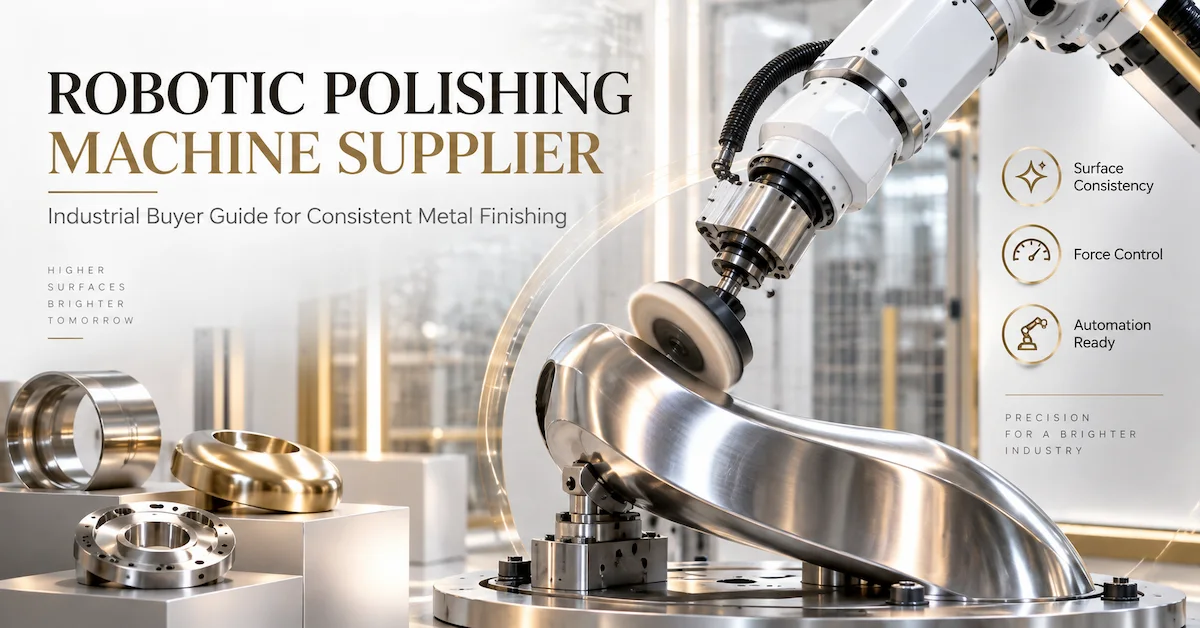
What Is a Robotic Polishing Machine?
A robotic polishing machine is an automated surface-finishing system that uses an industrial robot to manipulate either a polishing tool or a workpiece along controlled movement paths.
Depending on its design, the system may combine:
-
Industrial robotic arms
-
Polishing wheels and buffing units
-
Abrasive belts or finishing tools
-
Polishing compounds
-
Force-control or compliance mechanisms
-
Workpiece fixtures and grippers
-
PLC and operator-control interfaces
-
Safety and environmental protection systems
-
Automatic loading and unloading equipment
The purpose is to make the polishing process repeatable rather than relying entirely on manual skill.
A robotic polishing system can be configured for several objectives, including decorative finishing, surface smoothing, controlled scratch removal, preparation before plating, and improvement of visible surface consistency.
However, these applications may require very different polishing tools and process sequences.
A machine intended for coarse surface preparation is not automatically capable of producing a high-gloss decorative finish.
When evaluating a robotic polishing machine supplier, buyers should first explain what the finished component must look like and which surfaces must remain dimensionally unchanged.
The supplier should then recommend an equipment architecture based on that requirement.
What Should a Robotic Polishing Machine Supplier Actually Deliver?
Industrial buyers should view polishing equipment as a complete production solution.
A suitable supplier should be capable of addressing five connected areas.
1. Surface-Finishing Process Development
The supplier must understand the relationship between the initial surface condition and the required finished appearance.
This includes selecting the polishing stages, abrasive media, contact conditions, processing paths, and inspection methods.
2. Equipment Engineering
The proposed robot, polishing mechanism, fixtures, and control system must be appropriate for the component.
Machine specifications should be explained in relation to the actual workpiece rather than presented as isolated selling points.
3. Sample Testing
The supplier should demonstrate the proposed finishing process using representative customer samples.
Sample testing is particularly important where visual quality is difficult to describe using a single numerical parameter.
4. Production Validation
The system must achieve more than one attractive sample.
The buyer should verify repeatability, complete cycle time, consumable usage, and acceptable output across a representative production run.
5. Lifecycle Support
Training, maintenance, polishing-tool replacement, spare parts, programming changes, and technical troubleshooting should be addressed before equipment delivery.
XINMEI's robotic grinding and polishing automation solution describes a system approach integrating industrial robots, grinding and polishing units, tooling fixtures, control systems, constant-force technology, and configurable automation modules.
For industrial buyers, this is more relevant than evaluating a robotic arm independently from its finishing process.
Robotic Polishing vs. Robotic Grinding: What Is the Difference?
Grinding and polishing are related surface-processing operations, but their primary objectives are different.
Grinding generally emphasizes material removal and surface preparation. Polishing emphasizes achieving the specified final surface condition or appearance.
This distinction changes the equipment configuration, abrasive selection, contact pressure, inspection method, and production economics.
| Comparison | Robotic Grinding | Robotic Polishing |
|---|---|---|
| Primary objective | Remove excess material and surface defects | Improve surface finish and appearance |
| Typical operation | Weld removal, burr removal, leveling | Fine finishing, buffing, gloss improvement |
| Common tools | Grinding belts, abrasive wheels | Fine abrasives, polishing wheels, buffing tools |
| Material removal | Often more significant | Generally controlled and relatively limited |
| Critical parameters | Removal rate, geometry, force | Contact consistency, finish, compound, appearance |
| Common quality concern | Excessive removal or remaining defects | Scratches, haze, uneven reflection, polishing marks |
| Typical application | Castings and fabricated metal parts | Decorative hardware and visible components |
A complete manufacturing process may require both operations.
For example, a brass faucet body may need initial surface correction before progressively finer finishing and buffing.
Attempting to create the final appearance directly from a rough casting can result in excessive polishing time and consumable consumption.
Manufacturers evaluating the earlier material-removal stages can review XINMEI's separate guide to robotic grinding solutions for metal parts.
For this article, the primary focus is supplier evaluation for the final polishing and surface-finishing stages.
How Should Buyers Define the Required Polished Surface?
The most important step before requesting a quotation is establishing a clear finish specification.
Terms such as smooth, shiny, high quality, and mirror finish are frequently used in purchase inquiries.
Unfortunately, these descriptions are not precise enough to serve as reliable equipment acceptance criteria.
Two manufacturers may interpret the same term differently.
One may consider a bright satin surface acceptable. Another may expect a highly reflective finish with very limited visible distortion.
Define the Visual Finish
Buyers should identify whether the component requires:
-
Brushed or directional finishing
-
Satin finishing
-
Uniform fine finishing
-
Bright decorative polishing
-
High-gloss finishing
-
Mirror-like appearance
These descriptions should ideally be supported by approved physical samples.
The approved reference part is particularly valuable for products where appearance has a significant commercial impact.
Define Surface Roughness Where Relevant
Surface texture may be specified using parameters such as Ra, Rz, or other relevant measurements.
ISO 21920-2:2021 provides standardized terminology and parameters for profile-based surface texture evaluation.
However, surface roughness and visual appearance are not interchangeable.
A component can satisfy a specified roughness measurement while still showing unacceptable polishing lines, visible waviness, or local scratches.
Identify Protected Functional Surfaces
Not every area should receive the same polishing treatment.
Buyers should identify:
-
Sealing surfaces
-
Threads
-
Precision locating areas
-
Thin edges
-
Critical dimensions
-
Contact or assembly features
The polishing process must avoid damaging these features.
Establish an Appearance Inspection Method
Agree on:
-
Lighting conditions
-
Viewing distance
-
Inspection angle
-
Approved reference samples
-
Acceptable and unacceptable defects
-
Relevant surface zones
-
Sampling frequency
A robotic polishing machine supplier that asks for this information is approaching the project as a production-quality problem rather than simply a machinery sale.
Which Robotic Polishing Machine Configuration Is Best?
There is no single machine architecture suitable for every metal-polishing application.
The main options differ in how they move the workpiece, position the polishing tool, and coordinate processing stations.
Robot-Held Workpiece Polishing
In this arrangement, a robot grips the component and presents it to a stationary polishing wheel or other finishing unit.
This can be suitable for small and medium-sized components that can be held securely.
Potential advantages include:
-
A rigidly mounted polishing mechanism
-
Multiple polishing stations within robot reach
-
Controlled workpiece orientation
-
Access to several external surfaces
-
Adaptability to different polishing tools
However, gripper design, robot payload, workpiece geometry, and secure positioning are essential.
Robot-Held Polishing Tool
For larger or heavier components, the workpiece may remain stationary while the robot manipulates the polishing tool.
This approach may be appropriate when moving the workpiece would be difficult.
The supplier must evaluate tool weight, contact force, access, hoses, cables, and the effect of process forces on the robot.
Multi-Station Robotic Polishing Cell
A multi-station system can combine several polishing operations within one production cell.
For example, a workpiece may require initial fine abrasive processing followed by buffing with another polishing medium.
Separate stations can reduce manual transfers and support a controlled finishing sequence.
How to Compare Configurations
| Configuration | Best-Fit Application | Main Advantage | Main Limitation |
|---|---|---|---|
| Robot moves workpiece | Small or medium repeat parts | Access to multiple polishing stations | Workpiece gripping and payload constraints |
| Robot moves polishing tool | Larger or fixed components | Flexible tool positioning | Tool weight and stiffness considerations |
| Dedicated polishing machine | Simple repeatable geometries | Straightforward production concept | Less flexibility for complex shapes |
| Multi-station robotic cell | Several finishing steps | Integrated process sequence | Higher engineering complexity |
| Fully automated polishing line | Stable high-volume production | Reduced handling and scalable throughput | Larger investment and integration scope |
The most suitable configuration should be chosen after examining real workpiece samples.
Why Constant-Force Control Matters in Robotic Polishing
Consistent contact is one of the main challenges in robotic polishing.
A polishing wheel does not behave like a rigid cutting tool.
Its contact area and effective pressure can change due to tool compression, wear, workpiece geometry, and movement direction.
A robot following the same programmed coordinates may therefore produce different surface results on slightly different workpieces.
Problems Caused by Excessive Contact Force
Too much pressure can contribute to:
-
Unnecessary material removal
-
Surface overheating
-
Distortion of thin sections
-
Rounded edges
-
Uneven polishing patterns
-
Faster tool wear
-
Inconsistent gloss
Problems Caused by Insufficient Contact Force
Insufficient pressure may result in:
-
Incomplete finishing
-
Remaining fine scratches
-
Inconsistent brightness
-
Additional polishing passes
-
Increased processing time
Force Feedback and Compliance
A polishing system may use active force feedback, passive compliance, or a combination of mechanisms.
The appropriate solution depends on the required finish, component variation, contact-tool behavior, and processing method.
XINMEI's published robotic polishing automation system describes constant-force control with real-time feedback that compensates for variations in workpiece size and geometry.
Buyers should confirm the exact force-control arrangement included in their proposed equipment.
The supplier should also demonstrate performance on the actual product rather than relying exclusively on controller specifications.
Polishing Wheels, Abrasives, and Compounds: What Should Buyers Evaluate?
The polishing medium is central to the final surface result.
Even a well-designed robotic system will struggle to produce consistent finishes if the polishing tool is unsuitable or its condition is poorly controlled.
Polishing Wheels
Different polishing wheels have different contact characteristics.
Depending on the application, suppliers may evaluate:
-
Cotton buffing wheels
-
Cloth polishing wheels
-
Sisal-based buffing tools
-
Nonwoven finishing wheels
-
Flap wheels
-
Other specialized polishing media
Each type behaves differently under load.
Wheel stiffness and construction influence the contact area, polishing action, edge access, and ability to follow curved surfaces.
Polishing Compounds
Compounds can influence the cutting or finishing action and the appearance of the completed surface.
Selection depends on the workpiece material, initial condition, polishing-wheel type, and target finish.
Buyers should consider compound consumption, application method, residue, cleaning requirements, and compatibility with downstream manufacturing processes.
Abrasive Sequence
Some parts require progressively finer abrasives before final buffing.
For example:
-
Correct larger surface defects.
-
Reduce coarse grinding marks.
-
Refine the surface texture.
-
Perform final polishing or buffing.
-
Clean and inspect the finished component.
The exact sequence must be established through sample testing.
Polishing Tool Wear
As polishing wheels and other media wear, their effective diameter, compliance, contact area, or working condition may change.
A supplier should explain how the equipment maintains process consistency as consumables age.
Possible methods include tool-life tracking, planned replacement, position compensation, or appropriate force-control functions.
These features should be confirmed for the proposed machine.
How Does Workpiece Material Affect Robotic Polishing?
Material selection influences polishing-tool behavior, finish quality, processing time, and consumable usage.
A supplier should never assume that settings validated on one metal will perform identically on another.
Stainless Steel
Stainless steel components may require careful control of heat, abrasive selection, and surface contamination.
For decorative stainless steel, polishing consistency is often important across curved and flat visible surfaces.
The buyer should also consider whether the finished component needs subsequent cleaning or passivation-related processing.
Brass and Copper Alloys
Brass is widely used in faucets, valves, plumbing hardware, and decorative fittings.
A robotic polishing solution for brass products should consider the initial casting or machining condition, workpiece geometry, contact force, edge protection, and final appearance.
For components intended for electroplating, the surface-preparation requirements should be coordinated with the downstream plating process.
Aluminum
Aluminum can present challenges related to its relatively soft surface, abrasive loading, heat, and unwanted polishing marks.
The appropriate tool and compound should be validated on the specific alloy.
Dust and fire risks must also be evaluated when polishing aluminum or other relevant combustible metals.
Zinc Alloy
Decorative zinc-alloy products can contain curved or detailed surfaces.
The polishing process should control material removal and avoid damaging thin features, corners, and dimensional interfaces.
Carbon Steel
Carbon-steel polishing requirements depend heavily on whether the purpose is appearance improvement, coating preparation, or controlled surface finishing.
The initial surface condition and subsequent protective treatment should be considered together.
| Material | Common Polishing Priority | Important Evaluation Factor |
|---|---|---|
| Stainless steel | Uniform decorative finish | Heat, polishing marks, contamination |
| Brass | Bright surface before decorative finishing | Edge protection and polishing consistency |
| Aluminum | Smooth, uniform appearance | Abrasive loading and unwanted surface marks |
| Zinc alloy | Decorative component finishing | Controlled contact and feature protection |
| Carbon steel | Surface preparation and finishing | Initial defects and downstream coating requirements |
The final polishing process should be developed using the customer's actual material grade and production samples.
Robotic Polishing Applications in Industrial Manufacturing
A robotic polishing machine supplier should understand the requirements of the target industry.
The same equipment concept may serve several industries, but the acceptance criteria can differ significantly.
Faucet and Sanitary Ware Manufacturing
Faucet bodies, handles, angle valves, and bathroom fittings frequently contain visible surfaces that influence customer purchasing decisions.
For these products, inconsistent reflection or local polishing defects may result in rejection even when the part remains functional.
Important requirements include:
-
Uniform appearance
-
Controlled processing of curved surfaces
-
Protection of threaded and sealing areas
-
Stable polishing sequence
-
Repeatable surface quality across batches
Factories producing brass sanitary components should also evaluate compatibility with later plating or coating operations.
Valve and Plumbing Components
Valve bodies, handwheels, and related fittings may require localized surface treatment.
Not all surfaces need decorative polishing.
In many cases, the supplier must separate functional machining surfaces from exterior areas requiring improved appearance.
This distinction helps prevent unnecessary processing.
Door-Control and Architectural Hardware
Door handles, locks, hinges, and selected door-control components can require consistent visible finishes.
A robotic polishing system may be useful for repeatable product families with clearly defined surface requirements.
Automotive and Motorcycle Components
Automotive applications may involve visible metal components, selected housings, brackets, and other parts requiring controlled surface treatment.
The process must avoid damaging dimensions or features relevant to assembly and function.
A high-gloss decorative finish should not be assumed necessary for every automotive component.
Precision Metal Hardware
Industrial hardware manufacturers may produce a wide variety of components with different shapes and finish requirements.
For mixed production, fixture changeover, program management, and polishing-tool flexibility become important purchasing criteria.
Metal Castings and Fabricated Components
Cast and fabricated products may require surface correction before final polishing.
The supplier should evaluate whether the robotic polishing system must include a preliminary grinding stage.
In many cases, dividing surface correction and final polishing into separate operations improves process control.
How Should Polishing Quality Be Measured?
Robotic polishing quality should be evaluated using a combination of appearance, surface texture, dimensional checks, and repeatability.
No single measurement fully describes every decorative finish.
Surface Texture Measurement
Parameters such as Ra may help define part of the surface requirement.
However, roughness alone may not capture visually objectionable scratches, waviness, or local defects.
The selected measurement method should correspond to the actual quality requirement.
Visual Inspection
Visual appearance is often evaluated using approved reference parts and defined inspection conditions.
These conditions should specify viewing distance, lighting, surface orientation, and defect acceptance rules.
Gloss Measurement
Where appropriate, gloss measurement can provide additional information about surface reflectivity.
However, gloss measurements must be interpreted according to the material, geometry, and method used.
Dimensional Inspection
Polishing changes material surfaces.
Therefore, critical dimensions and edges should be inspected where unintended removal could affect function or assembly.
Repeatability Testing
The supplier should demonstrate that acceptable quality can be maintained over multiple parts.
The test should account for realistic variations in raw components and polishing consumables.
The central acceptance question is not whether the machine can produce one visually impressive sample, but whether it can reproduce the approved finish within the agreed production conditions.
Why Sample Polishing Tests Are Essential Before Purchasing
Sample testing is one of the most effective ways to reduce equipment-purchasing risk.
A robotic polishing machine may operate successfully in a supplier demonstration but perform differently on the buyer's specific component.
The correct test should use representative production samples.
Step 1: Provide Real Workpieces
Samples should represent normal production conditions.
Where raw-part variation is important, the test batch should include representative differences in geometry and surface condition.
Step 2: Agree on the Target Finish
Before testing, establish the required appearance or measurable surface parameters.
A reference sample is particularly helpful for decorative products.
Step 3: Develop the Polishing Process
The supplier selects the machine configuration, polishing media, movement strategy, and contact conditions.
More than one trial may be necessary.
Step 4: Evaluate the First Results
Check for:
-
Uneven reflection
-
Remaining scratches
-
Excessive material removal
-
Edge damage
-
Local overheating
-
Missed polishing areas
-
Surface contamination
Step 5: Optimize the Process
Adjust the polishing tools and parameters where necessary.
The objective should be stable production quality rather than simply the fastest demonstration.
Step 6: Test Repeated Parts
Process a representative batch to evaluate consistency and practical cycle time.
The test should consider tool condition and realistic workpiece variation.
Step 7: Document the Results
A useful trial report identifies the sample, material, polishing process, inspection method, results, and remaining technical risks.
XINMEI's documented project workflow includes sample testing and process evaluation before final equipment configuration is confirmed.
This stage allows buyers and engineers to assess whether the proposed finishing concept is technically practical.
Common Polishing Defects and Their Possible Causes
A supplier should understand common surface defects and explain how the proposed process attempts to prevent them.
| Defect | Possible Cause | What the Supplier Should Evaluate |
|---|---|---|
| Uneven gloss | Inconsistent contact or process conditions | Force, tool path, media condition |
| Visible scratches | Insufficient previous finishing or contamination | Abrasive sequence and cleaning |
| Haze | Incorrect finishing media or process sequence | Wheel, compound, processing conditions |
| Over-polished edges | Excessive contact or dwell time | Tool path and contact compensation |
| Missed surface areas | Poor access or positioning | Robot reach, fixtures, orientation |
| Surface overheating | Excessive friction or unsuitable parameters | Pressure, speed, material behavior |
| Inconsistent batch appearance | Consumable wear or raw-part variation | Tool-life management and incoming quality |
| Compound residue | Inadequate cleaning or application control | Compound selection and cleaning process |
These defects are diagnostic starting points, not proof of a single root cause.
A qualified supplier should investigate actual failed samples before prescribing changes.
What Technical Specifications Should Buyers Compare?
Polishing equipment quotations often emphasize robot payload, reach, or movement repeatability.
These specifications matter, but they are not enough to determine finishing capability.
The buyer should evaluate the complete polishing system.
| Specification | Why It Matters | What to Request |
|---|---|---|
| Robot payload | Supports tool or workpiece load | Approved payload for the complete application |
| Robot reach | Determines access to polishing areas | Reach and interference analysis |
| Polishing unit | Determines finishing process | Tool type, motor, structure, operating conditions |
| Force-control method | Influences contact consistency | Description and trial evidence |
| Polishing media | Affects appearance and consumption | Wheel, abrasive, compound specifications |
| Fixture design | Controls workpiece position | Fixture concept and changeover method |
| Number of stations | Influences process sequence | Station layout and functions |
| Complete cycle time | Determines capacity | Measured or trial-supported estimate |
| Surface quality | Determines acceptance | Inspection method and approved samples |
| Safety provisions | Protects operators and equipment | Project-specific safety scope |
| Dust management | Controls process emissions | Material-compatible extraction strategy |
| Automation interfaces | Supports line integration | Included control and mechanical interfaces |
When reviewing these specifications, buyers should distinguish between standard equipment features, optional modules, and project-specific engineering.
What Does a Robotic Polishing Machine Cost?
A reliable price comparison requires a clear definition of the project scope.
A simple robot-assisted polishing station and an integrated multi-station polishing line may have significantly different costs.
Important cost factors include:
-
Robot configuration
-
Polishing-unit quantity and type
-
Force-control hardware
-
Abrasive and buffing systems
-
Custom fixtures
-
Polishing compound application
-
Part loading and unloading
-
Vision positioning
-
Safety systems
-
Dust and environmental controls
-
Programming and process development
-
Sample testing
-
Installation and commissioning
The cheapest quotation may not provide the lowest production cost.
A lower-priced system that requires frequent manual corrections or produces unacceptable appearance variation may create greater operating expense.
Evaluate Cost per Accepted Polished Part
A practical comparison uses:
Polishing cost per accepted part = Total relevant polishing cost ÷ Number of accepted finished parts
Relevant costs can include labor, equipment ownership, consumables, energy, maintenance, cleaning, scrap, rework, and downtime.
For production planning, a supplier should help estimate the complete polishing cycle, including loading, clamping, tool contact, transfer, unloading, and necessary inspections.
These assumptions should be documented.
Avoid Unsupported ROI Promises
No supplier can reliably promise a fixed cost-reduction percentage without analyzing the customer's current production process.
The actual financial result depends on production volume, operating hours, labor costs, initial surface condition, tool consumption, accepted output, and equipment investment.
An engineering-based comparison is more useful than a generic statement about rapid payback.
When Is Robotic Polishing Automation Worth the Investment?
Robotic polishing may be particularly attractive when:
-
The factory produces repeatable parts.
-
Finished appearance is commercially important.
-
Manual polishing quality varies between operators.
-
Skilled polishing labor is difficult to maintain.
-
Rework costs are significant.
-
Production volume justifies automated equipment.
-
Product families have reasonably stable geometry.
-
The business needs more predictable finishing capacity.
However, automation may be less suitable when every part is unique or when acceptable polishing quality depends on extensive individual judgment.
A factory should also determine whether its current problems originate upstream.
If components arrive with widely varying surface defects, an automated polishing machine may require more complex sensing and adaptive processing.
Improving casting, grinding, or preliminary preparation quality may be necessary before final polishing automation becomes reliable.
Can Robotic Polishing Be Integrated With Other Manufacturing Processes?
Yes, where the equipment and production requirements support integration.
A polishing cell may be connected to upstream machining, grinding, part handling, inspection, and downstream cleaning or finishing operations.
A potential workflow is:
-
Workpiece loading
-
Part identification
-
Fixture positioning
-
Preliminary surface preparation
-
Robotic polishing
-
Cleaning
-
Surface inspection
-
Finished-part unloading
This is an illustrative process sequence, not a fixed configuration supplied with every machine.
Actual integration depends on product geometry, quality requirements, capacity, and investment.
XINMEI provides broader CNC automation and production-line solutions for manufacturers planning integrated equipment layouts.
For buyers, early consideration of automation is valuable because part handling, fixture design, and machine access can affect future expansion.
What Safety Requirements Matter for Robotic Polishing?
Robot movement, rotating polishing tools, workpiece handling, airborne particles, and polishing compounds can introduce workplace hazards.
Safety must be evaluated at the complete cell level.
Relevant considerations include:
-
Risk assessment
-
Physical guarding
-
Access interlocks
-
Emergency-stop functions
-
Safe maintenance access
-
Tool guarding
-
Dust and particle control
-
Material-specific fire hazards
-
Electrical safety
-
Operator training
ISO 10218-1:2025 addresses safety requirements for industrial robots, while ISO 10218-2:2025 addresses industrial robot applications and robot cells.
The equipment integrator should evaluate the relevant safety requirements for the complete installation.
These standards do not automatically establish that a particular polishing machine is certified or compliant.
Metal dust requires special attention.
Depending on the processed material and operating conditions, polishing dust may present combustible-dust hazards.
A dust-collection system should therefore be selected through a suitable process-specific assessment rather than assumed safe for all metals.
Buyers should confirm responsibility for safety assessment and final installation validation before approving the project.
How Should Buyers Evaluate Robotic Polishing Machine Suppliers?
A structured supplier evaluation makes it easier to compare companies that offer different machine concepts.
The following areas should receive particular attention.
Application Understanding
Does the supplier understand the material, surface geometry, finish requirement, and production target?
Polishing Process Knowledge
Can the team explain the proposed polishing tools, compound selection, contact conditions, and processing sequence?
Sample Testing
Will the supplier test actual workpieces and document the results?
Equipment Engineering
Can the supplier explain the selected robot architecture, polishing mechanism, fixtures, and control approach?
Customization
Can the system accommodate required product variations, multiple stations, or future automation?
Quality Verification
Are surface appearance, dimensions, repeatability, and production-cycle requirements covered by an acceptance plan?
Manufacturing and Assembly
Who assembles the system and controls its integration?
Service Support
Are commissioning, training, maintenance, documentation, and spare parts included or clearly defined?
Commercial Transparency
Does the quotation distinguish standard features from optional or customized components?
Long-Term Production Suitability
Can the supplier explain consumable management, changeover, and potential production bottlenecks?
A supplier should not be selected exclusively because it uses a familiar robot brand.
The robot is only one part of the finishing system.
What Should Be Included in a Robotic Polishing Machine FAT?
Factory Acceptance Testing should confirm that the completed equipment meets the agreed requirements before shipment.
For polishing equipment, the test should emphasize finished-part quality as well as machine functionality.
A practical FAT may include:
-
Equipment configuration verification
-
Robot movement and functional testing
-
Polishing-tool operation
-
Workpiece fixture verification
-
Program execution
-
Force-control testing where applicable
-
Representative sample processing
-
Surface appearance inspection
-
Dimensional checks
-
Complete cycle-time measurement
-
Consumable and changeover procedures
-
Agreed continuous-production trial
-
Safety-function verification
-
Documentation review
The buyer and supplier should agree on the workpiece samples, initial conditions, reference finishes, inspection methods, and acceptance limits.
Site Acceptance Testing should then confirm that the installed equipment operates as required in the customer's factory.
How Does XINMEI Support Robotic Polishing Applications?
XINMEI Intelligent develops CNC machining equipment and industrial automation solutions for manufacturers that require stable, repeatable production.
Its published robotic surface-finishing solution combines industrial robots, grinding and polishing units, tooling fixtures, control systems, force control, and configurable production modules.
Robotic Grinding & Polishing Automation Solution
The Robotic Grinding & Polishing Automation Solution is the most relevant starting point for polishing-project evaluation.
The solution describes:
-
Industrial robotic operation
-
Grinding and polishing tools
-
Constant-force control
-
Workpiece positioning
-
PLC and HMI control
-
Safety protection
-
Optional vision positioning
-
Multi-station configurations
-
Automatic loading and unloading
-
MES or production-line integration
-
Optional dust-management equipment
Actual configurations should be confirmed for each project.
CNC Intelligent Robot Grinder
XINMEI's CNC Intelligent Robot Grinder is another relevant equipment option for buyers whose finishing process includes robotic grinding and polishing.
The published machine design includes an integrated casting belt-grinding structure, stable sanding-belt tension, and a frame treated for structural stability.
It may be considered when the application requires controlled surface preparation or grinding combined with suitable polishing operations.
However, buyers should not assume that every configuration is designed for final mirror polishing without project-specific testing.
Engineering and Project Workflow
XINMEI's published implementation workflow includes:
-
Requirement Analysis
-
Sample Testing & Process Evaluation
-
Technical Solution Confirmation
-
Manufacturing & Assembly
-
Factory Commissioning
-
Installation, Training & Support
This provides a practical structure for planning a customized robotic polishing project.
For buyers, the next step should be defining the exact workpiece and finish requirement before requesting a machine configuration.
What Information Should You Send for a Robotic Polishing Machine Quotation?
A detailed request for quotation allows the supplier to evaluate the application more accurately.
Include the following information.
Workpiece Information
-
Product name
-
2D drawing or 3D model
-
Material specification
-
Part dimensions and weight
-
Raw-part manufacturing process
-
Representative samples
Surface Requirements
-
Areas requiring polishing
-
Areas that must remain untouched
-
Current surface condition
-
Required decorative finish
-
Surface roughness requirements where applicable
-
Approved reference samples
-
Acceptable and unacceptable defects
Production Requirements
-
Daily or monthly volume
-
Current polishing method
-
Existing cycle time
-
Number of product variants
-
Required production shifts
-
Changeover frequency
-
Current rework and scrap issues
Equipment Requirements
-
Preferred automation level
-
Available factory space
-
Existing production-line interfaces
-
Loading and unloading requirements
-
Safety and environmental requirements
-
Destination country
-
Installation and service expectations
Photographs or videos of the current polishing process can also provide valuable context.
For an application-specific proposal, buyers can submit their polishing project requirements to XINMEI.
Frequently Asked Questions About Robotic Polishing Machine Suppliers
1. What is a robotic polishing machine used for?
A robotic polishing machine uses programmed robotic movement and suitable polishing tools to improve the surface condition or appearance of components. Applications can include decorative metal finishing, fine surface smoothing, bright polishing, and preparation for later surface treatments.
2. What is the difference between robotic polishing and robotic grinding?
Robotic grinding generally focuses on removing excess material, burrs, weld seams, or major surface defects. Robotic polishing focuses on refining the surface and achieving a specified appearance or finish. Many products require grinding or surface preparation before final polishing.
3. Can a robotic polishing machine achieve a mirror finish?
A robotic system may achieve a mirror-like finish on suitable components when the initial surface condition, material, polishing tools, process sequence, and control parameters are appropriate. The supplier should demonstrate the result on actual samples. Mirror-finish capability should never be assumed from the robot specification alone.
4. Which metals can robotic polishing machines process?
Robotic polishing can be configured for materials such as stainless steel, brass, aluminum, zinc alloy, and carbon steel. However, abrasives, compounds, contact conditions, and safety requirements vary by material. Sample testing is necessary to validate the proposed process.
5. Is constant-force control necessary for robotic polishing?
Force control can be especially useful where workpiece geometry varies or consistent contact is difficult to maintain. Some applications may use passive compliance or other suitable mechanisms. The correct approach depends on the finish requirement, tool characteristics, and part geometry.
6. What affects robotic polishing machine price?
Important factors include robot configuration, polishing stations, grinding or buffing tools, force control, fixtures, automation, safety systems, engineering, sample testing, and commissioning. A fully integrated polishing line typically has a broader project scope than a standalone robotic station.
7. How do I verify polishing quality before buying the machine?
Provide representative samples and agree on an approved reference finish. Request a trial that evaluates visual quality, relevant surface measurements, dimensional integrity, processing time, and repeatability. The acceptance procedure should define how defects and deviations will be judged.
8. Can one robotic polishing machine process different product models?
Potentially, yes. Multiple robot programs, interchangeable fixtures, suitable tooling, and configurable stations may support different product models. However, the supplier must evaluate each part family's geometry, polishing requirements, and changeover frequency.
9. Is robotic polishing suitable for faucet and bathroom hardware production?
Robotic polishing can be suitable for repeatable faucet bodies, handles, fittings, and other visible metal components. These applications often require controlled finishing of curved surfaces and consistent appearance before plating or other surface treatments. The actual process should be validated using production samples.
10. How do I choose a reliable robotic polishing machine supplier?
Choose a supplier that can analyze your workpiece, explain the polishing process, demonstrate the required finish, provide appropriate customization, and document acceptance criteria. Engineering capability, surface-quality consistency, consumable management, and service support are more meaningful than robot brand alone.
11. Can robotic polishing equipment connect with an existing production line?
Yes, depending on system design. Integration may include part loading, conveyors, fixtures, inspection, cleaning, and production monitoring.The supplier should evaluate machine interfaces, cycle balance, safety, and available floor space before recommending a final layout.
12. What should I send to XINMEI for a robotic polishing project?
Send the workpiece drawing or sample, material, current surface condition, target finish, production volume, existing polishing process, and automation requirements. These inputs help the engineering team evaluate the appropriate equipment concept and identify any sample testing required before quotation.
Conclusion
Choosing a robotic polishing machine supplier requires more than comparing robot specifications or equipment prices. The critical factors are the ability to achieve the required surface finish, maintain consistent polishing contact, control consumable wear, and validate repeatable output under real production conditions.
XINMEI provides robotic grinding and polishing automation solutions for manufacturers evaluating automated metal surface finishing. To discuss a suitable configuration, contact XINMEI with your workpiece drawings, material details, reference finish, and production requirements for a project-specific engineering review.