+86 13163919000
 info@xinmeiintelligent.com

Manual grinding remains one of the most difficult metalworking processes to standardize. Surface quality often depends on the operator’s experience, applied pressure, tool angle, abrasive condition, and working speed.
As production volume increases, these differences can cause uneven surfaces, visible grinding marks, excessive material removal, higher rework rates, and unstable delivery schedules.
A robotic grinding solution for metal parts helps manufacturers convert a skill-dependent operation into a controlled and repeatable production process. By combining an industrial robot, grinding unit, fixture, abrasive system, process program, and safety controls, the solution can maintain a consistent grinding path and production rhythm across large batches.
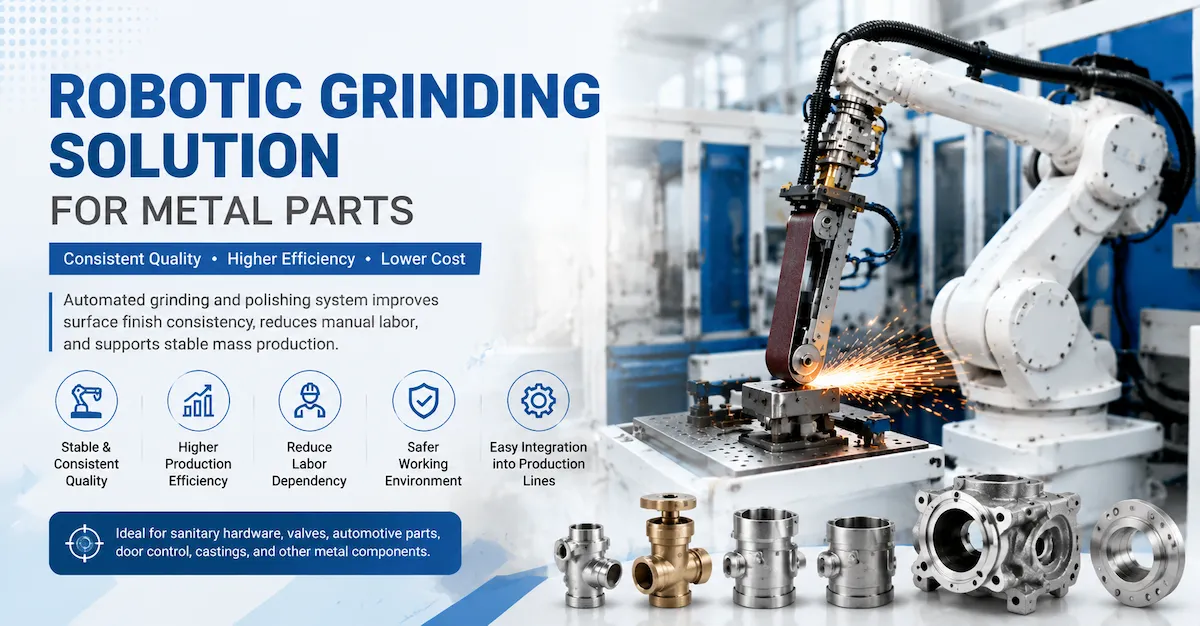
Xinmei Intelligent provides robotic grinding and polishing equipment for metal components requiring stable finishing quality and automated production. The system is suitable for manufacturers of sanitary hardware, valves, door control products, automotive components, housings, castings, and other industrial metal parts.
What Is a Robotic Grinding Solution for Metal Parts?
A robotic grinding solution for metal parts is an automated surface-processing system that uses an industrial robot to move a workpiece or grinding tool along a programmed path.
The system may perform:
- Surface grinding
- Belt sanding
- Weld-seam removal
- Edge blending
- Burr removal
- Parting-line removal
- Surface leveling
- Pre-polishing
- Final polishing preparation
A complete system normally includes:
- Industrial robotic arm
- Grinding or abrasive-belt unit
- Workpiece fixture
- Robot end effector
- CNC or robot control system
- Force or compliance control
- Abrasive compensation
- Dust extraction
- Safety enclosure
- Loading and unloading station
The objective is not simply to replace an operator. The system should maintain consistent contact, pressure, speed, angle, and path while adapting to real workpiece conditions.
Why Metal Grinding Is Difficult to Automate
Grinding is different from conventional CNC cutting because the abrasive tool remains in continuous contact with the workpiece surface.
Several variables affect the final result.
Workpiece variation
Cast, forged, welded, or stamped parts may have dimensional differences between batches. A rigid robot path that ignores this variation can create under-grinding or excessive material removal.
Contact pressure
Too much pressure can overheat the part, damage edges, shorten abrasive life, or remove too much material. Too little pressure may leave defects or require additional processing.
Abrasive wear
Grinding belts and wheels change during use. As the abrasive wears, the system must compensate to maintain surface consistency.
Complex geometry
Curved, recessed, angled, and irregular surfaces require carefully planned robot paths and suitable fixtures.
Dust and safety
Metal grinding creates dust, sparks, particles, and noise. The automated cell must include appropriate guarding, extraction, and safety interlocks.
A professional supplier should evaluate these conditions before recommending the robot, grinding structure, fixture, and process settings.
Which Metal Parts Are Suitable for Robotic Grinding?
A robotic grinding solution for metal parts is most valuable when the factory produces repeatable components with stable surface-finishing requirements.
| Industry | Typical workpieces | Common grinding objective |
|---|---|---|
| Bathroom hardware | Faucet bodies, handles, valve housings | Remove casting marks and prepare surfaces for polishing |
| Valve manufacturing | Valve bodies, manifolds, covers | Deburr edges and smooth cast surfaces |
| Door control | Door closer bodies, floor spring housings | Level surfaces and remove machining or casting marks |
| Automotive | Housings, brackets, suspension components | Remove burrs, weld seams, and surface defects |
| General hardware | Locks, hinges, handles, fittings | Improve appearance and edge consistency |
| Metal fabrication | Welded frames, panels, fabricated components | Blend welds and prepare surfaces for coating |
| Industrial castings | Aluminum, brass, steel, and iron castings | Remove flash, parting lines, and rough areas |
The workpiece material, geometry, initial surface condition, and final finish target must be confirmed before automation design begins.
Robotic Grinding vs Manual Grinding
| Comparison | Manual grinding | Robotic grinding |
| Surface consistency | Depends on operator experience | Controlled by programmed path and process |
| Cycle time | Can vary between workers | More predictable |
| Labor requirement | High | Reduced after setup |
| Worker fatigue | Significant in repetitive work | Lower |
| Dust exposure | Direct operator exposure | Reduced with enclosed cell |
| Process data | Limited | Easier to record and monitor |
| Batch production | Difficult to keep uniform | Suitable for repeat production |
| Product changeover | Flexible | Requires fixture and program setup |
| Initial investment | Lower | Higher |
| Long-term scalability | Requires more operators | Can expand into automated lines |
Manual grinding remains useful for repair work, prototypes, and products that change frequently. Robotic grinding offers stronger value for repeatable medium- and high-volume production.
Core Components of a Reliable Robotic Grinding System
Industrial Robot
Robot selection should consider:
- Payload
- Reach
- Repeatability
- Wrist capacity
- Mounting direction
- Working environment
- Required cycle time
- Grinding force
The robot must carry the grinding tool or workpiece without exceeding its rated load during acceleration and contact.
Grinding and Abrasive-Belt Unit
The grinding unit should provide stable structural rigidity and belt operation.
Important points include:
- Belt tension
- Belt tracking
- Spindle or wheel speed
- Abrasive replacement
- Vibration resistance
- Heat control
- Dust extraction connection
Stable belt tension helps prevent slipping, uneven sanding, and loss of grinding efficiency during continuous operation.
Fixture and Workholding
The fixture must position the workpiece accurately while allowing access to every required surface.
A suitable fixture should:
- Hold the part securely
- Prevent vibration
- Avoid workpiece deformation
- Provide repeatable location
- Allow fast loading
- Protect finished surfaces
- Support robotic handling
- Permit convenient changeover
For irregular castings, the locating method should account for blank variation.
Force and Compliance Control
Grinding requires controlled contact between the abrasive and the workpiece.
Force-control options may include:
- Robot force sensors
- Compliant grinding heads
- Pneumatic compensation
- Servo-controlled pressure
- Floating abrasive units
These systems help the robot follow surface variation and maintain more consistent material removal.
Safety and Dust Control
A robotic grinding cell should include:
- Safety fencing
- Interlocked doors
- Emergency stops
- Spark-resistant protection
- Dust extraction
- Fire-risk assessment
- Part-presence sensors
- Robot collision monitoring
Safety should be included in the initial system design rather than added after installation.
How a Robotic Grinding Solution Improves Surface Quality
A robotic grinding solution for metal parts improves consistency by controlling variables that are difficult to maintain manually.
Repeatable Grinding Paths
The robot follows the same programmed path for each part. This reduces missed areas and differences between operators.
Controlled Contact Angle
The angle between the abrasive and workpiece can be maintained throughout the process, helping create a more uniform surface pattern.
Stable Processing Speed
Robot speed can be adjusted by surface area, geometry, and material-removal requirements. Slower movement can be used for heavy grinding, while faster passes can support surface blending.
Consistent Pressure
Force-control systems reduce pressure variation and help prevent over-grinding.
Abrasive Compensation
The system can adjust the robot path or grinding unit as the abrasive wears, supporting longer periods of stable production.
Automation does not automatically guarantee the required finish. Process development, abrasive selection, workholding, and sample validation remain essential.
Selecting Abrasives for Different Metal Parts
| Material | Common processing concern | Abrasive-selection focus |
| Aluminum | Heat, loading, and surface marking | Open-coated abrasives and controlled pressure |
| Brass | Appearance and controlled material removal | Fine and consistent abrasive sequence |
| Stainless steel | Heat discoloration and work hardening | Suitable abrasive grain and cooling strategy |
| Carbon steel | Scale, weld seams, and corrosion preparation | Durable abrasive with appropriate cutting ability |
| Cast iron | Dust and rough casting surfaces | Effective extraction and robust abrasive |
| Zinc alloy | Soft surface and risk of over-grinding | Lower pressure and finer abrasive control |
The supplier should validate abrasive type, grit sequence, belt speed, robot speed, contact pressure, and expected belt life using actual samples.
When Should a Factory Invest in Robotic Grinding?
The investment is generally more suitable when:
- The same parts are produced repeatedly
- Surface quality varies between operators
- Skilled grinding workers are difficult to recruit
- Grinding limits production capacity
- Rework rates are increasing
- Workers handle heavy or uncomfortable parts
- Dust and safety risks need to be reduced
- Customers require more consistent appearance
- The factory plans to expand output
- Grinding cycle time needs to become measurable
It may be less suitable when production consists mainly of one-off parts, repair jobs, or frequently changing components with no stable fixture or process.
How to Evaluate the Automation Level
Robot Holds the Grinding Tool
The workpiece remains fixed while the robot moves the abrasive tool.
This approach is useful for:
- Larger workpieces
- Fixed fixtures
- Complex external surfaces
- Weld-seam grinding
Robot Holds the Workpiece
The robot moves the component against a fixed abrasive-belt or grinding unit.
This approach is useful for:
- Small and medium parts
- Multi-surface grinding
- Fast change between grinding positions
- Integration with loading stations
Fully Integrated Grinding Line
A complete line may include:
- Raw-part loading
- Part identification
- Robotic grinding
- Abrasive compensation
- Surface inspection
- Cleaning
- Polishing or secondary processing
- Finished-part unloading
The correct layout depends on part size, production volume, process sequence, and available workshop space.
What Buyers Should Ask a Robotic Grinding Supplier
| Evaluation area | Question to ask |
| Workpiece analysis | Have you tested our actual part and material? |
| Surface target | How will the required finish be defined and verified? |
| Robot selection | Why is the proposed payload and reach appropriate? |
| Grinding pressure | How will contact force be controlled? |
| Fixture design | How will the part be located without deformation? |
| Abrasive system | Which belt, wheel, or brush is recommended? |
| Abrasive wear | How will the system compensate for belt wear? |
| Cycle time | What operations are included in the estimate? |
| Dust control | What extraction and safety systems are included? |
| Changeover | How long does a product change require? |
| Training | Will operators learn programming and fault recovery? |
| After-sales service | How are spare parts and technical support provided? |
A useful proposal should clearly define the robot, grinding unit, fixtures, programs, safety system, installation, training, and buyer responsibilities.
Common Robotic Grinding Project Mistakes
Automating an Unstable Manual Process
If the existing grinding standard is unclear, transferring it directly to a robot will not solve the problem. The desired surface and acceptable variation must first be defined.
Ignoring Blank Variation
Castings and welded parts may vary. The system should account for dimensional changes through suitable locating, force control, or sensing.
Choosing the Robot Before Testing the Part
Robot selection should follow sample grinding and process analysis, not precede them.
Underestimating Abrasive Management
Abrasive wear affects cycle time and finish quality. Replacement intervals and inventory should be included in production planning.
Focusing Only on Labor Reduction
The business case should also consider:
- Lower rework
- Higher output
- Stable surface quality
- Improved workplace safety
- Reduced training dependency
- Better delivery reliability
- Easier process monitoring
Why Choose Xinmei Intelligent?
Xinmei Intelligent provides CNC equipment, robotic automation, and intelligent production-line solutions for industrial manufacturers.
Its robotic grinding equipment combines industrial robot automation with a rigid grinding structure and stable abrasive-belt operation. The solution is designed to support consistent surface finishing, reduced manual labor, and scalable batch production.
Project support can include:
- Workpiece and sample evaluation
- Grinding-process development
- Robot and grinding-unit selection
- Fixture planning
- Abrasive recommendations
- Robot programming
- Safety and dust-control integration
- Production-line layout
- Installation and commissioning
- Operator training
- Long-term technical support
View the related CNC Intelligent Robot Grinding Machine or compare other equipment through the Xinmei product center.
Information Needed Before Requesting a Proposal
Prepare the following information:
- 2D or 3D drawings
- Physical workpiece samples
- Workpiece material
- Raw-part manufacturing method
- Initial surface condition
- Areas requiring grinding
- Required surface standard
- Current manual process
- Current cycle time
- Rework or defect data
- Daily or monthly output
- Product-model quantity
- Workshop layout
- Dust-extraction conditions
- Preferred automation level
Photos and videos of the current grinding process can help engineers identify tool angles, worker movements, difficult surfaces, and potential automation risks.
FAQ
What is a robotic grinding solution for metal parts?
A robotic grinding solution for metal parts combines an industrial robot, abrasive system, fixture, controls, and safety equipment to automate surface grinding, deburring, weld removal, and preparation processes.
Which metal parts can be robotically ground?
Common applications include faucet bodies, valves, door closer housings, automotive castings, welded components, locks, handles, brackets, and industrial hardware.
Can robotic grinding process irregular surfaces?
Yes. Suitable robot paths, fixtures, force control, compliant tools, and sensing can support curved and irregular surfaces.
Does robotic grinding replace polishing?
Grinding generally removes defects and prepares the surface. Additional polishing may still be required when the product needs a decorative, mirror, or fine cosmetic finish.
Can the system process different materials?
Yes. Aluminum, brass, stainless steel, carbon steel, cast iron, and zinc alloys can be processed with suitable abrasives and parameters.
How is grinding pressure controlled?
Pressure can be controlled using robot force sensors, compliant grinding heads, pneumatic systems, or servo-controlled compensation.
What affects the cost of a robotic grinding system?
Cost depends on robot size, grinding unit, fixture complexity, force control, sensing, product variety, dust extraction, safety equipment, and production-line integration.
Can robotic loading be included?
Yes. Loading trays, conveyors, additional robots, or integrated handling systems can be added for continuous production.
Conclusion
A robotic grinding solution for metal parts can help manufacturers improve surface consistency, reduce manual dependency, control grinding pressure, and build a safer, more predictable production process.
The best solution is not simply a robot placed beside a grinding machine. It is a coordinated system designed around the workpiece, surface requirement, abrasive, fixture, force control, cycle time, dust conditions, and production target.
For factories producing stable batches of sanitary hardware, valves, door control products, automotive components, castings, or fabricated metal parts, robotic grinding can reduce rework and support scalable manufacturing.
Review Xinmei’s robotic grinding equipment or submit your workpiece drawings, samples, and surface requirements through the Contact Us page to request a customized grinding proposal.