+86 13163919000
 info@xinmeiintelligent.com

Hardware parts are widely used in construction, automotive, sanitary ware, machinery, electrical equipment, and industrial products. Although many hardware components appear small and simple, their manufacturing process often requires multiple machining operations, strict dimensional control, and stable production quality.
For factories producing hardware parts in large quantities, traditional machining methods can create several challenges:
- Too many manual operations
- Unstable machining consistency
- Long production cycle time
- High labor dependency
- Repeated loading and unloading
- Difficulty maintaining quality during mass production
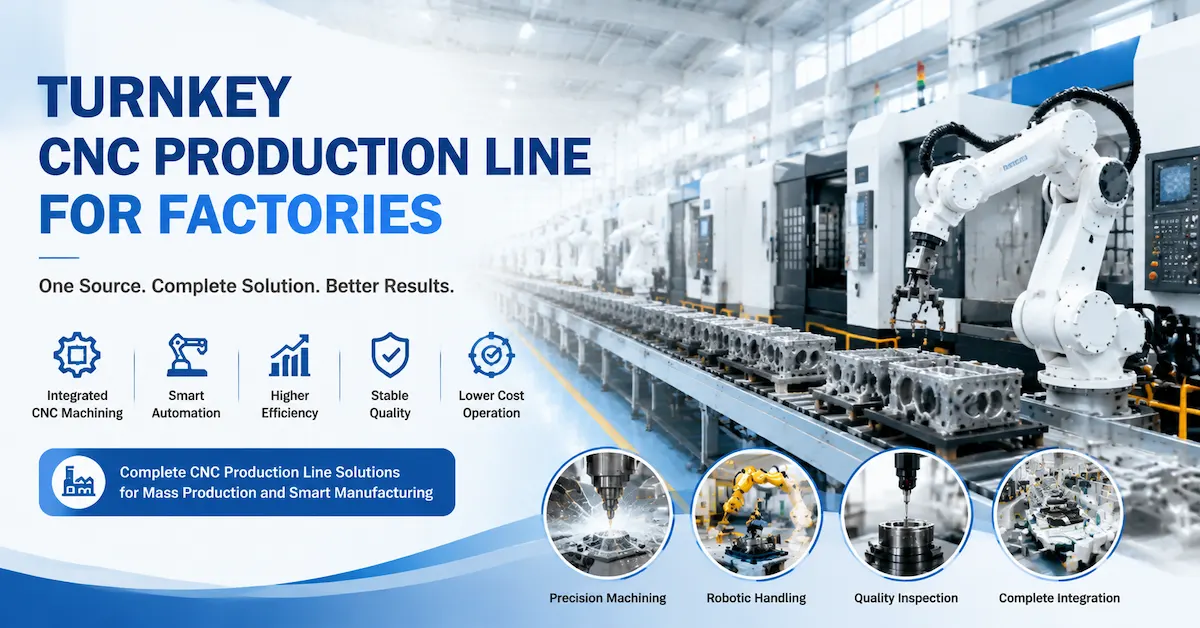
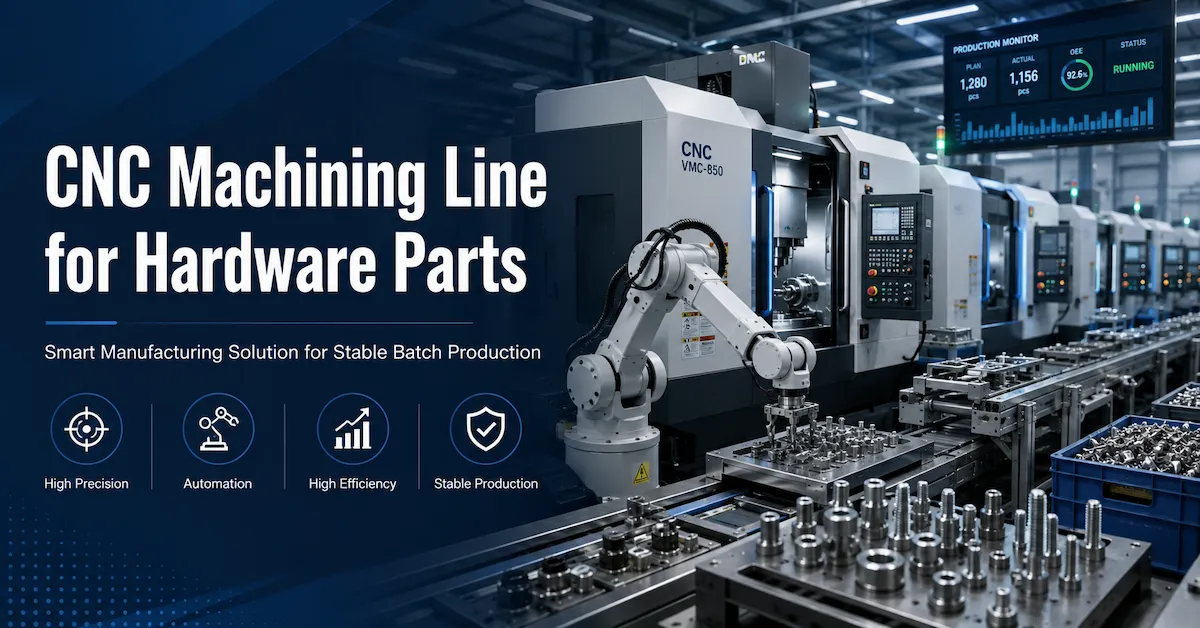
A professional CNC machining line for hardware parts helps manufacturers integrate CNC machines, fixtures, automation systems, material handling, and inspection processes into one efficient production workflow.
Instead of relying on separate machines and manual transfer, a CNC production line creates a more controlled and scalable manufacturing environment.
Xinmei Intelligent provides CNC equipment and intelligent manufacturing solutions for hardware manufacturers, supporting automated production from machining process planning to mass production implementation.
Explore Xinmei’s CNC equipment solutions through the products page.
What Is a CNC Machining Line for Hardware Parts?
A CNC machining line for hardware parts is an integrated production system designed for high-efficiency manufacturing of metal components.
The system may include:
- CNC drilling machines
- CNC tapping machines
- CNC milling equipment
- Horizontal machining centers
- Special-purpose CNC machines
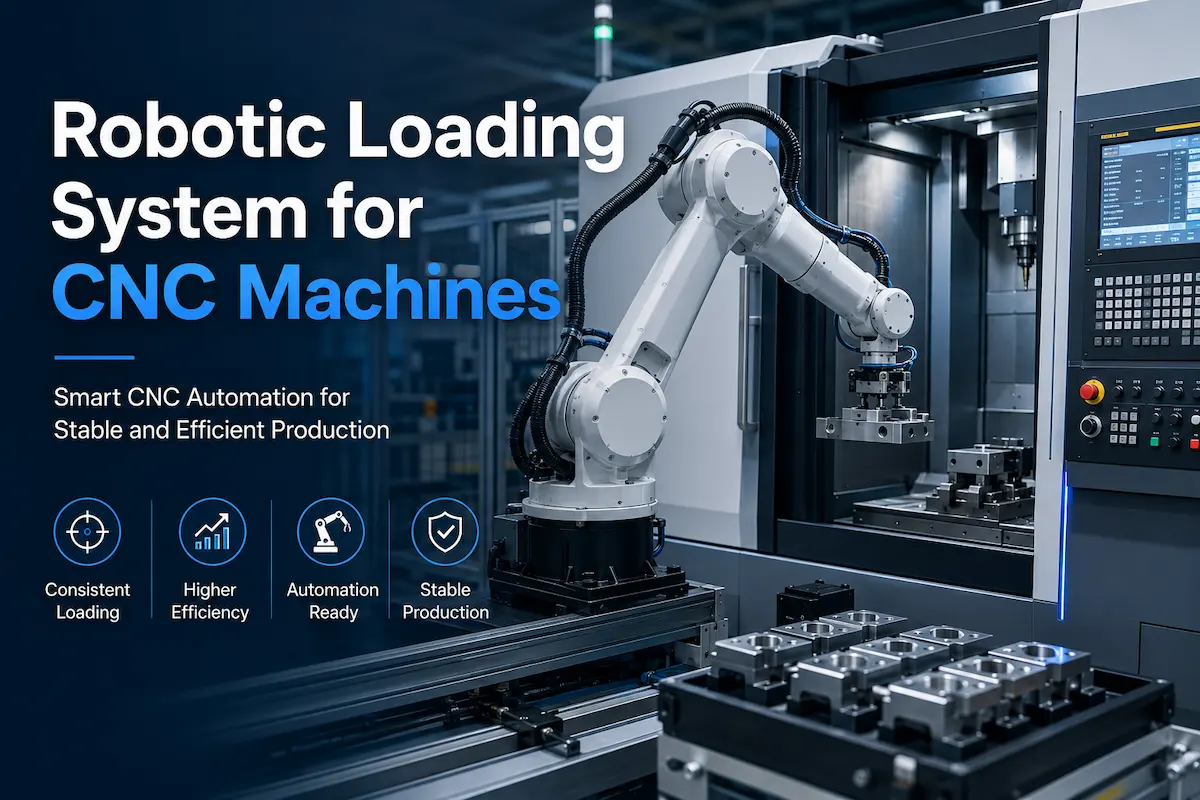
- Robotic loading and unloading systems
- Automatic fixtures
- Material transfer systems
- Inspection stations
- Production monitoring systems
Unlike a single CNC machine, a machining line focuses on the complete production process.
The objective is to improve:
- Machining consistency
- Production speed
- Operator efficiency
- Quality stability
- Equipment utilization
- Long-term manufacturing scalability
A suitable CNC machining line should be designed according to the hardware part structure, material, tolerance requirement, and production volume.
Why Hardware Manufacturers Need CNC Machining Lines
Many hardware factories begin production with standalone CNC machines. This approach works for small orders, but problems often appear when production volume increases.
Common manufacturing challenges include:
High Labor Dependency
Operators may need to repeatedly:
- Load raw parts
- Remove finished parts
- Change fixtures
- Transfer components
- Check dimensions
These repetitive operations consume labor resources and limit production capacity.
Inconsistent Production Quality
Manual handling can create differences between operators, including:
- Different loading positions
- Different clamping force
- Different inspection timing
- Different machining adjustments
This affects batch consistency.
Low Equipment Utilization
A CNC machine may spend significant time waiting for:
- Material loading
- Operator availability
- Manual inspection
- Part transfer
Automation helps the machine spend more time performing actual machining.
Difficult Production Expansion
When orders increase, adding more workers is not always the best solution.
A CNC machining line allows factories to increase capacity through:
- More automation
- Better process flow
- Reduced idle time
- Higher production stability
Hardware Parts Suitable for CNC Machining Lines
A CNC machining line can be customized for many types of industrial hardware components.
| Hardware Part | Common Processes | Production Focus |
|---|---|---|
| Door closer bodies | Drilling, milling, boring, tapping | Stable dimensions and assembly accuracy |
| Faucet bodies | Drilling, tapping, milling | Sealing quality and thread consistency |
| Valve components | Turning, drilling, boring, tapping | Internal accuracy and reliability |
| Lock components | Milling, drilling, finishing | Precision and repeatability |
| Gear shafts | Turning, milling, drilling | Position accuracy and surface quality |
| Bearing housings | Boring, milling, drilling | Structural stability |
| Connectors | Precision drilling and machining | Tight tolerance control |
Different hardware parts require different machining strategies.
The supplier should evaluate:
- Product structure
- Material
- Production quantity
- Required tolerance
- Machining sequence
- Automation requirements
before designing the production line.
Main Components of a Hardware CNC Machining Line
CNC Machining Equipment
The CNC machines are the core of the production system.
Depending on the part requirements, factories may use:
- Vertical CNC machines
- Horizontal machining centers
- Drilling and tapping machines
- Multi-spindle machines
- Special-purpose equipment
The machine selection directly affects:
- Cycle time
- Accuracy
- Tool life
- Production stability
Customized Fixtures
Fixtures determine how accurately the hardware part is positioned during machining.
A good fixture should:
- Hold the workpiece securely
- Prevent deformation
- Improve repeat positioning
- Reduce loading time
- Support automation integration
For irregular hardware components, customized fixture design is especially important.
Robotic Loading and Unloading
Robotic systems help automate material transfer.
They can:
- Pick raw components
- Load CNC machines
- Remove finished parts
- Transfer parts between processes
- Reduce manual handling
This improves production rhythm and allows longer unattended operation.
Inspection System
Quality control should be integrated into the production process.
Inspection may include:
- Dimensional checking
- First-piece inspection
- In-process measurement
- Final quality verification
Early detection helps prevent large quantities of defective parts.
CNC Machining Line vs Standalone CNC Machines
| Comparison | Standalone CNC Machines | CNC Machining Line |
| Initial investment | Lower | Higher |
| Flexibility | Higher | Depends on design |
| Manual operation | More required | Reduced |
| Production consistency | Operator dependent | More stable |
| Batch efficiency | Limited | Higher |
| Automation capability | Limited | Strong |
| Expansion potential | Requires more machines | Easier system upgrade |
For factories producing stable hardware products in medium or large quantities, a CNC machining line usually provides stronger long-term production advantages.
How to Design the Right CNC Machining Line
Step 1: Analyze the Hardware Part
The supplier should review:
- Product drawings
- Material type
- Dimensions
- Tolerance requirements
- Machining features
- Surface requirements
This determines the correct equipment configuration.
Step 2: Define Production Requirements
Important factors include:
- Daily output
- Monthly capacity
- Product models
- Cycle time target
- Operator availability
- Future expansion plans
Automation should match actual production demand.
Step 3: Plan the Machining Process
A typical hardware production flow may include:
- Raw material loading
- Workpiece positioning
- CNC machining
- Drilling and tapping
- Milling and boring
- Cleaning or deburring
- Inspection
- Finished-part unloading
A good process layout reduces unnecessary movement and improves efficiency.
Step 4: Evaluate Automation Level
Possible configurations include:
- Single CNC automation cell
- Multiple CNC machines with robot handling
- Complete intelligent production line
The correct choice depends on:
- Production volume
- Product stability
- Labor cost
- Factory space
- Future growth
What Buyers Should Check Before Choosing a Supplier
When selecting a CNC machining line for hardware parts, buyers should evaluate the supplier’s engineering capability.
| Evaluation Factor | Questions |
| Industry experience | Have you handled similar hardware parts? |
| Process planning | Can you optimize the complete machining flow? |
| Fixture design | Can you create customized workholding solutions? |
| Automation ability | Can robots and CNC machines be integrated? |
| Quality control | How is machining consistency monitored? |
| Production capacity | What output can the line achieve? |
| Installation support | Do you provide commissioning and training? |
| Future expansion | Can the system be upgraded later? |
A reliable supplier should provide a complete manufacturing solution rather than simply selling individual machines.
Benefits of CNC Automation for Hardware Manufacturing
A properly designed CNC machining line can help factories achieve:
Higher Production Efficiency
Automated transfer reduces waiting time between processes.
Better Quality Consistency
CNC programs and fixtures reduce operator variation.
Lower Labor Dependency
Automation reduces repetitive manual operations.
Improved Production Management
Standardized processes make production easier to monitor.
Stronger Scalability
Factories can expand capacity without completely rebuilding the workflow.
Why Choose Xinmei Intelligent?
Xinmei Intelligent focuses on CNC equipment and intelligent production solutions for industrial manufacturers.
The company supports hardware manufacturers with:
- CNC machining equipment
- Special-purpose CNC machines
- Robotic loading systems
- Automated production lines
- Fixture optimization
- Process planning
- Manufacturing efficiency improvement
Xinmei solutions are suitable for industries including:
- Door control hardware
- Bathroom hardware
- Valves
- Automotive parts
- Precision connectors
- Industrial components
Learn more about Xinmei’s manufacturing capability through the About Us page.
How to Prepare Before Requesting a CNC Machining Line Proposal
Prepare:
- Hardware part drawings
- 3D models
- Material information
- Current production process
- Required output
- Quality requirements
- Existing equipment information
- Factory layout
- Automation expectations
This allows engineers to design a practical solution based on real production conditions.
Submit your requirements through the Contact Us page.
FAQ
What is a CNC machining line for hardware parts?
It is an integrated production system combining CNC machines, fixtures, automation equipment, and inspection processes for efficient hardware manufacturing.
What hardware parts can use CNC machining lines?
Applications include door closer bodies, faucet bodies, valve components, lock parts, gear shafts, bearing housings, and precision connectors.
Why use CNC automation for hardware manufacturing?
Automation improves production consistency, reduces labor dependency, increases machine utilization, and supports large-volume production.
Can a CNC machining line be customized?
Yes. The system can be customized according to part structure, material, production volume, machining process, and automation requirements.
What affects the cost of a CNC machining line?
Main factors include machine quantity, automation level, fixture complexity, inspection requirements, production capacity, and installation scope.
What information should buyers provide?
Provide drawings, samples, materials, production targets, current processes, factory layout, and quality requirements.
Conclusion
A CNC machining line for hardware parts helps manufacturers improve production efficiency, machining consistency, automation level, and long-term manufacturing capability.
For factories producing door hardware, sanitary components, valves, connectors, and industrial metal parts, automation is becoming an important strategy for improving competitiveness.
The right production line should not simply add machines. It should create a complete manufacturing system that matches the product, process, quality requirements, and future growth plan.
Xinmei Intelligent provides CNC machining equipment and intelligent automation solutions for hardware manufacturers looking to achieve stable and scalable production.