+86 13163919000
 info@xinmeiintelligent.com


Knowing how to choose CNC production line equipment becomes especially important when an established factory needs higher output but already owns machines, fixtures, control systems, and production infrastructure. Replacing everything may create unnecessary investment, while adding automation to incompatible equipment can introduce integration problems and unexpected downtime.
For manufacturers producing automotive components, valve bodies, door-control hardware, sanitary fittings, and other precision metal parts, the purchasing decision should start with the existing process. Buyers need to identify which machines remain useful, where capacity is constrained, and whether retrofitting, expanding, or rebuilding the production line offers the most practical long-term value.
Quick Answer: Choose CNC production line equipment by evaluating workpiece requirements, existing machine condition, controller compatibility, production bottlenecks, factory infrastructure, and the total cost of integration. Compare retrofitting existing machines, adding new machining cells, and replacing the line. Require documented performance assumptions and agreed factory and site acceptance tests before committing to a purchase.
This guide provides a practical equipment-selection framework for production managers, manufacturing engineers, factory owners, and international CNC equipment buyers.
Explore XINMEI CNC Equipment | Request a Production Line Evaluation
1. What Should Manufacturers Evaluate Before Upgrading a CNC Production Line?
The first decision is not which CNC machine to purchase. It is whether the existing factory has a clearly defined production constraint that new equipment can solve.
A factory may experience insufficient output because of slow machining, repeated manual loading, fixture adjustments, tool failures, inspection delays, or poor material flow.
These problems require different solutions.
For example, installing a faster machining center may have little effect if completed parts continue waiting for manual transfer or inspection.
Identify the Actual Production Bottleneck
Before selecting equipment, collect the following information:
-
Current products, material grades, and machining requirements.
-
Existing CNC machine types, models, and operating condition.
-
Actual cycle times, including loading and unloading.
-
Planned and unplanned downtime.
-
Workpiece rejection and rework rates.
-
Number of production shifts.
-
Target accepted output per shift.
-
Product variation and changeover frequency.
A new machine is justified when it addresses a measured production requirement—not simply because its technical specifications exceed those of existing equipment.
Manufacturers should also determine whether expected demand is sufficiently stable to justify dedicated machining equipment.
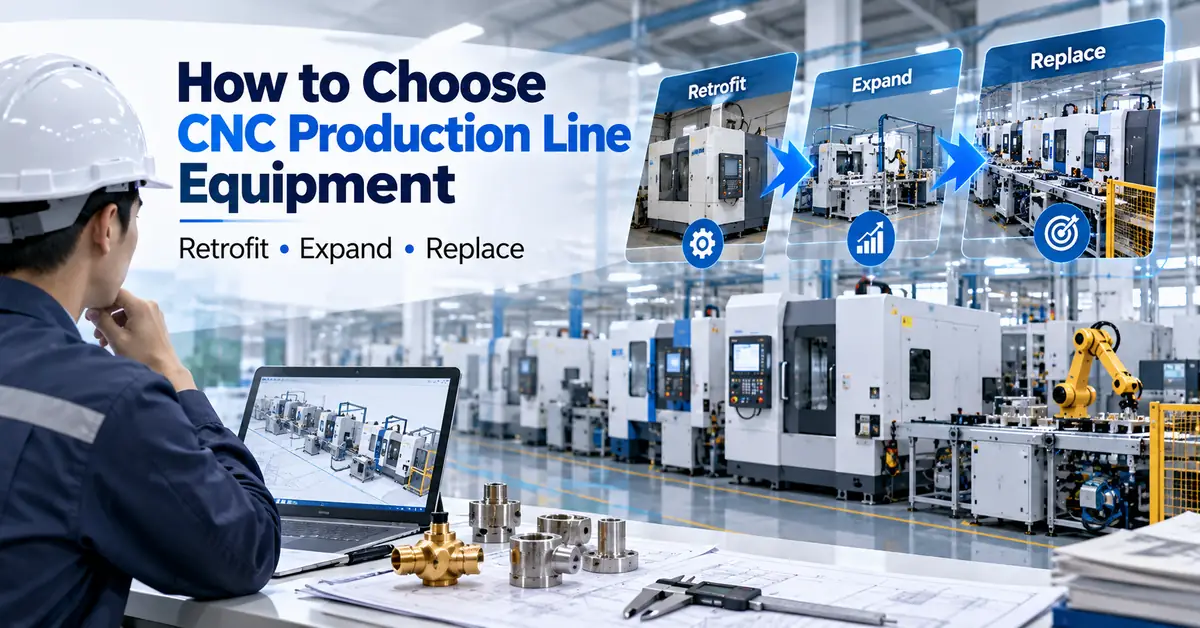
2. Retrofit, Expand, or Replace: Which CNC Investment Strategy Is Best?
There are three common approaches to improving an existing CNC manufacturing system.
Option A: Retrofit Existing CNC Equipment
Retrofitting may involve adding automatic loading, modifying fixtures, updating control interfaces, or integrating compatible material-handling equipment.
This approach can be attractive when the existing machine remains mechanically sound and produces acceptable components.
However, retrofitting does not automatically correct spindle wear, poor machine rigidity, unstable positioning, or inadequate machining capability.
Option B: Expand With Additional CNC Equipment
Adding a machining center or automated machining cell may address a specific bottleneck while allowing other production stations to remain operational.
This approach can also reduce installation disruption compared with a complete line replacement.
Its success depends on material flow, available floor space, operator access, and whether the added capacity matches upstream and downstream operations.
Option C: Replace the Complete Production Line
A new integrated CNC line may be justified when existing machines are incompatible, maintenance costs are increasing, the process requires major restructuring, or a substantial capacity increase is needed.
However, the investment must account for equipment, engineering, installation, commissioning, operator training, and the temporary loss of production during transition.
CNC Equipment Upgrade Comparison
| Selection factor | Retrofit existing CNC | Add machining cell | Replace production line |
|---|---|---|---|
| Initial investment | Often lower, depending on compatibility | Moderate to high | Usually highest |
| Existing equipment reuse | High | Partial | Limited |
| Production interruption | Project-dependent | Potentially manageable | May require major transition |
| Process flexibility | Limited by existing machines | Depends on new configuration | Can be designed around new requirements |
| Integration complexity | Existing interfaces may be difficult | Requires process coordination | Requires full system engineering |
| Best application | Sound machines with handling bottlenecks | Localized capacity shortage | Major process or capacity transformation |
| Primary risk | Hidden compatibility problems | Unbalanced production flow | Higher project cost and commissioning risk |
No single option is universally superior.
A well-maintained machining center may remain valuable for years, while an unsuitable older machine can make an automation retrofit more expensive than purchasing a compatible replacement.
For additional equipment configurations, explore XINMEI's CNC Machining Centers.
3. How to Audit Existing CNC Machines Before Purchasing New Equipment
An existing-equipment audit helps manufacturers identify what can be retained, upgraded, or replaced.
The evaluation should cover machine condition, machining capability, electrical systems, controls, tooling, and maintenance requirements.
Mechanical and Machining Condition
Evaluate the machine's:
-
Axis positioning and repeatability.
-
Spindle condition and operating stability.
-
Machine structure and rigidity.
-
Tool-changing performance.
-
Fixture condition and workholding reliability.
-
Lubrication, coolant, and chip-removal systems.
-
Ability to produce components within drawing tolerances.
Machine-axis performance should not be confused with finished-workpiece accuracy.
A machine may pass an axis positioning test but still produce unacceptable components because of fixture deflection, worn tooling, thermal changes, or process instability.
CNC Controller and Automation Compatibility
Controller compatibility is particularly important when adding robotic loading or integrating several machines.
The engineering evaluation should identify:
-
Controller make, model, and software version.
-
Available input/output signals.
-
External cycle-start and machine-ready functions.
-
Door-opening arrangements.
-
Fixture clamp confirmation.
-
Alarm and fault-reset procedures.
-
Program selection requirements.
-
Available communication interfaces.
-
Safety-system integration requirements.
An older CNC controller should not be assumed compatible with modern robotic automation until its interfaces have been reviewed.
The supplier should also establish which modifications are technically possible and who will be responsible for implementing and validating them.
4. Which Technical Specifications Matter Most When Choosing CNC Production Equipment?
Machine specifications should be converted into purchasing requirements connected to the actual workpieces.
Generic descriptions such as "high precision" or "high-speed machining" are insufficient for comparing quotations.
CNC Equipment Technical Evaluation Checklist
| Specification | Buyer should define | Supplier should confirm |
|---|---|---|
| Workpiece size and weight | Maximum dimensions and blank mass | Suitable machine envelope |
| Material | Alloy, grade, and blank condition | Process and tooling suitability |
| Machining operations | Drilling, milling, tapping, boring, turning | Supported operations |
| Critical tolerances | Drawing-defined dimensions | Verification method |
| Spindle configuration | Required machining directions | Proposed spindle arrangement |
| Axis travel | Necessary workpiece and tool movement | Actual equipment travel |
| Fixture requirements | Datum and clamping conditions | Proposed workholding concept |
| Tool capacity | Number and type of operations | Tooling arrangement |
| CNC control | Preferred or required interfaces | Available configuration |
| Automation | Loading, unloading, transfer, inspection | Integration scope |
| Production output | Accepted parts per shift | Cycle and capacity assumptions |
| Factory infrastructure | Power, air, space, access | Installation requirements |
This table is a buyer-side specification framework, not a list of guaranteed performance figures for every XINMEI machine.
Materials, Fixtures, and Process Compatibility
Machine suitability also depends on workpiece material and manufacturing method.
Brass valve bodies, aluminum automotive housings, steel components, and cast-iron parts can require different spindle, cutting-tool, coolant, and clamping strategies.
A suitable proposal should therefore consider both the machine structure and the entire machining process.
For high-volume repetitive components, XINMEI's Special Purpose Machines provide another equipment category for technical evaluation.
Dedicated configurations can be advantageous when component geometry and production requirements remain stable.
5. How Should Buyers Select Automation Equipment for an Existing Factory?
Automation should solve a defined handling or production problem.
Adding a robot to an existing CNC machine may improve workflow when manual loading limits machine utilization. However, successful integration requires more than selecting a suitable robotic arm.
Evaluate the Complete Automation Interface
A CNC automation proposal should define:
Workpiece handling: How blanks arrive, how they are oriented, and how finished components leave the system.
Fixture operation: How the machine confirms that the workpiece is correctly seated and clamped.
Machine communication: How CNC equipment and automation exchange operating, ready, completion, and fault information.
Safety: How operators are protected during automatic and manual operations, including guarding, access control, emergency stops, and maintenance.
Fault recovery: What happens when a workpiece is missing, a loading cycle fails, or a machine stops unexpectedly.
Product changeover: How the system accommodates different workpieces and production programs.
ISO 12100:2010, Safety of machinery — General principles for design — Risk assessment and risk reduction, provides a recognized methodology for machinery risk assessment.
Relevant safety requirements must be evaluated for the actual machine and destination market. Referring to a standard does not itself establish regulatory compliance.
When Is Robot Loading a Suitable Upgrade?
Robotic loading may be appropriate when machining is already stable, workpieces can be presented consistently, and handling time creates a measurable limitation.
It may be less attractive when batches are small, product shapes change frequently, or an older machine lacks practical automation interfaces.
XINMEI's Robot Loading and Unloading Line and CNC + Robot Integrated Automation Lines are relevant product platforms for evaluating automated machining projects.
Actual integration feasibility must be confirmed for the machines and workpieces involved.
6. How Can Manufacturers Estimate Real Production Capacity?
Understanding how to choose CNC production line equipment also requires a reliable method for comparing expected output.
Machine suppliers may quote different cycle times because they include different operations in their calculations.
One quotation may refer only to cutting time, while another includes loading, unloading, clamping, inspection, and part transfer.
These figures are not directly comparable.
Calculate the Production-Line Bottleneck
For a sequential line where each station processes one component per cycle:
Theoretical line output = 3,600 ÷ Bottleneck cycle time in seconds
Consider an illustrative production cell:
| Station | Operation | Complete cycle |
|---|---|---|
| Station A | CNC drilling and milling | 60 seconds |
| Station B | Boring and tapping | 80 seconds |
| Station C | Final machining | 55 seconds |
Station B is the bottleneck.
The nominal maximum production rate is:
3,600 ÷ 80 = 45 parts/hour
Installing faster equipment at Station A will not increase nominal line throughput unless it also addresses the bottleneck or another relevant constraint.
If Station B can be redesigned to a 60-second cycle without reducing quality, the nominal line limit becomes 60 parts/hour.
These are illustrative engineering calculations, not actual XINMEI project results.
Measure Accepted Output
Theoretical output must be adjusted for production losses.
These may include:
-
Machine downtime.
-
Tool replacement.
-
Setup and changeover.
-
Loading errors.
-
Material shortages.
-
Rejected or reworked components.
ISO 22400-2:2014, Automation systems and integration — Key performance indicators for manufacturing operations management — Part 2, provides established KPI definitions used in manufacturing operations.
Buyers should request a clearly defined measurement method that distinguishes available time, productive time, total parts produced, and accepted components.
The most useful purchasing target is often accepted parts per shift under agreed operating conditions.
7. What Determines the Total Cost of CNC Production Line Equipment?
Purchase price represents only one part of the investment.
A factory-upgrade project may also require electrical modifications, tooling, fixture development, automation programming, relocation, commissioning, and production training.
Total Investment Cost Categories
| Cost category | Items to consider |
|---|---|
| Equipment | CNC machines, controllers, spindle configuration |
| Tooling and fixtures | Cutting tools, workholding, replacement tooling |
| Automation | Robots, grippers, conveyors, controls |
| Integration | Machine interfaces, programming, testing |
| Infrastructure | Electrical supply, compressed air, coolant, foundations |
| Installation | Equipment positioning, commissioning, training |
| Operating costs | Labor, energy, maintenance, consumables |
| Production losses | Installation downtime, scrap, rework |
| Future modifications | Product changes, capacity expansion, software changes |
How to Compare Retrofit and Replacement Costs
A retrofit may have a lower purchase price but a higher integration risk.
A completely new line may require more capital but provide a more coordinated equipment architecture.
For a fair comparison, estimate:
Total project cost = Equipment + Tooling + Integration + Installation + Transition costs
Then evaluate recurring operating costs and expected accepted output over a common planning period.
Avoid relying on an ROI claim unless the assumptions are documented.
A supplier promising a specific efficiency improvement should explain the baseline process, calculation method, test conditions, and limitations.
8. How to Evaluate CNC Production Line Suppliers With a 100-Point Scorecard
A structured supplier evaluation can make purchasing decisions more consistent.
The following weighted scorecard is a proposed procurement tool, not an official industry certification or a claim about XINMEI's current rating.
| Evaluation area | Maximum score | What to assess |
|---|---|---|
| Process and workpiece suitability | 25 | Ability to meet machining and quality requirements |
| Existing machine integration | 20 | Controller interfaces, retrofit feasibility, responsibilities |
| Production performance | 20 | Cycle model, accepted output, changeover strategy |
| Quality and acceptance planning | 15 | Inspection, FAT/SAT, test documentation |
| Maintenance and lifecycle cost | 10 | Spare parts, service access, operating costs |
| Commercial and delivery clarity | 10 | Scope, exclusions, milestones, support |
| Total | 100 | Overall technical and commercial evaluation |
Ask each shortlisted supplier to address the same technical requirements.
A high overall score should not override a critical problem. An unsafe arrangement, unachievable workpiece tolerance, or incompatible machine interface must be resolved regardless of the numerical result.
Questions Worth Asking Before Shortlisting
Can the supplier explain why its proposed machine configuration matches the workpiece? Can it identify existing machines that should not be reused? Does it provide a realistic integration plan and measurable acceptance criteria?
These questions help distinguish a production-engineering proposal from a quotation based only on equipment specifications.
9. What Should FAT and SAT Verify Before Production Begins?
Factory Acceptance Testing (FAT) and Site Acceptance Testing (SAT) help confirm whether a production-line project meets agreed requirements.
Their scope should be defined before equipment manufacturing or integration begins.
Recommended FAT and SAT Checklist
| Verification item | Factory Acceptance Test | Site Acceptance Test |
|---|---|---|
| New machine configuration | Verify supplied equipment | Confirm installed configuration |
| Machining quality | Test representative components | Recheck agreed critical features |
| Cycle performance | Test under defined conditions | Verify site production performance |
| Automation logic | Test available machine interfaces | Verify integrated operation |
| Safety functions | Test agreed safety measures | Validate installed system safety |
| Fault recovery | Simulate agreed failure conditions | Confirm practical recovery procedures |
| Existing machine integration | Test or simulate available interfaces | Verify actual retained machines |
| Documentation | Review agreed deliverables | Confirm final handover |
| Operator training | Verify training scope | Complete agreed site training |
If existing equipment remains inside the buyer's factory, FAT may not be able to verify every interface.
The purchasing agreement should identify which functions are simulated at the supplier's facility and which require validation after installation.
Define Acceptance Criteria Clearly
The technical agreement should specify:
-
Approved workpiece drawings and revisions.
-
Sample quantities and test duration.
-
Applicable dimensional tolerances.
-
Complete cycle-time boundaries.
-
Expected accepted output.
-
Permitted adjustments during testing.
-
Fault recording and recovery requirements.
-
Final documentation and training responsibilities.
A successful demonstration with one workpiece is not necessarily evidence of stable production across an entire shift.
10. How Does XINMEI Support CNC Production Line Upgrades?
Fujian Xinmei Machinery Technology Co., Ltd. (XINMEI) designs and manufactures CNC machine tools for drilling, tapping, milling, boring, and industrial production applications.
Its published product portfolio includes CNC machining centers, special-purpose machines, robot loading and unloading systems, and integrated CNC automation solutions.
For factories evaluating new equipment or existing-line upgrades, XINMEI's published engineering capabilities cover process-oriented machine configuration, machining process optimization, customized solutions, installation and commissioning, and after-sales support.
Relevant XINMEI Equipment Platforms
| Equipment platform | Potential project application |
|---|---|
| CNC Machining Centers | Flexible machining and additional production capacity |
| Special Purpose Machines | Dedicated processing of stable, repetitive parts |
| Flexible High Speed Horizontal Machining Center | Complex machining and flexible system configuration |
| Robot Loading and Unloading Line | Automated handling for compatible CNC processes |
| CNC + Robot Integrated Automation Lines | Coordinated machining and robotic production flow |
These are equipment categories and platforms, not confirmation that every existing machine can be integrated or that one configuration fits every workpiece.
Buyers can explore XINMEI's Flexible High Speed Horizontal Machining Center when comparing machining architectures.
Project-specific capabilities, pricing, delivery schedules, integration scope, and acceptance commitments require engineering confirmation.
Planning a CNC factory upgrade?
Contact XINMEI for Equipment Selection and Engineering Consultation
11. How to Prepare a CNC Production Line Equipment RFQ
A detailed Request for Quotation allows suppliers to compare retrofit, expansion, and replacement options against the same requirements.
For an existing factory, include more than the new workpiece specifications.
Essential RFQ Information
Workpiece details
Provide drawings, material grades, dimensions, critical tolerances, and representative physical samples where possible.
Existing machine information
Include machine manufacturers, model numbers, controller types, machine age, available interfaces, operating condition, and maintenance history.
Production requirements
State current and target output, shifts, cycle times, bottlenecks, batch quantities, and expected product variations.
Factory infrastructure
Provide a layout showing available space, equipment positions, power supply, compressed air, material flow, maintenance access, and other relevant constraints.
Automation requirements
Define loading, unloading, inspection, part transfer, fault recovery, and desired integration with existing equipment.
Commercial and acceptance requirements
Request a defined supply scope, engineering responsibilities, exclusions, FAT/SAT plan, documentation, operator training, warranty terms, and project milestones.
Request Alternative Configurations
Where feasible, ask the supplier to compare at least two solutions.
For example:
-
Retrofit suitable existing machines and add automatic loading.
-
Retain reliable machines and add a dedicated machining cell.
-
Replace the current equipment with an integrated CNC production line.
The purpose is to understand technical trade-offs before approving the investment.
Discuss Your Project With XINMEI
Manufacturers can submit drawings, existing-equipment details, production targets, and factory-layout information through the XINMEI Contact Us page.
This information provides a basis for determining which CNC equipment configurations and automation solutions may be suitable for further engineering evaluation.
Frequently Asked Questions About CNC Production Line Equipment Selection
1. How to choose CNC production line equipment for an existing factory?
Start by assessing existing machines, workpiece requirements, production bottlenecks, controller compatibility, and factory infrastructure. Compare retrofitting, expansion, and replacement options using the same capacity, quality, cost, and acceptance criteria.
2. Is retrofitting CNC equipment cheaper than buying new machines?
It can be, particularly when the existing machines are mechanically sound and have compatible interfaces. However, substantial control modifications, worn machine components, or complex automation integration may reduce the economic advantage.
3. Can old CNC machines be connected to modern automation systems?
Some can, but feasibility depends on controller interfaces, machine condition, door operation, fixture control, communication signals, and safety requirements. Each machine should be assessed individually.
4. What CNC equipment is best for high-volume metal parts production?
The best configuration depends on machining operations, component geometry, required output, and product stability. Multi-spindle machines, special-purpose equipment, machining centers, and automated CNC lines should be compared against actual workpiece requirements.
5. How do manufacturers calculate CNC production line capacity?
For a simple sequential line, the slowest effective station often determines nominal throughput. Adjust the capacity estimate for operating time, downtime, changeovers, and rejected components to calculate expected accepted output.
6. What should be checked before purchasing CNC automation equipment?
Check workpiece handling, machine interfaces, fixture operation, robot access, production cycle, fault recovery, safety requirements, and the compatibility of existing machines. Agree on the integration and acceptance responsibilities before purchasing.
7. What is the difference between FAT and SAT?
FAT evaluates the agreed equipment or system before shipment, generally at the supplier's facility. SAT verifies the installed system under site conditions. Actual integration with retained factory equipment may require specific SAT procedures.
8. How much does a CNC production line upgrade cost?
Cost varies with machine quantity, equipment condition, tooling, automation, controls, integration, installation, and commissioning. A meaningful estimate requires an assessment of the existing production process and proposed project scope.
9. How can buyers compare CNC production line equipment suppliers?
Use a common RFQ and evaluate process suitability, integration capability, output calculations, quality verification, lifecycle costs, service arrangements, and project responsibilities. Avoid selecting solely by initial purchase price.
10. How can I request CNC production line equipment from XINMEI?
Prepare your workpiece drawings, existing machine information, machining requirements, current output, target capacity, and factory layout. Then contact XINMEI to discuss available CNC equipment and application-specific production solutions.
Conclusion
Understanding how to choose CNC production line equipment is essential for manufacturers seeking to increase capacity while protecting their existing investment.
For established factories, the best solution may involve retrofitting suitable CNC machines, adding a new machining cell, or replacing outdated equipment with an integrated production line. The decision should depend on machine condition, workpiece requirements, compatibility, production capacity, integration risk, and total project cost.
Buyers should also require clear engineering specifications, realistic capacity calculations, documented responsibilities, and agreed FAT/SAT acceptance procedures. These measures can reduce purchasing uncertainty and support more reliable equipment deployment.
XINMEI Intelligent offers CNC machining centers, special-purpose machines, and industrial automation solutions for a range of metal component manufacturing applications.
If your factory is considering a CNC production line upgrade, expansion, or replacement, contact XINMEI with your existing equipment details and production requirements to discuss a suitable manufacturing solution.