+86 13163919000
 info@xinmeiintelligent.com


What Should a CNC Machining Automation Supplier Actually Solve?
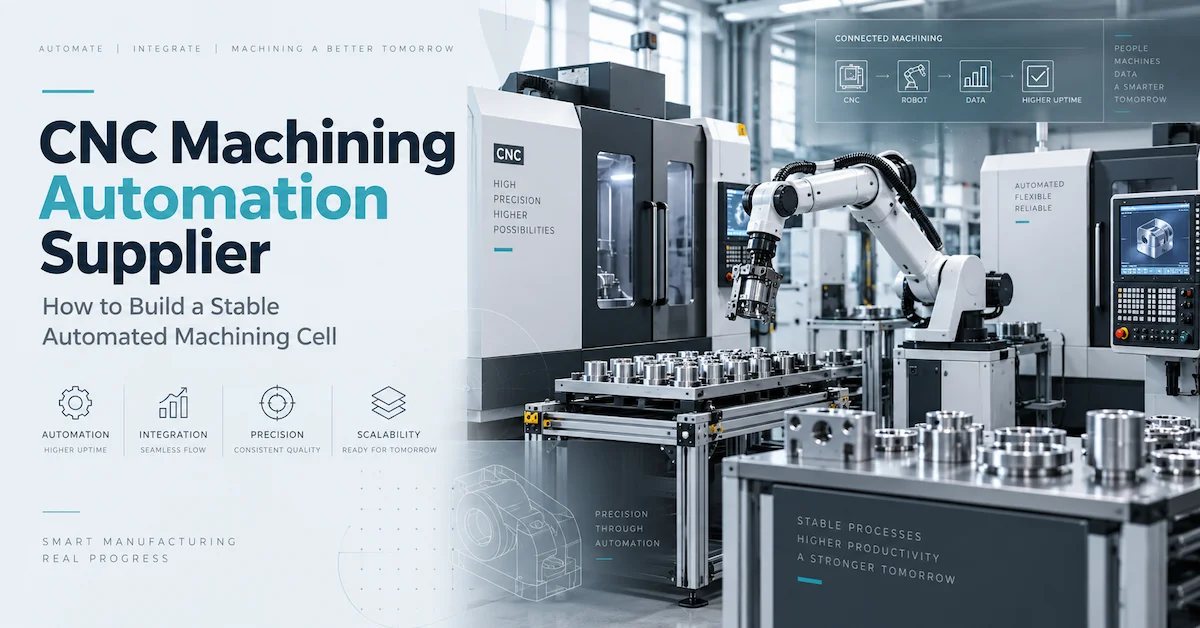
A CNC machining automation supplier should solve a production problem rather than simply add a robot beside a CNC machine. The useful starting point is the complete workpiece flow: how raw parts arrive, how they are located and clamped, which machining operations are performed, how parts move between stations, where quality is checked, and what happens when production is interrupted. Only after these requirements are understood should the supplier determine whether the project needs robotic machine tending, several linked CNC machines, buffers, automatic fixtures, conveyors, inspection, or a broader production-line system.
Xinmei Intelligent develops CNC machinery and automated manufacturing systems for industrial component production. Its Automation Lines category currently includes robot loading and unloading systems, CNC and robot integrated automation lines, and product-specific automatic assembly solutions. The company’s intelligent production-line solution also describes multi-machine CNC integration, robotic loading and unloading, multi-station production, monitoring, and configurable production-line design around actual parts and production targets.
For buyers, the important distinction is that automation is not a single machine feature. It is the coordination of machining, workholding, handling, controls, quality, and production recovery. A project can have technically capable CNC machines and a capable robot yet still underperform if those elements are not designed around the same process.
Which Factories Should Consider CNC Machining Automation?
CNC machining automation is most relevant when a factory already has a repeatable machining requirement but loses efficiency through manual loading, repeated transfers, waiting between processes, inconsistent workpiece handling, or insufficient coordination among several machines. Typical candidates include manufacturers of door-control components, valves and sanitary hardware, automotive and motorcycle parts, bearing housings, connectors, and other repeatedly machined industrial components.
Xinmei’s published CNC automation guidance similarly identifies manual loading, unstable cycle time, repeated clamping, part-quality variation, and disconnected machining steps as common reasons factories evaluate automation.
Automation is less convincing when the underlying production process remains unstable. If tool life is unpredictable, fixtures do not locate the part consistently, blank quality changes substantially, or part drawings change every few weeks, automating the existing workflow can reproduce those problems faster rather than eliminate them. In that situation, the supplier should first help determine whether the machining process itself needs to be stabilized.
A good CNC machining automation supplier should therefore be willing to recommend a smaller or staged solution when full integration is not yet justified.
Start With the Part and Process, Not the Robot Brand
The first automation discussion should begin with a part drawing and a process map. Before deciding robot payload, reach, machine quantity, or conveyor layout, define what is actually being produced.
The buyer should provide the workpiece material, blank condition, dimensions, weight, critical datums, holes, bores, threads, machined surfaces, tolerances, current machines, current setup count, present cycle time, target output, shift pattern, and foreseeable product variants. If the project includes existing equipment, identify each machine model and control system as well.
The supplier can then determine whether the process should use one CNC machine with automatic loading, several linked machines, a dedicated multi-station system, or a combined machining and automation cell. Xinmei’s CNC + Robot Integrated Automation Lines are positioned around combining CNC machining with robotic handling rather than treating the robot as a standalone production solution.
Build an Automation Requirement Specification Before Requesting Price
A quotation is difficult to compare when suppliers make different assumptions. One supplier may include automatic fixtures, grippers, guarding, and commissioning, while another quotation may cover only the CNC machines and robot.
Use one controlled project specification so every shortlisted supplier evaluates the same production requirement.
| Requirement Area | Buyer Should Provide | Supplier Should Confirm |
|---|---|---|
| Workpiece | Drawing, material, blank condition, size and weight | Handling and machining feasibility |
| Machining | Required drilling, tapping, milling, boring or turning | Machine and operation allocation |
| Quality | Critical dimensions, datums and inspection requirements | Proposed validation method |
| Output | Accepted parts per hour, shift or day | Cycle assumptions and expected line output |
| Product variants | Current and planned workpiece versions | Changeover strategy |
| Workholding | Blank variation and locating requirements | Fixture design and actuation |
| Part supply | Tray, conveyor, pallet, manual rack or other method | Robot pick-up and orientation method |
| Existing equipment | Machine model, controller and condition | Integration feasibility and modifications |
| Automation | Loading, transfer, buffering and inspection needs | Included equipment and control scope |
| Layout | Floor area and access limitations | Final footprint and service clearance |
| Acceptance | Test parts and measurement method | FAT/SAT procedure |
| Documentation | Manuals, programs, drawings and training expectations | Final handover package |
This is a buyer-side RFQ framework rather than a fixed specification for every Xinmei automation project.
Choose the Right Level of CNC Automation
Not every factory needs a complete automated production line. The right architecture depends on where the bottleneck actually occurs.
| Automation Approach | Main Purpose | Suitable Situation | Main Purchasing Question |
|---|---|---|---|
| Automatic machine tending | Load and unload one or several CNC machines | Machining is stable but manual handling limits utilization | Can the robot reliably handle the real blanks and fixtures? |
| CNC machining cell | Connect several machining operations in one cell | Parts require several repeatable processes | How are workpiece status and orientation controlled? |
| Multi-machine automated line | Coordinate several CNC machines and transfers | Stable high-volume component production | Is cycle balance realistic across all stations? |
| Special-purpose CNC + automation | Combine dedicated machining with automatic handling | Stable component family with repeated processes | Does the production volume justify specialization? |
| Broader intelligent production line | Integrate machining, handling, monitoring and other modules | Factory-level production upgrade | Who owns each subsystem and integration boundary? |
Xinmei publishes both Robot Loading and Unloading Lines and CNC + Robot Integrated Automation Lines, allowing buyers to evaluate automation at different process scopes rather than assuming every project needs the same architecture.
Robot Loading Must Be Designed Around Real Parts
A robotic loading system has to deal with more than nominal CAD dimensions. Real workpieces may contain casting variation, oil, chips, burrs, unfinished surfaces, or orientation differences. The gripper and fixture must work with that reality.
Buyers should ask how the part is presented to the robot, how orientation is maintained, what surfaces the gripper contacts, whether finished surfaces can be marked, and how the system detects a missing or incorrectly seated workpiece.
The supplier should also explain the recovery process. If a robot picks a part but the CNC machine becomes unavailable, where does that part go? If clamping confirmation fails, does the system retry, reject the part, or stop for operator intervention? If an alarm occurs midway through production, how is workpiece status preserved?
These questions distinguish a production automation design from a successful short demonstration.
Fixtures and Automation Must Be Engineered Together
Fixture design becomes even more important when manual judgment is removed from loading. An operator can sometimes notice that a casting has not seated properly; an automated system requires predictable geometry, sensors, and defined logic.
The fixture should establish stable locating references while leaving enough clearance for robot access, cutting tools, chips, and coolant. Automatic clamping must also fit the required cycle without introducing unnecessary complexity.
For part families, determine which elements are fixed and which need changeover. A factory producing several related valve bodies, door closer housings, or automotive components may benefit from interchangeable locating elements or gripper fingers, but flexibility should be based on known part differences rather than a vague requirement that one cell should “process everything.”
Xinmei’s wider machining content emphasizes the relationship between workholding, process planning, and machining stability. Its equipment portfolio also combines dedicated machining platforms with automated production options, making fixture definition an important part of the overall application review.
Cycle Balance Matters More Than the Fastest Individual Machine
One of the most common purchasing errors is evaluating automation using only the shortest machining cycle.
Consider a three-station process:
- Station A takes 42 seconds.
- Station B takes 58 seconds.
- Station C takes 46 seconds.
- Robot handling adds additional non-overlapping tasks.
The line cannot simply be described as a 42-second process because the 58-second station already limits the basic production rhythm. If the robot must also service multiple machines at overlapping times, effective output may be different again.
A CNC machining automation supplier should therefore provide a station-by-station timing analysis covering machining, door movement, fixture clamping, robot travel, part orientation, loading, unloading, and any inspection or transfer activities included in the cycle.
Buyers should ask for three different numbers:
Machine cutting time, complete automated cycle time, and accepted production output during an agreed test period.
They answer different questions and should not be presented as if they were interchangeable.
Buffers Can Prevent One Station From Stopping the Entire Cell
A tightly synchronized line can create another problem: a fault at one machine may immediately stop every upstream and downstream process.
A buffer can provide limited independence between stages. It may hold unfinished parts temporarily while one machine is serviced, support different cycle times, or provide space for cooling, inspection, or orientation.
However, buffers should not be added without reason. Too much intermediate inventory occupies floor space, complicates traceability, and hides process problems.
A useful design review asks what happens when each major station stops for five, fifteen, or thirty minutes. Does the entire line stop immediately? Can upstream production continue? Where are parts stored? How is their machining status identified?
This kind of failure-mode discussion gives buyers more useful information than only reviewing the line under perfect operating conditions.
Control Interfaces Need a Clear Responsibility Matrix
An automated cell may combine CNC controls, servo systems, robots, fixtures, sensors, conveyors, safety-related equipment, inspection devices, and factory-level monitoring. The buyer needs to know who is responsible for making these systems communicate.
Define the required interface signals, including machine ready, loading permission, door status, fixture status, cycle start, machining complete, robot clear, alarms, and relevant part-status information.
Xinmei’s Supply Chain page lists suppliers including Siemens, FANUC, SYNTEC, HIWIN, Schneider Electric, NSK, Airtac, PMI, and other component brands within its wider equipment ecosystem. The component list for the actual project should still be confirmed separately; presence on a supplier-network page does not mean every brand is used on every automation system.
Ask for an approved configuration and define the substitution process before production. This reduces maintenance and spare-parts uncertainty after installation.
Quality Control Should Verify the Machine and the Workpiece
A CNC automation supplier should demonstrate that the complete process produces acceptable parts, not merely that the robot and machines can complete an automatic cycle.
Xinmei’s Quality Assurance process describes technical review, material and component verification, structural and assembly control, and final machine validation. It also states that its manufacturing facilities use equipment including coordinate measuring machines, Renishaw measurement systems, and hardness testing systems.
For a buyer-specific project, convert these general quality capabilities into measurable acceptance requirements.
Define which workpiece features will be inspected, the sample quantity, measuring method, drawing revision, machine setup, tooling, and production conditions. Keep machine accuracy and finished-part quality conceptually separate because the result can also be affected by fixtures, cutting tools, material variation, process parameters, and thermal conditions.
Use FAT to Test Production Logic Before Shipment
Factory Acceptance Testing should verify the agreed production system under defined conditions.
For an automated machining project, FAT may include:
- Workpiece loading and unloading
- Fixture operation
- CNC machining
- Robot-machine communication
- Station transfer
- Cycle-time measurement
- Alarm behavior
- Agreed recovery sequences
- Critical workpiece inspection
- Product changeover where relevant
- Continuous-production testing under agreed conditions
A one-part demonstration is not equivalent to production validation.
Before FAT begins, agree on test duration or quantity, allowed adjustments, how stoppages are recorded, how rejected parts are counted, and what constitutes acceptance.
If existing CNC machines remain at the buyer’s factory and cannot participate in factory testing, identify which interfaces are simulated during FAT and which must be verified during Site Acceptance Testing after installation.
Compare Factory Capacity With Project Lead Time Separately
A supplier may have strong manufacturing capability but still require significant engineering time for a complex automation project. Likewise, a technically straightforward project can be delayed if drawings, samples, or buyer approvals are not available.
Instead of asking only “What is your delivery time?”, request a milestone plan:
Requirement confirmation → process design → layout approval → equipment and fixture engineering → component procurement → assembly → programming → system integration → trial machining → FAT → shipment → installation → SAT → training.
Xinmei’s intelligent CNC production-line solution describes a project approach based on actual parts, machining requirements, production volume, machine configuration, robotic integration, and production-line planning.
For your own project, ask which milestones depend on buyer-supplied drawings, workpieces, approvals, and factory preparation so the schedule reflects responsibilities on both sides.
Automation Cost Is More Than the Robot and CNC Machines
A reliable comparison should evaluate the complete project scope.
Automation investment may include CNC machines, dedicated fixtures, robot hardware, grippers, part-supply systems, conveyors, buffers, sensors, guarding, programming, controls, inspection integration, installation, training, FAT, and initial spare parts.
Operating costs may include cutting tools, fixture wear, gripper maintenance, coolant, energy, scheduled maintenance, spare components, and downtime.
One supplier may appear cheaper because important engineering is excluded. Another may include more integration responsibility.
For that reason, purchasing teams should compare quotation boundaries before comparing headline prices.
The financial question is not simply “How much does the automation cost?” It is:
What production system is included, which risks remain with the buyer, and what output assumption supports the investment?
Clarify Custom Engineering and Integration Scope
Industrial automation terms such as OEM, ODM, turnkey, customized, and integrated solution can be interpreted differently by different suppliers.
Instead of relying on these labels, specify responsibilities.
A custom CNC automation project may involve machining-process design, machine selection, fixture engineering, gripper development, robotic programming, CNC programming, electrical integration, control logic, material-flow equipment, installation, and commissioning.
Ask which elements are designed and supplied directly, which are sourced from other companies, and which remain the buyer’s responsibility.
For future modifications, clarify whether fixture drawings, parameter backups, robot programs, CNC programs, electrical documentation, and other project files are included in the agreed handover package.
Plan Maintenance Access Before Freezing the Layout
A production-line drawing should not optimize only robot reach and floor area.
Maintenance staff still need access to machine doors, spindle areas, lubrication systems, chip conveyors, electrical cabinets, robot bases, fixtures, sensors, and other components. Tool replacement and fixture servicing also need working space.
Ask the supplier to show:
production access, maintenance access, operator access, and abnormal-recovery access separately.
If servicing one machine requires dismantling guarding or moving another major system, the compact line layout may become expensive over its operating life.
This is especially important in high-volume production because small maintenance delays can affect the complete automated cell rather than one standalone machine.
Define Documentation, Training, and After-Sales Support Before Shipment
A CNC machining automation project is not finished when the equipment passes FAT.
The final handover should define which drawings, instructions, configuration lists, spare-parts information, backup files, inspection records, and training materials are supplied. Xinmei maintains a User Manual resource section, but buyers should confirm which model- and project-specific documents are included with the actual system.
Operator training should cover normal production, changeover, common alarms, and approved recovery procedures. Maintenance training should address the installed CNC machines, robotic equipment, fixtures, and control architecture.
Also clarify remote-support arrangements, escalation contacts, spare-part ordering, warranty boundaries, and any third-party component support responsibilities before the equipment enters production.
What Should You Send a CNC Machining Automation Supplier?
A useful technical inquiry should give the supplier enough information to understand the production problem rather than merely quote a robot and several machines.
Send the workpiece drawing, material and blank details, critical tolerances, required machining operations, existing process sequence, current machines, cycle-time records, production target, number of shifts, product variants, factory layout, utility information, current fixtures, preferred control standards where required, inspection requirements, and desired automation scope.
If you already operate the process manually, photographs or process videos can help identify handling and layout constraints.
You can first review Xinmei’s Automation Lines and CNC + Robot Integrated Automation Lines, then submit the project requirements through Contact Us for technical evaluation.
Frequently Asked Questions
1. What does a CNC machining automation supplier provide?
The exact scope depends on the project. It can include CNC machines, robot loading, fixtures, grippers, workpiece transfer, controls, programming, system integration, testing, installation, and training. Buyers should define the complete responsibility boundary before ordering.
2. Is CNC automation only suitable for very high production volumes?
No universal volume threshold applies. Automation becomes more attractive when processes are repetitive, demand is stable, manual handling creates a meaningful constraint, and the technical and financial case supports the investment. Lower-volume factories may still use flexible machine tending where changeover is manageable.
3. Can my existing CNC machines be automated?
Potentially. The supplier needs to review machine condition, controller and available signals, doors, fixtures, loading access, cycle logic, documentation, and required modifications before confirming compatibility.
4. How many CNC machines can one robot load?
There is no fixed answer. It depends on CNC cycle time, robot travel, loading time, fixture operation, workpiece orientation, station locations, and whether machine service requests overlap. Request a detailed timing study.
5. Does faster robot movement automatically increase line output?
No. If machining is the bottleneck, a faster robot may have little effect on accepted output. Production should be evaluated through the complete cycle and station balance.
6. How should I verify an automated CNC system before shipment?
Use an agreed FAT that covers machining, loading, communication, fixtures, representative alarms, cycle measurement, repeated workpiece quality, and other project-specific acceptance requirements.
7. Can one automation system process several component models?
Possibly. Submit the complete part family so the supplier can identify changes to CNC programs, tools, fixtures, robot grippers, part-supply systems, and control logic. Do not assume all variants require only a software change.
8. How much does a CNC machining automation project cost?
Cost depends on machine quantity and type, robot configuration, fixtures, grippers, transfer systems, controls, programming, safety-related equipment, validation, installation, and other integration requirements. A meaningful quotation requires the actual production scope.
9. How long does CNC automation implementation take?
Project time depends on process complexity, equipment configuration, fixture and robot engineering, component procurement, sample availability, integration, FAT, shipment, and site commissioning. Request milestone-based planning instead of one generic lead-time number.
10. What should I check when comparing CNC machining automation suppliers?
Compare process-engineering capability, machine and fixture knowledge, robot integration, station balancing, control interfaces, quality validation, FAT methodology, documentation, customization boundaries, service responsibilities, and total project scope. The supplier should be able to explain why the proposed architecture fits your workpiece rather than only presenting automation hardware.
Conclusion
Selecting a CNC machining automation supplier is a decision about how reliably an entire machining process will operate, not simply which robot or CNC machine is installed. Buyers should begin with real workpieces and production data, then evaluate machine selection, fixtures, robot handling, station balance, buffers, controls, quality validation, FAT requirements, maintenance access, project cost, and handover responsibilities as one connected system. Xinmei Intelligent provides automation-line solutions, robot loading and unloading systems, and CNC + robot integrated automation lines for different industrial machining requirements. To evaluate a specific project, submit your workpiece drawings, material, current machining process, target output, equipment information, factory layout, and automation objectives through Xinmei Contact Us so the proposed machining and automation scope can be reviewed before equipment configuration is finalized.