+86 13163919000
 info@xinmeiintelligent.com

Vertical vs Horizontal Machining Center: The Difference That Matters to a Factory
When comparing a vertical vs horizontal machining center, the most important question is not simply which machine is more advanced. The real question is which machine architecture fits the geometry of your parts, machining sequence, production volume, workholding method, and automation strategy.
A vertical machining center, or VMC, positions the spindle vertically above the workpiece. This configuration gives operators direct access to the table and is well suited to components whose main machining features can be reached from the top.
A horizontal machining center, or HMC, positions the spindle horizontally. Combined with suitable fixtures, rotary tables, pallets, or multi-station systems, this layout can make it easier to machine several faces of a component with fewer re-clamping operations.
For a factory producing valve bodies, faucet components, door-control parts, automotive components, bearing housings, or other repeat metal parts, this difference can directly affect cycle time, fixture strategy, chip evacuation, operator involvement, batch consistency, and future automation potential.
Xinmei develops both vertical CNC drilling and tapping equipment and flexible high-speed horizontal machining solutions, with machine configuration based on actual production requirements rather than machine orientation alone.
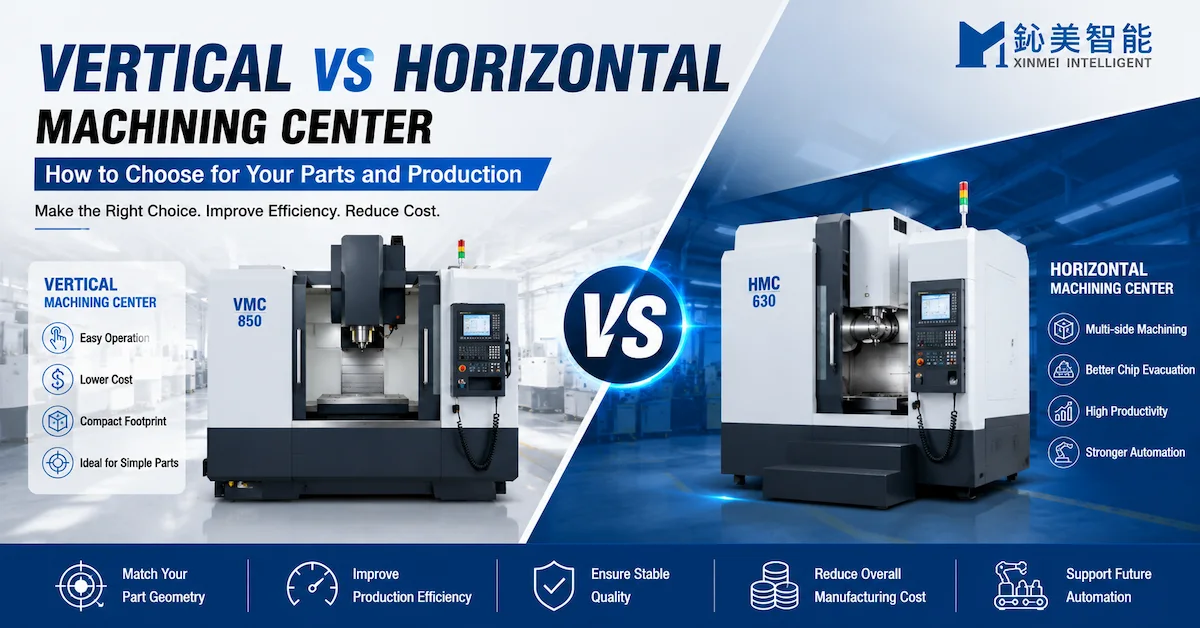
Vertical vs Horizontal Machining Center at a Glance
| Selection Factor | Vertical Machining Center | Horizontal Machining Center |
|---|---|---|
| Spindle orientation | Vertical | Horizontal |
| Operator access | Generally direct and convenient | More dependent on enclosure and pallet layout |
| Best suited to | Top-side and relatively straightforward machining | Multi-side and production-oriented machining |
| Workholding | Vises, fixtures, rotary tables | Tombstones, rotary fixtures, pallets, multi-station fixtures |
| Multi-face machining | May require repositioning or rotary-axis support | Often well suited to several faces in one setup |
| Chip evacuation | Requires effective coolant and conveyor design | Gravity often helps chips leave the cutting zone |
| Floor-space requirement | Often relatively compact | Depends strongly on pallet and automation configuration |
| Automation potential | Good; robot and pallet automation are possible | Strong fit for palletized and continuous production |
| Initial investment | Often lower for comparable basic configurations | Typically higher due to machine and system complexity |
| High-volume production | Effective for suitable parts | Often attractive for complex, multi-face repeat production |
| Operator learning curve | Often easier for factories familiar with conventional milling | May require more advanced fixture and process planning |
| Key purchasing question | Can the part be completed efficiently from limited orientations? | Can fewer setups and more spindle utilization justify the investment? |
This table should be treated as a selection framework rather than an absolute rule. Modern VMCs can use fourth-axis, fifth-axis, pallet, robot, and automatic loading systems, while HMC configurations vary widely in size and complexity.
What Is a Vertical Machining Center?
A vertical machining center uses a vertically oriented spindle, with the cutting tool approaching the workpiece primarily from above.
This architecture is widely used because the machining area is easy to observe, loading and unloading can be straightforward, and conventional fixtures can often be installed without highly complex workholding.
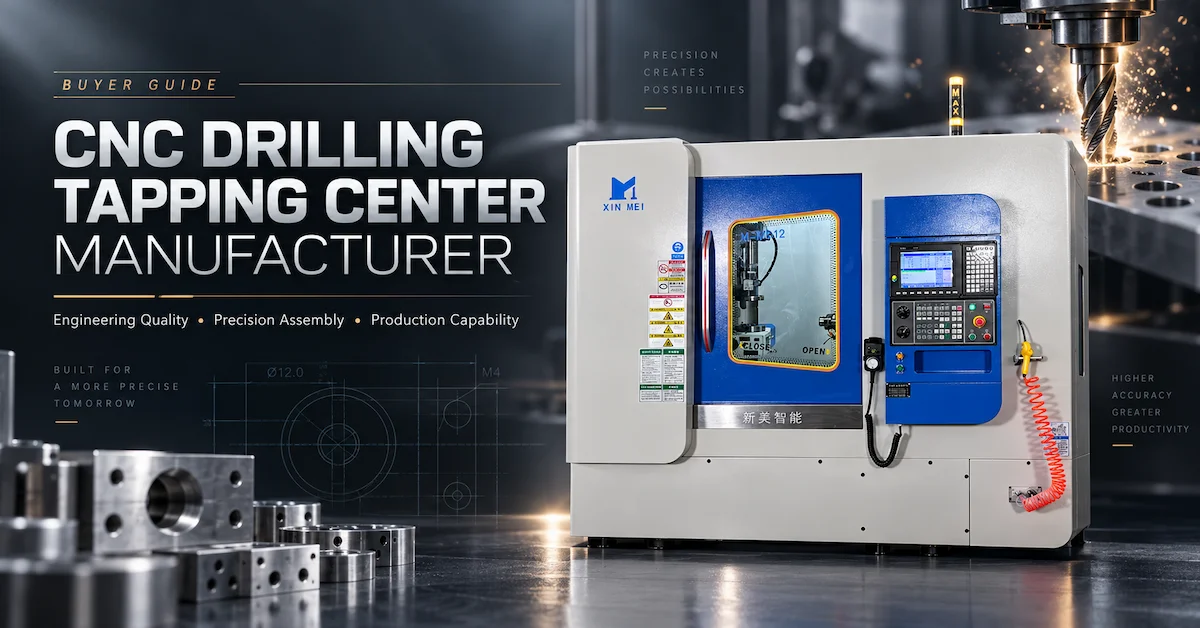
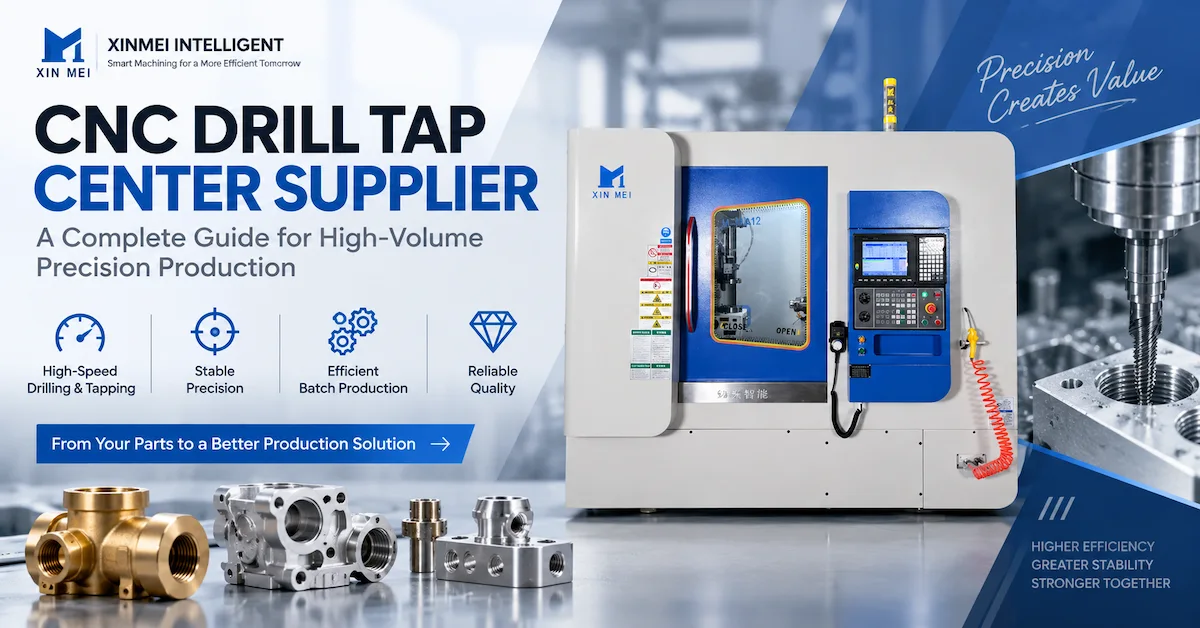
Xinmei's Vertical CNC Drilling and Tapping Machine, for example, is designed around high-speed drilling and tapping, rapid tool changes, a compact vertical layout, rigid construction, and batch production of parts such as faucet components, automotive components, and hardware fittings.
Where a VMC Makes the Most Sense
A vertical machining center is often practical when:
- Most critical features are accessible from one main direction.
- The workpiece can be completed in one setup or a limited number of setups.
- Drilling, tapping, milling, and related operations dominate the process.
- Operators need frequent access to parts and fixtures.
- Factory floor space is limited.
- Product mix changes frequently.
- Production volume does not justify a more complex HMC system.
- Capital investment needs to remain controlled.
For example, a relatively flat mounting plate with holes, threads, pockets, and top-facing surfaces may gain little from a horizontal architecture if all critical features are already accessible vertically.
Why VMCs Are Attractive for Flexible Production
For factories producing multiple part numbers rather than one dedicated high-volume component, setup flexibility can matter more than maximum automation.
A VMC can often accommodate different vises, dedicated fixtures, fourth-axis units, probing systems, and robot loading configurations without requiring an entirely dedicated production architecture.
That does not mean a VMC is automatically the less productive machine. If the workpiece matches the machine orientation, a vertical machining center may deliver a simpler process with lower unnecessary complexity.
What Is a Horizontal Machining Center?
A horizontal machining center positions the spindle parallel to the floor and generally approaches the workpiece from the side.
The major manufacturing advantage is not the word “horizontal” itself. The advantage comes from how that orientation can change part access, fixture layout, chip movement, palletization, and the number of machining operations completed before the workpiece must be manually repositioned.
Xinmei's Flexible High Speed Horizontal Machining Center is positioned for synchronized multi-station machining, continuous production, flexible part configuration, improved chip evacuation, and integration into automated manufacturing systems.
Where an HMC Becomes More Valuable
A horizontal machining center becomes especially relevant when:
- Several sides of the part require machining.
- Re-clamping currently consumes significant production time.
- Datum transfer between machines creates consistency problems.
- Chip accumulation interferes with cutting.
- Production volume is high enough to justify more advanced fixtures or pallets.
- The factory wants longer periods of automated production.
- The same component is repeatedly produced in medium or large batches.
- Multiple operations need to be consolidated into one machining cell.
Official machine-tool guidance from Okuma also identifies multi-side machining as a major application advantage of HMCs, while Makino positions its horizontal platforms around high-volume flexible machining lines and efficient chip removal.
The Real Selection Factor: How Many Times Must the Part Be Re-Clamped?
For many industrial components, the most useful comparison is not VMC versus HMC.
It is:
one machining setup versus multiple machining setups.
Every time a workpiece moves from one fixture or machine to another, the process adds:
- Handling time
- Loading and unloading time
- Datum reconstruction
- Operator involvement
- Fixture variation
- Additional inspection requirements
- Risk of cumulative positioning error
Suppose a valve body requires machining on the front, rear, and side faces.
A conventional vertical process might require the operator to machine one face, unload the component, reposition it in another fixture, establish another datum, and continue machining.
If an HMC with a suitable rotary fixture can expose those faces without removing the component, the comparison should include the time and quality impact of the eliminated setups.
But One Setup Is Not Automatically Better
Consolidating processes only creates value when the machine, fixture, cutting tools, tool access, chip control, and program are stable enough to support it.
An overly complicated fixture can create its own problems:
- Insufficient rigidity
- Poor tool access
- Longer tool overhang
- Difficult loading
- Interference between fixture and spindle
- Increased fixture cost
- Longer changeover time
Therefore, CNC machining center selection should begin with the workpiece drawing and process route—not the machine catalog.
Chip Evacuation: A Practical Difference That Can Affect Production Stability
Chip evacuation is one of the most important practical differences in a vertical vs horizontal machining center comparison.
On a VMC, chips can remain on top of the part, inside pockets, around fixtures, or on horizontal surfaces. Modern coolant systems, washdown systems, augers, and chip conveyors can manage this effectively, but process planning remains important.
On an HMC, gravity can help chips fall away from vertical workpiece surfaces and the cutting zone. This is particularly useful when the process generates a large chip volume or when deep cavities and repeated production make manual chip cleaning undesirable.
Makino, for example, explicitly designs horizontal machining platforms around efficient chip removal for high-volume machining lines.
For buyers, the correct question is therefore not:
Does an HMC have better chip removal?
A better question is:
Does chip accumulation currently limit tool life, surface quality, cycle stability, or unattended production for this specific workpiece?
If the answer is no, chip evacuation alone may not justify changing machine architecture.
Part Geometry Should Drive the Choice
Choose a VMC When the Important Features Face Upward
A VMC is often efficient for parts such as:
- Plates
- Covers
- Flanges
- Relatively shallow housings
- Brackets
- Top-drilled components
- Parts dominated by drilling and tapping
- Components that require frequent manual loading
If most operations are accessible from the top, introducing a horizontal machine may create capital and fixture complexity without removing enough process steps.
Consider an HMC for Multi-Side Housings and Bodies
Horizontal machining becomes more attractive for components that have critical features on multiple sides, including certain:
- Valve bodies
- Manifolds
- Automotive housings
- Steering components
- Pump bodies
- Door-control components
- Bearing housings
- Complex industrial castings
Xinmei's current application structure includes valve components, faucet and bathroom hardware, door-control parts, automotive steering components, brake pumps, cylinder heads, bearing housings, and connectors—applications where machine configuration needs to be selected according to actual feature orientation and batch requirements.
VMC vs HMC for High-Volume Production
Production volume changes the economics of machine selection.
If a factory produces 50 pieces of a component every few months, reducing two manual setups may not recover the cost of a complex horizontal machining system.
If the same factory produces thousands of repeat components every month, small reductions in handling and non-cutting time may accumulate across every shift.
For High-Volume Buyers, Evaluate These Numbers
Do not compare machines only by spindle speed or rapid traverse.
Collect:
- Current cycle time per finished part
- Actual cutting time
- Loading and unloading time
- Number of setups
- Number of machines involved
- Work-in-process between operations
- Operators required per shift
- Tool-change time
- Fixture-change time
- Scrap and rework related to repositioning
- Planned annual production
- Expected future automation level
This gives a more useful purchasing model than comparing isolated specifications.
Think in Cost Per Finished Part
A lower machine purchase price does not always produce the lowest manufacturing cost.
A useful evaluation is:
Total annual machining cost ÷ acceptable finished parts = manufacturing cost per part
The calculation may include:
- Machine investment
- Fixture investment
- Tooling
- Labor
- Electricity
- Floor space
- Preventive maintenance
- Consumables
- Scrap
- Rework
- Work-in-process
- Machine utilization
- Automation equipment
An HMC may have a higher initial purchase cost, while a VMC may require more operator handling for a particular multi-side component. The better machine is the one that creates the stronger total production economics for the specific part family.
Automation Changes the Vertical vs Horizontal Machining Center Decision
A common mistake is comparing a standalone VMC with an automated HMC.
That is not a fair comparison.
Both orientations can be automated.
Vertical machining centers can be integrated with:
- Robot loading
- Automatic parts loaders
- Pallet systems
- Machine tending
- Automatic inspection
Horizontal systems can also integrate:
- Automatic pallets
- Rotary fixtures
- Multi-station machining
- Robotic material handling
- Circulating production
- Integrated machining lines
The important question is how easily each architecture fits the required material flow.
Xinmei's equipment portfolio extends beyond individual machining centers to CNC machines, special-purpose equipment, and automation systems, allowing machine orientation to be evaluated as one part of the complete production system.
Fixture Design Can Matter More Than Machine Orientation
A rigid machine cannot compensate for unstable workholding.
When comparing a VMC vs HMC, buyers should ask the supplier to explain how the part will actually be held.
Evaluate the Fixture Around Six Questions
1. What Datum Is Used?
The fixture should establish repeatable reference surfaces that match the process and drawing requirements.
2. How Many Faces Must Be Accessible?
Clamping positions should not block tools from critical surfaces, holes, or threads.
3. Is the Clamping Force Stable?
Too little force can allow movement. Excessive force can deform thin or sensitive parts.
4. Will Chip Accumulation Affect Locating Surfaces?
Repeated production requires a strategy for preventing chips from remaining between the workpiece and locating surfaces.
5. Is Tool Overhang Increased?
A fixture that forces the cutter to extend excessively can reduce machining stability.
6. How Long Does Loading Take?
A technically sophisticated fixture may still be unsuitable if every workpiece takes too long to load.
This is why Xinmei describes its machine-development approach around real shop-floor machining conditions, machine rigidity, structural design, and medium-to-large batch production rather than theoretical specifications alone.
Accuracy: Do Not Assume HMC or VMC Is Automatically More Precise
Machine orientation alone does not determine finished-part accuracy.
Real production accuracy depends on a system that includes:
- Machine rigidity
- Linear-motion accuracy
- Spindle condition
- Thermal behavior
- Fixture repeatability
- Tool condition
- Cutting parameters
- Workpiece material
- Datum strategy
- Programming
- Measurement and compensation
A well-configured VMC can outperform a poorly matched HMC for the correct part, and the reverse is also true.
Buyers should therefore request evidence related to the specific proposed machine and process, rather than asking only for a generic accuracy number.
Xinmei's quality assurance process includes precision inspection methods such as CMM, measurement systems, component inspection, assembly control, and machine validation to support equipment consistency.
When a Vertical Machining Center Is Usually the Better Investment
A VMC is often the more rational choice if several of the following conditions apply:
- Parts are mainly machined from one direction.
- Production volume is moderate.
- Product types change frequently.
- Operators need direct access.
- Available floor space is limited.
- Existing employees are already experienced with vertical CNC machines.
- A simple fourth-axis solution can handle the additional faces.
- Automation requirements are relatively straightforward.
- The extra cost of an HMC cannot be justified by eliminated setups or higher utilization.
The objective is not to buy the most complex machine.
It is to avoid paying for capabilities the process will rarely use.
When a Horizontal Machining Center Is Usually Worth Evaluating
An HMC deserves serious consideration if:
- Parts require machining on three or four sides.
- Multiple manual setups are a current bottleneck.
- Batch production is large and repetitive.
- Chip removal is difficult.
- Labor dependency is limiting output.
- Fixtures can expose multiple faces effectively.
- Pallet or robot automation is planned.
- The machine will operate for long production periods.
- Reduced workpiece handling can materially improve process flow.
Xinmei's horizontal machining solution emphasizes multi-station machining, continuous circulating production, scalable configuration, stable chip evacuation, and automated line integration, making these factors especially relevant when evaluating high-volume projects.
A Practical Selection Matrix for CNC Buyers
Use the following matrix during early equipment evaluation.
| Your Production Condition | VMC Tendency | HMC Tendency |
| Mainly one-face machining | ✓✓✓ | ✓ |
| Frequent product changeover | ✓✓✓ | ✓✓ |
| Limited floor space | ✓✓✓ | ✓ |
| Simple drilling/tapping work | ✓✓✓ | ✓ |
| Multiple side faces | ✓ | ✓✓✓ |
| Large repeat batches | ✓✓ | ✓✓✓ |
| Heavy chip generation | ✓✓ | ✓✓✓ |
| Palletized production | ✓✓ | ✓✓✓ |
| Multiple manual re-clamping operations | ✓ | ✓✓✓ |
| Lower initial capital priority | ✓✓✓ | ✓ |
| Continuous automated production | ✓✓ | ✓✓✓ |
| Simple operator access priority | ✓✓✓ | ✓✓ |
This is only an early-stage screening tool. Final equipment selection should be based on drawings, tolerances, materials, annual quantity, cycle-time targets, fixture concept, and automation requirements.
What Information Should You Send a Machine Supplier Before Requesting a Quote?
A quotation based only on the sentence “I need a machining center” is unlikely to produce the best technical solution.
For a meaningful vertical vs horizontal machining center evaluation, prepare:
- 2D or 3D part drawing
- Material
- Current production process
- Required tolerances
- Surface-finish requirements
- Annual and monthly quantity
- Current cycle time
- Number of existing setups
- Required machining operations
- Available factory space
- Loading method
- Target automation level
- Shift pattern
- Tooling requirements
- Inspection requirements
- Future part-family plans
This information allows an application engineer to determine whether a standard VMC, HMC, rotary solution, multi-spindle machine, special-purpose machine, or automated production line is the more rational configuration.
Xinmei's engineering approach covers process-oriented machine configuration, machining process optimization, customized solutions, installation, commissioning, and long-term production support. Buyers can learn more about the company's engineering direction on the About Xinmei page.
Avoid These Five Purchasing Mistakes
Choosing by Spindle Speed Alone
High RPM does not guarantee shorter total cycle time if the process contains excessive handling, repositioning, tool changes, or idle movement.
Assuming Horizontal Is Always More Productive
An HMC can provide major production advantages, but only when the workpiece and manufacturing volume use those capabilities.
Assuming Vertical Is Always Cheaper
Initial machine price is only one part of ownership cost. A low-cost machine that creates extra labor, fixtures, WIP, and setup time may be more expensive over the full project.
Ignoring Fixture Design Until After Machine Purchase
Workholding should be part of equipment selection, not an afterthought.
Buying for Today's Volume Only
If production is expected to increase, consider whether the selected platform can later support robotic loading, pallet handling, additional stations, inspection, or line integration.
How Xinmei Approaches VMC and HMC Selection
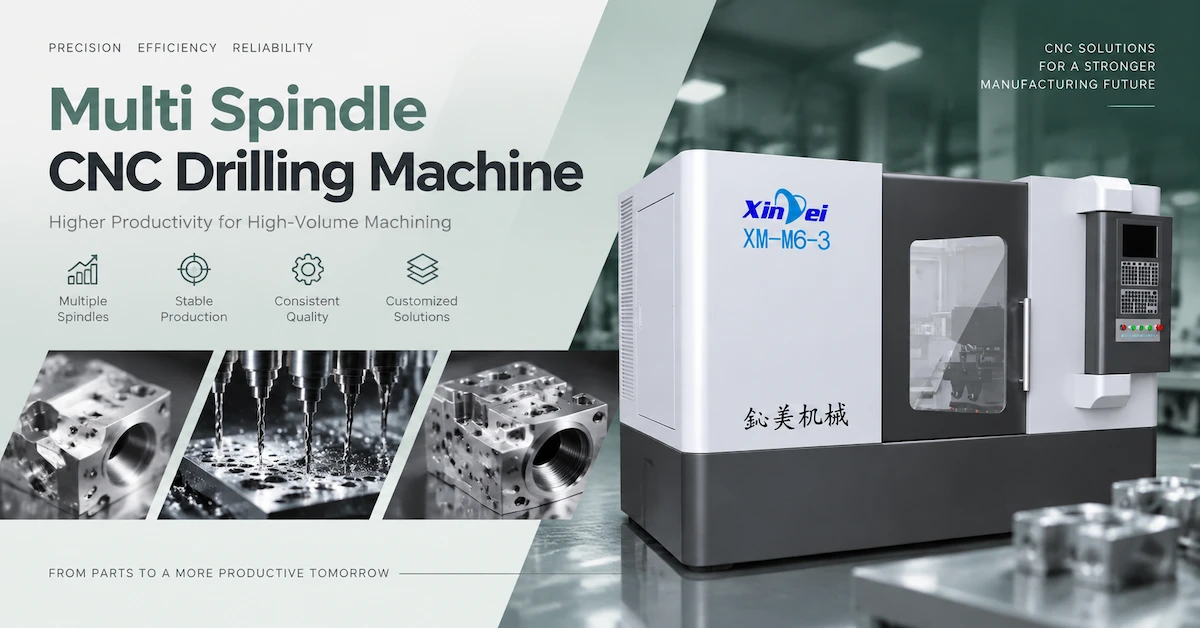
Xinmei Intelligent focuses on machining equipment and intelligent production solutions for practical manufacturing environments, particularly medium-to-large batch production. Its current equipment portfolio includes vertical drilling and tapping machines, horizontal machining solutions, multi-spindle equipment, special-purpose machines, robot loading systems, and integrated CNC automation.
The equipment-selection process should therefore begin with the part and production requirement:
Workpiece → material → machining features → datum → fixture → process sequence → cycle-time target → machine configuration → automation
This method helps avoid a common procurement problem: purchasing a technically capable machine that is poorly matched to the actual production process.
Factories comparing VMC and HMC configurations can contact Xinmei's engineering team with drawings, output targets, existing process information, and automation requirements for a project-specific evaluation. Xinmei's contact page states that its engineering support covers process consultation, machine installation, and production optimization.
FAQ
1. What is the main difference between a vertical and horizontal machining center?
The primary structural difference is spindle orientation. A VMC uses a vertical spindle, while an HMC uses a horizontal spindle. In production, this affects part accessibility, fixture configuration, chip evacuation, multi-side machining, and automation layout.
2. Is a horizontal machining center better than a vertical machining center?
Not universally. An HMC can be more suitable for multi-face, repetitive, automated, or high-volume machining, while a VMC can be more economical and flexible for top-facing operations, frequent changeovers, and less complex parts.
3. Which machine is better for high-volume production?
If the component requires several machining orientations and is produced repeatedly in large quantities, an HMC or other multi-station solution may reduce handling and setups. If the component is simple and mainly machined from one direction, a VMC can still be highly productive.
4. Is an HMC more expensive than a VMC?
Comparable HMC systems often require a higher initial investment because the machine, workholding, pallet, and automation architecture can be more complex. Buyers should compare total cost per finished part rather than purchase price alone. Okuma also notes that typical HMC purchase prices are generally higher than comparable VMCs.
5. Which machining center has better chip evacuation?
Horizontal machine architecture can allow gravity to assist chip removal from the workpiece and cutting zone. However, modern VMCs can also provide effective chip management through coolant, enclosure design, conveyors, and washdown systems.
6. Can a vertical machining center machine several sides of a part?
Yes. A VMC can use fourth-axis rotary tables, fifth-axis systems, indexed fixtures, or multiple setups. The important question is whether those methods provide the required cycle time and repeatability for the intended production quantity.
7. Which machine is better for valve and faucet body machining?
It depends on the number and orientation of holes, threads, sealing surfaces, cavities, required tolerances, and production quantity. A simple part may suit a vertical drilling and tapping center, while a multi-face body produced in large volumes may justify a horizontal or dedicated multi-station solution.
8. Should I choose an HMC to reduce labor?
Possibly, but machine orientation alone does not reduce labor. Workholding, pallets, automatic tool changes, robotic loading, process integration, and inspection strategy determine how much operator involvement can actually be removed.
9. What should I compare besides VMC vs HMC?
Compare machine rigidity, spindle capability, axis travel, fixture design, tool capacity, chip management, cycle time, setup count, automation compatibility, maintainability, inspection strategy, after-sales support, and total cost of ownership.
10. How can I determine which machining center fits my part?
Provide the machine supplier with your part drawing, material, tolerances, machining operations, production quantity, current cycle time, number of setups, and automation target. A process-based evaluation is much more reliable than selecting a machine from specifications alone.
Conclusion
The vertical vs horizontal machining center decision should be based on manufacturing economics and process design rather than a simple comparison of machine specifications.
A VMC is often the practical solution for accessible top-side machining, flexible production, compact installations, and projects where additional complexity provides limited return. An HMC becomes increasingly attractive when a workpiece requires multiple machining faces, repeated re-clamping is limiting output, chip evacuation is difficult, or high-volume production can benefit from pallets and automation.
For industrial buyers, the most useful question is therefore not “Which machining center is better?”
It is:
“Which machine configuration can produce this part at the required quality, cycle time, consistency, and cost with the fewest unnecessary operations?”
If your factory is evaluating a new machining center or upgrading from multiple standalone processes, review Xinmei's CNC machining and automation equipment or send your workpiece requirements to the engineering team for a configuration based on your actual production conditions.