+86 13163919000
 info@xinmeiintelligent.com

Choosing the right automated polishing machine manufacturer is important for factories that need stable surface quality, lower labor dependency, and repeatable finishing results. In many manufacturing industries, polishing is still one of the most difficult processes to standardize. Manual polishing depends heavily on worker experience, pressure control, tool angle, abrasive selection, and production rhythm.
For factories producing metal parts, bathroom hardware, valves, door control components, automotive parts, bearing housings, or precision components, inconsistent polishing can lead to visible defects, poor surface uniformity, higher rework cost, and delayed delivery.
An automated polishing solution helps manufacturers turn a skill-dependent process into a more controllable and repeatable production system.
Xinmei Intelligent provides CNC equipment and intelligent automation solutions for manufacturers that need stable machining, grinding, polishing, and batch production support. You can explore related equipment and automation solutions on the Xinmei products page.
What Is an Automated Polishing Machine?
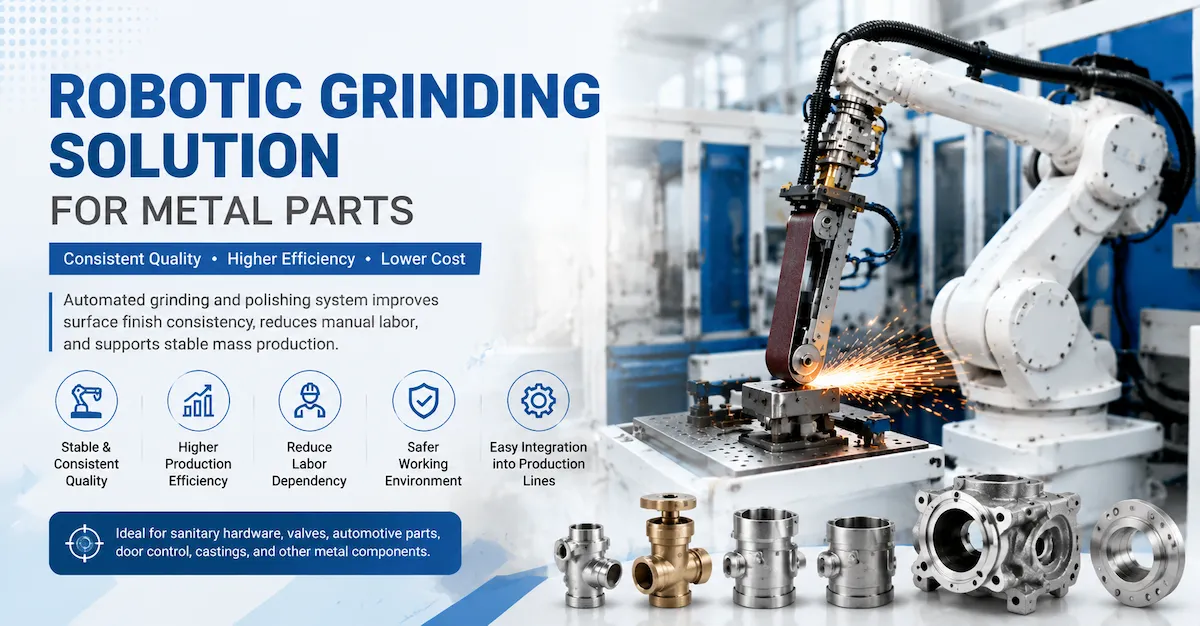
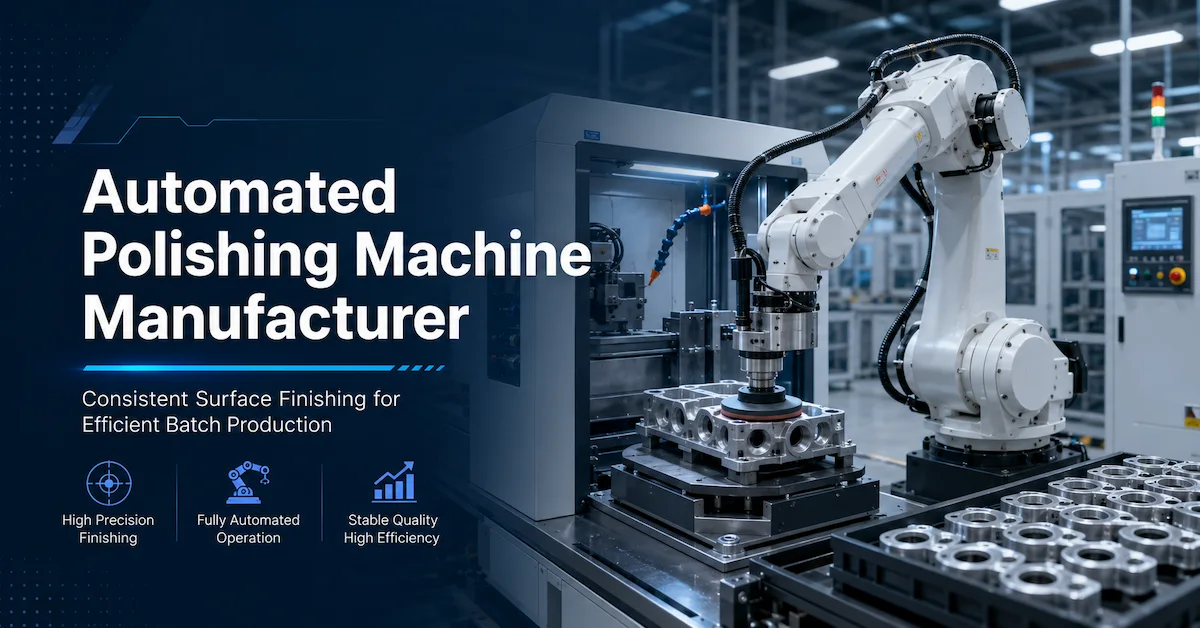
An automated polishing machine is equipment designed to perform polishing, grinding, deburring, or surface finishing through controlled mechanical movement, robotic handling, abrasive tools, and programmed processing logic.
Compared with manual polishing, automated polishing helps control key process factors such as:
- Polishing pressure
- Tool path
- Workpiece position
- Processing time
- Surface contact angle
- Abrasive wheel or belt movement
- Repeatability between batches
A professional automated polishing machine manufacturer should not only provide a machine body. The supplier should understand the workpiece material, surface requirement, production quantity, fixture design, polishing media, and process sequence.
For many factories, the goal is not simply “making the surface shiny.” The real goal is stable, repeatable, and measurable surface finishing.
Why Manual Polishing Becomes a Production Bottleneck
Manual polishing is flexible, but it becomes difficult to control when production volume increases. Different workers may apply different pressure, use different angles, or polish for different durations. This creates variation from part to part.
Common problems include:
- Uneven surface finish
- Excessive material removal
- Visible polishing marks
- High rework rate
- Worker fatigue
- Dust and safety risks
- Difficulty maintaining stable output
- Long training time for skilled workers
- Unstable quality during large orders
For factories with repeat products, these problems can reduce production efficiency and increase quality risk.
An automated polishing machine helps reduce variation by standardizing the polishing path, pressure, fixture position, and processing rhythm.
Typical Applications of Automated Polishing Machines
Automated polishing is suitable for parts that require repeatable surface finishing, deburring, grinding, or appearance improvement.
| Industry | Typical Parts | Polishing Requirement |
|---|---|---|
| Bathroom hardware | Faucet bodies, angle valves, handwheels, stainless steel fittings | Smooth surface, consistent appearance, controlled finishing |
| Valve manufacturing | Ball valves, filter valves, manifolds, globe valves | Deburring, surface smoothing, edge finishing |
| Automotive parts | Brake pump parts, steering components, cylinder heads | Stable surface treatment and burr removal |
| Door control hardware | Door closer bodies, floor spring bodies, lock components | Consistent exterior finishing and edge treatment |
| Bearing housings | Bearing block bases and mechanical housings | Surface leveling and finishing consistency |
| Precision metal parts | Aluminum, brass, stainless steel components | Controlled finish quality and repeatability |
For these products, polishing quality affects both function and appearance. A good automated polishing system can improve surface consistency while reducing dependence on manual skill.
What Buyers Should Check Before Choosing a Manufacturer
Before selecting an automated polishing machine manufacturer, buyers should evaluate whether the supplier can design a practical surface finishing solution around the actual workpiece.
| Evaluation Factor | Why It Matters | What to Ask the Manufacturer |
| Workpiece shape | Affects robot path, fixture, and tool contact | Can the machine handle curved, flat, or irregular surfaces? |
| Material type | Determines abrasive tool and polishing pressure | Is the solution suitable for brass, aluminum, steel, or stainless steel? |
| Surface requirement | Affects polishing process and inspection standard | What surface finish level can be achieved? |
| Fixture design | Controls positioning and repeatability | Can you design fixtures for our specific parts? |
| Polishing media | Affects finish quality and tool cost | What wheel, belt, brush, or abrasive is recommended? |
| Automation level | Determines labor reduction | Is the system manual loading, semi-automatic, or robotic? |
| Dust and safety control | Affects workshop environment | Does the solution include safety protection and dust management? |
| After-sales support | Affects long-term uptime | Do you provide installation, training, and technical support? |
A reliable manufacturer should ask for drawings, samples, surface requirements, material, production volume, and current polishing problems before giving a proposal.
Robotic Polishing vs Traditional Polishing Equipment
Some factories use simple polishing machines, while others need robotic polishing systems. The better choice depends on part complexity, production volume, and quality requirements.
| Option | Best For | Advantage | Limitation |
| Manual polishing | Small batches and flexible repair work | Low initial cost and flexible operation | Unstable quality and high labor dependency |
| Standard polishing machine | Simple surfaces and basic finishing | More stable than manual work | Limited flexibility for complex shapes |
| Robotic polishing machine | Repeat parts and complex surfaces | Better consistency, path control, and automation value | Requires process planning and fixture design |
| Integrated polishing line | Large batch production | Higher efficiency and stronger process control | Higher project planning requirement |
If your factory has repeat parts, rising labor pressure, and strict surface quality requirements, robotic or automated polishing may provide stronger long-term value.
Key Technical Points in Automated Polishing
1. Stable Pressure Control
Polishing pressure directly affects surface quality. Too much pressure may remove excessive material or create marks. Too little pressure may fail to achieve the required finish. Automated systems help keep pressure more consistent during repeated production.
2. Tool Path Planning
For flat, curved, or irregular parts, the polishing path must follow the surface shape. Good path planning helps avoid missed areas, over-polished edges, and inconsistent texture.
3. Fixture Positioning
Fixture stability is critical. If the workpiece shifts during polishing, the final surface may become uneven. A professional supplier should design fixtures that secure the part while allowing the polishing tool to reach key surfaces.
4. Abrasive Selection
Different parts require different polishing wheels, belts, brushes, or abrasive media. Material hardness, surface roughness, and final finish goals all affect abrasive choice.
5. Dust and Safety Protection
Polishing can generate dust, particles, and noise. Automated polishing systems should consider safety guards, dust collection, emergency stop systems, and operator protection.
When Should a Factory Invest in Automated Polishing?
A factory should consider automated polishing when it faces one or more of these problems:
- Surface quality varies between workers
- Skilled polishing labor is difficult to hire
- Rework rate is too high
- Polishing output cannot keep up with machining capacity
- Large orders require more consistent appearance
- Manual polishing creates safety or dust concerns
- Production managers need measurable cycle time
- The factory plans to build a more automated production line
The right system should not just replace workers. It should help build a more stable surface finishing process.
Why Choose Xinmei Intelligent
Xinmei Intelligent focuses on intelligent CNC equipment and automated production solutions for real factory applications. For buyers looking for an automated polishing machine manufacturer, Xinmei can support the project from workpiece evaluation to process planning and automation configuration.
Xinmei solutions are suitable for manufacturers that need:
- Robotic grinding and polishing automation
- Stable surface finishing for repeat parts
- Customized fixtures based on workpiece shape
- Integrated CNC machining and polishing production flow
- Reduced manual polishing dependency
- Improved consistency for batch production
- Practical support from samples to mass production
You can learn more about Xinmei’s manufacturing direction and intelligent production capability through the Xinmei About Us page.
How to Prepare Before Requesting a Quotation
To receive a useful quotation, buyers should prepare practical project information.
You should provide:
- Product drawings or samples
- Workpiece material
- Surface area that needs polishing
- Current polishing method
- Required surface finish or appearance standard
- Defect problems in current production
- Daily or monthly output target
- Manual, semi-automatic, or robotic automation requirement
- Workshop space and production layout
- Photos or videos of current polishing process
With this information, the manufacturer can evaluate the correct polishing method, fixture design, abrasive tool, robot configuration, and production rhythm.
If your factory is planning a surface finishing automation project, you can send your requirements through the Xinmei contact page.
FAQ
1. What is an automated polishing machine used for?
An automated polishing machine is used for surface finishing, deburring, grinding, smoothing, and polishing metal parts with more consistent quality than manual polishing.
2. What industries use automated polishing machines?
Common industries include bathroom hardware, valves, automotive parts, door control hardware, bearing housings, gas appliances, and precision metal component manufacturing.
3. Can automated polishing machines handle irregular parts?
Yes. With proper fixture design, robot path planning, and polishing tool selection, automated polishing systems can process flat, curved, and irregular workpiece surfaces.
4. Is robotic polishing better than manual polishing?
For repeat parts and batch production, robotic polishing can provide better consistency, lower labor dependency, and more stable cycle time. Manual polishing may still be suitable for small batches or repair work.
5. What information is needed before quotation?
You should provide drawings, samples, material, surface finish requirements, current polishing problems, output target, and automation level expectations.
Conclusion
Choosing the right automated polishing machine manufacturer can help your factory improve surface consistency, reduce manual dependency, lower rework rates, and build a more stable finishing process.
For manufacturers producing bathroom hardware, valves, door control parts, automotive components, bearing housings, or precision metal parts, automated polishing is not only an equipment upgrade. It is a process control strategy that helps improve quality, output, and long-term competitiveness.
Xinmei Intelligent provides intelligent CNC equipment and automation solutions for factories that need practical production upgrades. Visit the Xinmei blog page for more manufacturing insights, or contact Xinmei Intelligent to discuss your automated polishing project.