+86 13163919000
 info@xinmeiintelligent.com


Searching for a CNC drill tap center supplier usually starts with a machine requirement, but the real buying problem is larger than the machine itself.
A production manager may need to reduce the cycle time of a brass valve body. A process engineer may be trying to combine drilling, tapping, and light milling in one setup. An automotive parts factory may need more consistent threaded holes across several shifts. Another manufacturer may already have conventional machining centers but find that tool changes, loading time, or single-spindle processing are limiting daily output.
In each case, the wrong purchasing method is to compare only spindle speed, axis travel, controller brand, or quotation price.
The better question is:
Can the supplier turn your workpiece, tolerance, process sequence, batch size, and production target into a stable machining process?
That is the standard industrial buyers should use when evaluating a drill tap center manufacturer.
A capable supplier should be able to discuss the complete production chain: part material, datum strategy, fixture layout, drilling sequence, thread requirements, cutting tools, spindle configuration, tool-change frequency, chip evacuation, inspection, operator loading, automation, maintenance, and acceptance testing.
For manufacturers planning medium- or high-volume production, this approach matters because a few seconds saved in a machining cycle may be valuable, but a machine that creates unstable threads, difficult changeovers, frequent tool breakage, or unplanned downtime can erase those gains quickly.
This guide explains how to evaluate the machine and the supplier as one production system.
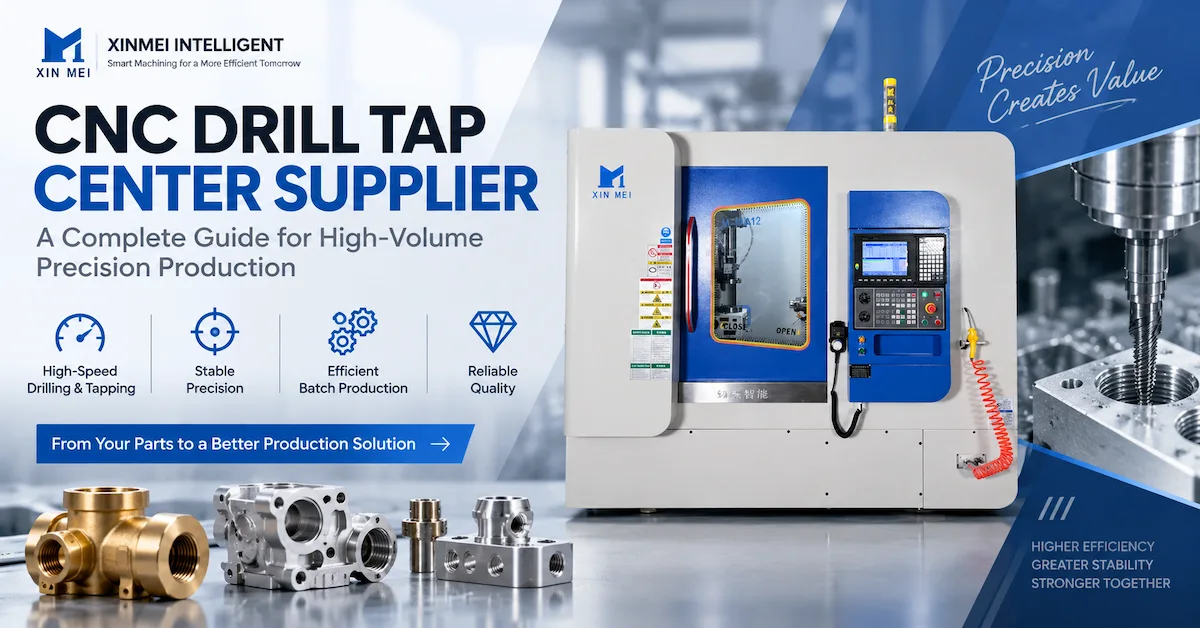
What Is a CNC Drill Tap Center?
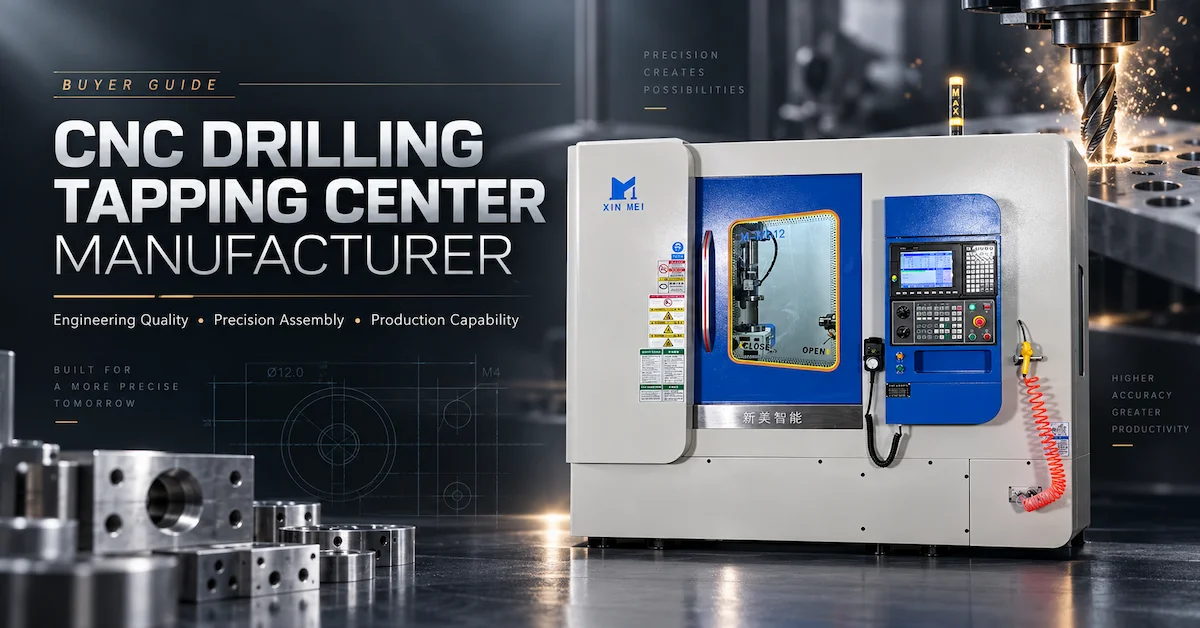
A CNC drill tap center is a numerically controlled machining platform optimized for operations such as drilling, tapping, thread production, hole positioning, and usually light-to-medium milling.
Compared with a general-purpose machining center, a drill tap center is commonly selected when production places a high value on:
-
Fast positioning
-
Frequent drilling operations
-
Repeated tapping cycles
-
Short tool-change time
-
Compact machine footprint
-
Efficient machining of small and medium-sized components
-
Repeatable batch production
-
Integration of several hole-making operations in one setup
The important point is that “drill tap center” describes a production role, not one universal machine configuration.
A factory machining aluminum connector bodies may need different spindle behavior and chip control from a plant machining brass faucet bodies. A brake-component manufacturer may prioritize repeatability and process validation, while a hardware manufacturer may care more about short takt time and the ability to load several workpieces per cycle.
For this reason, buyers should review the actual range of CNC machining centers available from a supplier rather than assume that one tapping center design is suitable for every application.
What Should a CNC Drill Tap Center Supplier Actually Solve?
A professional CNC drill tap center supplier should solve a machining problem, not simply deliver a machine with a spindle and CNC controller.
The supplier should first understand five things:
-
What part is being produced?
-
Which machining operations must be completed?
-
What dimensional and thread requirements matter?
-
How many acceptable parts must be produced per shift or per month?
-
What production constraints already exist in the factory?
That information changes the machine recommendation.
Imagine two buyers asking for a drilling and tapping center.
Buyer A produces mixed precision components in relatively small batches. Parts change frequently, and flexibility is more important than maximum output.
Buyer B produces the same valve housing every day in large quantities. Each part requires a repeated hole pattern and multiple threaded features.
Buyer A may benefit from a flexible vertical drill tap center with a fast tool system.
Buyer B may gain more from a multi-spindle or multi-station configuration because the cost of the machine should be judged against output per shift, not simply purchase price.
This is why supplier engineering capability matters.
XINMEI describes its own approach as process-oriented configuration based on material, machining complexity, and production volume, with support covering tooling, fixtures, machining parameters, installation, commissioning, and after-sales service. Buyers can review the company's broader engineering and manufacturing approach before comparing an individual machine.
Who Is a CNC Drill Tap Center Best For?
A drill tap center is especially relevant when the majority of a part's machining time involves holes, threads, positioning moves, tool changes, or relatively light milling operations.
Typical applications include:
-
Valve bodies
-
Faucet and plumbing components
-
Brake pump components
-
Automotive housings
-
Door-control parts
-
Lock components
-
Connector bodies
-
Manifolds
-
Precision hardware
-
Small mechanical housings
-
Industrial fittings
-
Repetitive aluminum, brass, steel, stainless-steel, or other metal parts
The machine becomes more attractive when the buyer needs to shorten non-cutting time as well as actual cutting time.
A production process can appear fast when measured only from spindle engagement, yet still perform poorly because the machine spends too much time positioning, changing tools, waiting for the operator, or moving parts between separate operations.
A drill tap center should therefore be evaluated on complete part cycle time, not an isolated spindle specification.
When Is a Drill Tap Center Not the Best Choice?
Professional equipment selection also means knowing when not to use a machine.
A drill tap center may not be the first choice if:
-
The workpiece is extremely large or heavy
-
Heavy rough milling dominates the cycle
-
Deep boring is the primary process
-
Very high cutting torque is more important than rapid movement
-
The component requires a highly specialized multi-face process better handled by dedicated equipment
-
Batch size is too small to justify a production-oriented configuration
-
The workpiece changes constantly and requires unusually broad machining flexibility
In those situations, another machining center or a special-purpose CNC solution may provide a better technical and financial fit.
A trustworthy CNC drill tap center supplier should be willing to say this.
If every workpiece is automatically recommended for the same machine, the supplier is probably selling a catalog model rather than engineering a production solution.
1. Start Supplier Evaluation With the Workpiece
The first serious discussion with a supplier should be about the part.
Send the drawing before spending too much time comparing brochures.
The engineering team should review:
-
Overall dimensions
-
Raw material
-
Casting, forging, extrusion, or bar-stock condition
-
Hole diameters
-
Hole depths
-
Thread specifications
-
Datum locations
-
Critical tolerances
-
Surface-finish requirements
-
Number of machining faces
-
Existing machining operations
-
Required annual or monthly production volume
The objective is to determine whether drilling and tapping are truly the production bottleneck.
For example, a brass valve component may have many threaded ports distributed across several directions. Moving that part between multiple conventional machines creates handling time and increases the number of locating operations.
In another case, a brake pump component may have a simpler geometry but an extremely high production requirement. The more important question may be whether several holes or several components can be processed at the same time.
Supplier selection becomes much more precise once the workpiece is placed at the center of the discussion.
2. Evaluate Spindle Performance in Context, Not by RPM Alone
High spindle speed is commonly promoted in the drilling and tapping center market.
It matters, but RPM by itself does not tell a buyer whether production will be fast or stable.
The useful questions are:
-
What material will be cut?
-
What drill diameter will be used?
-
What tapping method is planned?
-
What cutting-tool material is selected?
-
How deep are the holes?
-
Is coolant delivery adequate?
-
How quickly does the spindle accelerate and decelerate?
-
How does the spindle behave through repeated tapping cycles?
-
What happens during an eight- or sixteen-hour production period?
A higher maximum spindle speed does not automatically mean a shorter real cycle.
Acceleration, axis movement, tool change, positioning, fixture access, chip clearing, and operator handling all contribute to takt time.
XINMEI's Vertical CNC Drilling and Tapping Machine, for example, is positioned around high-speed drilling and tapping, rapid tool changes, compact layout, machine rigidity, and continuous batch-production stability rather than presenting spindle speed as an isolated benefit.
That is the right way to evaluate this equipment category: as a complete production platform.
3. Look Closely at Tapping Stability
Tapping is usually less forgiving than simple drilling.
A drilled hole that is slightly inefficient may increase cycle time. An unstable tapping process can produce scrap, damaged threads, broken taps, rework, or even costly tool-removal procedures.
When evaluating a CNC tapping center supplier, ask how the proposed machine and control strategy handle repeated threading operations.
Topics should include:
-
Spindle synchronization
-
Feed synchronization
-
Rigid tapping capability
-
Tap selection
-
Cutting speed
-
Hole preparation
-
Thread depth
-
Coolant or lubrication
-
Chip formation
-
Tool-life management
-
Reversal stability
-
Thread inspection
The supplier should also ask what type of threads you produce.
Blind holes and through holes behave differently. Brass, aluminum, stainless steel, and carbon steel present different chip and lubrication conditions. Small threads may be sensitive to tool runout and alignment, while deeper threads require careful chip control.
A supplier who asks only for the thread size but ignores material, hole depth, production quantity, and tool strategy has not yet analyzed the application deeply enough.
For additional process context, buyers can review XINMEI's technical article on selecting a CNC tapping machine manufacturer.
4. Machine Rigidity Still Matters on a High-Speed Drill Tap Center
Drilling and tapping centers are often associated with speed, compactness, and rapid movement.
That does not make structural rigidity unimportant.
The machining system includes:
-
Machine frame
-
Column
-
Spindle
-
Axis system
-
Table
-
Fixture
-
Tool holder
-
Cutting tool
-
Workpiece
Weakness anywhere in that chain can influence hole position, tool life, surface quality, vibration, and repeatability.
For a production buyer, machine rigidity should be discussed together with fixture rigidity and cutting conditions.
This becomes more important when the drill tap center also performs milling, when tools have longer overhang, or when several parts are mounted in a production fixture.
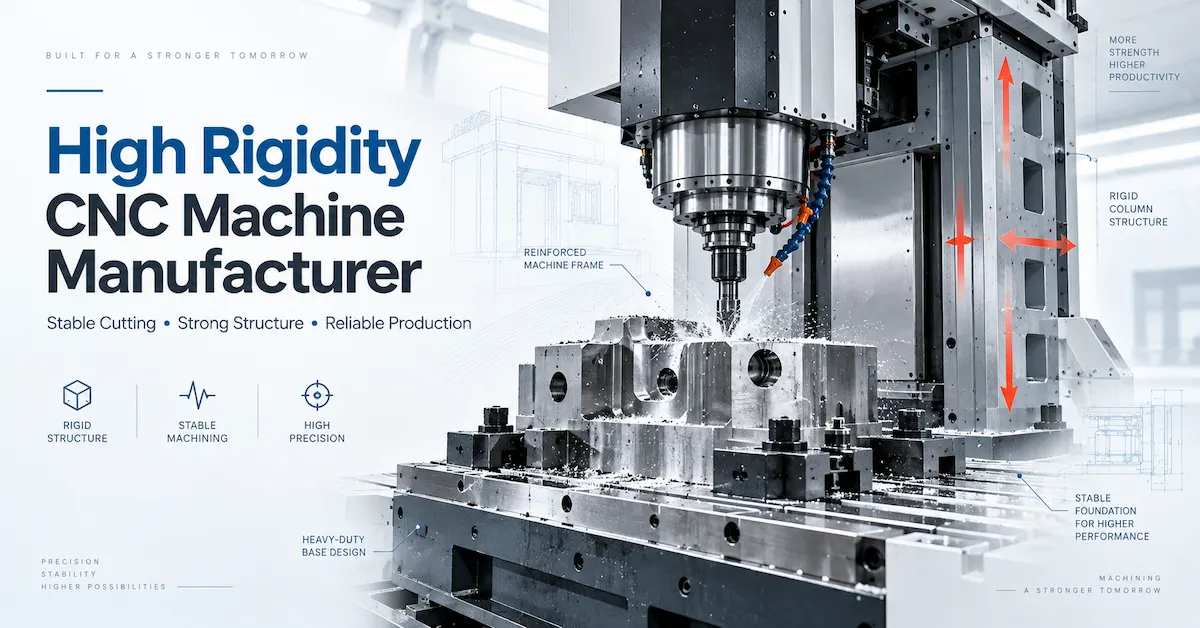
XINMEI states that its vertical drilling and tapping machine uses a rigid machine structure and optimized internal mechanical layout to support stable cutting and consistent production. The company's broader CNC machine engineering also emphasizes machine structure optimization and long-term production stability.
The purchasing lesson is simple:
Do not evaluate speed without evaluating structural stability.
5. Compare Tool Change and Non-Cutting Time
One of the reasons buyers choose a drilling and tapping center is to reduce time that does not directly create a finished feature.
Suppose a component requires:
-
Spot drilling
-
Drilling
-
Chamfering
-
Tapping
-
Light face milling
-
A second drilled diameter
The cutting time may be relatively short, but tool changes happen repeatedly.
A machine with a responsive turret or tool magazine can reduce dead time between operations.
However, brochure tool-change figures need context.
Ask whether the quoted time is:
-
Tool-to-tool
-
Chip-to-chip
-
Measured under ideal conditions
-
Representative of the actual part program
Also examine how tools are arranged.
If production repeatedly uses the same six tools, tool-management strategy may be more important than maximum magazine capacity.
The best CNC drill tap center supplier will evaluate the actual process sequence rather than simply recommend the largest available magazine.
6. Decide Whether Single-Spindle or Multi-Spindle Machining Is Better
This is one of the most important decisions for high-volume buyers.
A conventional vertical drill tap center processes operations sequentially through one main spindle.
That provides flexibility and is appropriate for many components.
But when a large production volume repeatedly uses the same hole pattern, parallel machining may reduce cycle time substantially.
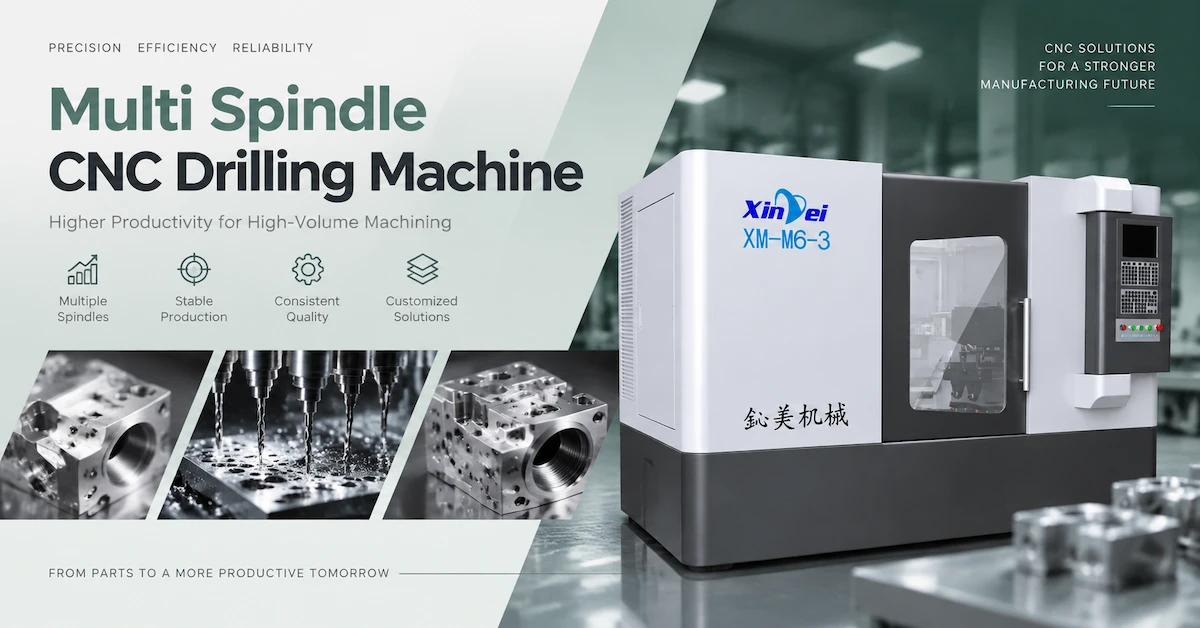
XINMEI's six-spindle horizontal drilling and tapping machine is designed around simultaneous spindle operation, allowing multiple holes to be drilled or tapped during the same machining cycle.
The decision should depend on production economics, not on the assumption that more spindles are automatically better.
| Production Condition | Single-Spindle Drill Tap Center | Multi-Spindle Solution |
|---|---|---|
| Frequent product changes | Strong fit | Requires careful evaluation |
| Low or medium batch size | Often practical | May be excessive |
| Stable repeated workpiece | Good | Often very attractive |
| Repeated hole pattern | Good | Potentially much faster |
| Maximum production output | Moderate to high | High |
| Fixture complexity | Usually lower | Often higher |
| Initial engineering effort | Lower | Higher |
| Cost per part at high volume | Depends on cycle | Can become very competitive |
| Future product flexibility | Generally higher | Depends on design |
A buyer should ask the supplier to model both approaches when production volume is high enough to justify the comparison.
7. Fixture Engineering Can Matter More Than the Machine Brochure
A fast machine with a poor fixture is still a poor production system.
Fixture design determines:
-
Workpiece location
-
Clamping repeatability
-
Loading access
-
Tool accessibility
-
Part deformation
-
Chip evacuation
-
Changeover time
-
Operator ergonomics
-
Automation compatibility
This becomes especially important when machining castings, irregular valve bodies, thin-wall parts, or multiple workpieces in one cycle.
Consider a faucet body with several uneven surfaces.
If the fixture references an unstable casting surface, machine accuracy cannot compensate for inconsistent positioning. Likewise, excessive clamping force can distort a thin part and create dimensional changes after release.
The supplier should therefore explain the datum strategy.
Ask:
-
Which surfaces locate the part?
-
How many locating points are used?
-
How is over-constraint avoided?
-
Is hydraulic, pneumatic, manual, or another clamping method proposed?
-
Can chips accumulate on the locating surfaces?
-
How will the operator confirm correct loading?
-
Can the fixture later be adapted for robotic loading?
XINMEI's engineering content includes resources on CNC fixture selection and workholding within its technical knowledge area. Buyers should treat fixture review as part of machine selection rather than a secondary accessory discussion.
8. Ask How the Supplier Plans the Complete Machining Sequence
The same part can be machined in several different ways.
A good supplier should be able to explain why one sequence is preferable.
For example:
-
Should a hole be drilled before face milling?
-
Should reference surfaces be finished before secondary holes?
-
Should several threads be produced in one orientation?
-
Can two setups become one?
-
Can drilling and tapping be combined with light milling?
-
Does another machine need to complete a heavy operation?
-
Which processes create the most tool wear?
-
Where should inspection occur?
Process planning is where a supplier begins to create measurable value.
If changing the operation sequence eliminates one workpiece transfer, the benefit can extend beyond cycle time.
It may also reduce:
-
Operator handling
-
Intermediate inventory
-
Date transfer error
-
WIP
-
Floor-space consumption
-
Inspection complexity
This is why industrial buyers should evaluate the supplier's machining knowledge alongside machine specifications.
9. Compare Drill Tap Centers With Conventional Vertical Machining Centers
A drilling and tapping center and a general vertical machining center can overlap in capability.
The better choice depends on the workpiece.
| Factor | Drill Tap Center | General Vertical Machining Center |
|---|---|---|
| Drilling/tapping intensity | Excellent fit | Good |
| Rapid positioning | Usually a major priority | Depends on model |
| Frequent tool changes | Strong fit | Good |
| Compact footprint | Often favorable | Often larger |
| Light milling | Well suited | Well suited |
| Heavy milling | Application dependent | Often better suited |
| High-volume small/medium parts | Strong fit | Good |
| Broad process flexibility | Good | Often broader |
| Production specialization | High | Medium |
| Very heavy cuts | Not usually the first choice | Often more suitable |
The wrong way to choose between them is by asking which machine is “better.”
The right question is:
Which configuration produces your accepted part at the required rate, with the required process stability and acceptable lifetime cost?
Buyers comparing broader machine categories can review XINMEI's CNC machining center selection resources.
10. Match the Machine to the Material
“Metal parts” is not a sufficient application description.
The supplier needs the actual material.
For example:
Aluminum
Aluminum often permits high cutting speeds, but chip evacuation, burr control, tool geometry, and surface finish still matter. High-speed positioning can be valuable when the component contains many small features.
Brass and Copper Alloys
Valve and sanitary-ware manufacturers often machine brass components with multiple holes and threads. Stable workholding, efficient multi-hole processing, and fast cycle time can strongly influence unit cost.
Stainless Steel
Stainless steel changes the discussion around tool wear, heat, cutting speed, lubrication, and tapping stability. Selecting a machine based solely on an aluminum demonstration would be a poor purchasing method.
Cast Iron
Dust, chips, tool selection, and machine protection require different consideration.
The drill tap center supplier should connect material properties with spindle use, cutting tools, fixtures, coolant strategy, and cycle expectations.
11. Evaluate Applications by Production Problem
A supplier with industry experience should be able to discuss the workpiece, not simply list industry names.
Valve and Sanitary Ware Manufacturing
Valve bodies, faucet components, manifolds, angle valves, water-control parts, and similar components can involve many drilled and tapped holes.
Buyers often need:
-
Shorter cycle time
-
Consistent thread quality
-
Multi-hole machining
-
Reduced setups
-
Brass or stainless-steel process knowledge
-
Fixtures for irregular shapes
-
High-volume output
These applications are a strong fit for comparing vertical and multi-spindle drilling and tapping solutions.
Automotive and Motorcycle Components
Brake-system parts, steering components, cylinder-related components, suspension parts, and other automotive workpieces typically place greater emphasis on repeatability and controlled production.
Important questions include:
-
Can the process remain stable through long batches?
-
How will critical dimensions be measured?
-
How will fixture repeatability be verified?
-
Is automation required?
-
What happens when a tool approaches the end of its useful life?
XINMEI lists automotive and motorcycle parts among its application areas and provides drilling, tapping, machining, and automation equipment for industrial production.
Door-Control Components
Door closer bodies, floor spring components, lock bodies, gears, and related hardware can contain repeated holes and multi-face features.
For high volume, the purchasing discussion may eventually extend beyond a standard drill tap center into dedicated machines or automatic production systems.
That is another reason to select a supplier with a broader equipment portfolio.
Precision Connectors and Industrial Hardware
Connector bodies and smaller precision components may place more emphasis on hole position, repeatability, tool condition, and compact high-speed machining.
For these parts, a supplier should consider production volume and feature density together.
12. Review Automation Before You Need It
A common purchasing mistake is treating automation as a completely separate future project.
Even if a factory intends to start with manual loading, it is worth asking how the machine could fit into a future automated cell.
Topics include:
-
Automatic door interface
-
Robot access
-
Fixture actuation
-
Part-present sensors
-
Machine-ready signals
-
Cycle-start communication
-
Alarm communication
-
Automatic chip management
-
Part orientation
-
Finished-part handling
-
Inspection integration
XINMEI currently provides industrial automation lines in addition to standalone CNC machines.
That matters for a buyer who expects production volume to increase.
A machine that is easy for an operator to load is not automatically easy for a robot to load. Fixture access, gripping surfaces, door clearance, signal integration, part orientation, and recovery after interruption all need to be considered.
Planning those details early can prevent expensive redesign later.
13. How Should Buyers Evaluate CNC Drill Tap Center Quality?
Quality should be separated into two categories:
machine quality and workpiece quality.
Machine quality includes:
-
Structural assembly
-
Axis alignment
-
Spindle installation
-
Motion accuracy
-
Electrical integration
-
Controller operation
-
Repeatability
-
Long-running stability
Workpiece quality includes:
-
Hole position
-
Hole diameter
-
Thread quality
-
Surface condition
-
Dimensional repeatability
-
Process capability under actual cutting conditions
A supplier should have a structured validation process before shipment.
XINMEI's quality assurance system describes material and component verification, structural and assembly control, final machine validation, in-house assembly and testing, CMM inspection, Renishaw measurement systems, and hardness testing.
Its published quality page also states reference performance and validation information including:
-
Surface roughness down to Ra ≤ 0.8 μm
-
Roundness tolerance ≤ 0.01 mm
-
24-hour continuous-operation testing
-
100% inspection before shipment
These values should not be interpreted as a universal guarantee for every workpiece and every machine configuration. Your own purchase agreement should define the dimensions, tolerances, test workpiece, sampling method, and machining conditions required for the actual project.
That distinction is important.
A professional procurement process converts general supplier quality capability into project-specific acceptance criteria.
14. Component Brands Matter, but Configuration Matters More
Buyers frequently ask which control, guideway, bearing, pneumatic, servo, or electrical brands are used.
That is reasonable.
Recognized components can simplify maintenance, technical support, and spare-parts planning.
XINMEI's supply chain lists supplier-network brands including Siemens, FANUC, SYNTEC, HIWIN, Schneider Electric, NSK, Airtac, PMI, and others.
However, a supplier-network page is not the same as a machine-specific bill of materials.
Before placing an order, ask for the approved configuration for your machine.
Confirm:
-
CNC controller
-
Servo system
-
Linear guides
-
Bearings
-
Pneumatic components
-
Main electrical components
-
Spindle-related components
-
Lubrication system
-
Coolant system
-
Sensors
-
Allowed substitutions
The supplier should also explain what happens if a specified component becomes unavailable before assembly.
A controlled substitution process is better than discovering a change after the machine arrives.
15. What Does a CNC Drill Tap Center Actually Cost?
Buyers naturally ask for machine price, but equipment cost should be considered in several layers.
Initial Machine Cost
This includes the base machine and selected configuration.
Fixture Cost
A customized multi-part fixture can materially change project value and productivity.
Tooling Cost
Drills, taps, toolholders, cutters, and tool-management requirements belong in the process budget.
Automation Cost
Robot loading, conveyors, part feeders, automatic fixtures, and inspection can increase initial investment but change labor and utilization economics.
Installation Cost
International projects may require freight, local handling, utilities, commissioning, training, and site preparation.
Operating Cost
Consider:
-
Energy
-
Cutting tools
-
Maintenance
-
Lubrication
-
Coolant
-
Spare parts
-
Operator labor
-
Scrap
-
Downtime
Cost Per Accepted Part
For a production factory, this is often the most useful economic metric.
A lower-priced machine that produces fewer accepted parts per shift, needs more operators, creates more setups, or stops more frequently may have a higher real manufacturing cost.
Therefore, when requesting a quotation from a CNC drill tap center supplier, compare machines using the same production assumptions.
16. How Should ROI Be Evaluated Without Making Unrealistic Claims?
ROI should be calculated from your own factory data.
Avoid supplier claims such as “50% cost reduction” unless the underlying comparison is clearly defined.
A practical evaluation can use:
Current process:
-
Machines used
-
Operators required
-
Cycle time
-
Setup time
-
Scrap rate
-
Tool consumption
-
Shifts per day
-
Accepted parts per shift
Proposed process:
-
Machines required
-
Operators required
-
Expected cycle
-
Setup method
-
Automation level
-
Planned uptime
-
Accepted output target
Then estimate:
Annual production benefit – annual operating cost difference – investment cost
The result is far more useful than a generic percentage.
For a multi-spindle system, the largest gain may come from simultaneous machining.
For a vertical drill tap center, it may come from rapid movement, fast tool changes, and consolidation of several operations.
For an automated cell, it may come from labor utilization and longer unattended production.
Different factories will reach different results.
17. What Information Should You Send in an RFQ?
A vague message such as “Please quote CNC tapping machine” usually produces a vague quotation.
A strong RFQ should include:
| Buyer Information | Why It Matters |
|---|---|
| Part drawing | Defines geometry and tolerances |
| 3D model if available | Helps fixture and access review |
| Material | Determines cutting strategy |
| Blank condition | Affects clamping and machining |
| Annual/monthly volume | Influences machine concept |
| Required parts per shift | Establishes capacity target |
| Critical dimensions | Guides acceptance |
| Thread specifications | Supports tapping analysis |
| Existing process | Reveals current bottlenecks |
| Current cycle time | Creates a comparison baseline |
| Existing machines | Helps line integration |
| Automation requirement | Changes fixture and interface design |
| Preferred controller | Supports maintenance standardization |
| Destination country | Influences electrical/service planning |
| Required delivery schedule | Helps project planning |
For application-specific discussion, buyers can contact XINMEI's engineering team with the workpiece drawing, material, production target, and current process.
That is a more productive starting point than requesting a catalog price alone.
18. What Should Be Included in Factory Acceptance Testing?
A Factory Acceptance Test, or FAT, should prove the agreed project requirements before shipment.
The test plan should be written before the machine is finished.
A useful FAT may include:
Machine Function
Verify:
-
Axis movement
-
Tool change
-
Spindle operation
-
Safety functions
-
Coolant
-
Lubrication
-
Alarm behavior
-
Program execution
Test Workpiece
Use an agreed component or representative test part.
Machining Conditions
Record:
-
Material
-
Tools
-
Speeds and feeds
-
Coolant conditions
-
Fixture
-
Program revision
Dimensional Inspection
Define which dimensions matter.
Avoid simply saying “machine accuracy qualified.”
Specify:
-
Hole diameter
-
Hole position
-
Thread inspection
-
Reference date
-
Measurement method
-
Sample quantity
Cycle Time
State exactly what the measured cycle includes.
Does it begin when the operator loads the part?
Does it include clamping?
Does it include tool changes?
Does it include unloading?
Without a common definition, two cycle-time claims cannot be compared fairly.
Continuous Production
If long-run stability matters, include a defined production run rather than evaluating only the first finished component.
19. After-Sales Support Should Be Evaluated Before Ordering
Service questions become expensive only after the machine stops.
Ask them before signing the purchase order.
Important areas include:
-
Installation
-
Commissioning
-
Operator training
-
Programming support
-
Electrical documentation
-
Maintenance manuals
-
Spare parts
-
Remote diagnosis
-
Software backup
-
Parameter backup
-
Technical upgrades
-
Automation modifications
-
Service coverage in your region
XINMEI states that its engineering support extends from process consultation and equipment configuration through installation, commissioning, production optimization, maintenance, and technical upgrades. Its contact and service network currently lists international sales markets and service coverage across several countries.
For an overseas buyer, those details should still be converted into a project-specific service agreement.
Confirm response method, responsible party, included services, chargeable services, spare-parts terms, and warranty conditions.
20. Common Mistakes When Choosing a CNC Drill Tap Center Supplier
Mistake 1: Comparing Only Price
Purchase price is visible. Production losses are often hidden.
Compare cost per accepted part instead.
Mistake 2: Buying Based on Maximum RPM
Spindle speed is only one part of total cycle performance.
Mistake 3: Ignoring Fixtures
The fixture determines whether machine capability reaches the workpiece consistently.
Mistake 4: Ignoring Tapping Details
Thread depth, material, hole preparation, lubrication, and tool selection matter.
Mistake 5: Assuming More Spindles Are Always Better
Multi-spindle machining is powerful when volume and part stability justify it.
Mistake 6: Using Generic Acceptance Standards
Your project should define its own workpiece, dimensions, and inspection method.
Mistake 7: Delaying Automation Planning
Future robot loading may require changes to fixtures, access, controls, and part presentation.
Mistake 8: Accepting Unclear Component Specifications
Request the approved configuration for the actual machine.
Mistake 9: Ignoring Changeover
A machine can be productive on one part and inefficient when switching between variants.
Mistake 10: Choosing a Supplier That Cannot Explain the Process
If the supplier cannot explain why the proposed process will work, a polished quotation is not enough.
21. How XINMEI Approaches Drill and Tap Center Applications
XINMEI Machinery develops CNC equipment for drilling, tapping, milling, boring, special-purpose machining, and automated production.
Its current CNC machining center range includes several configurations relevant to production buyers.
Vertical CNC Drilling and Tapping Machine
The Vertical CNC Drilling and Tapping Machine is aimed at high-speed drilling and tapping with a compact vertical structure, rapid tool switching, rigid mechanical design, and continuous batch-production capability.
This configuration is relevant where factories need:
-
Flexible part handling
-
Frequent drilling and tapping
-
Multiple tools
-
Compact floor-space use
-
Stable repetitive production
Six-Spindle Drilling and Tapping Machine
For applications with repeated multi-hole processing or higher throughput requirements, the CNC Horizontal Lifting Six Spindle Drilling and Tapping Machine uses multiple spindles to process holes simultaneously.
Its published design features include:
-
Six-spindle simultaneous machining
-
Horizontal structure with lifting column
-
Servo-driven tool-change system
-
HIWIN linear guide rails
-
Rigid machine structure
-
Fully servo-driven configuration
-
Batch-production orientation
The two machine concepts illustrate why supplier selection should begin with the production problem.
A flexible vertical center and a six-spindle production machine are not competing only on specifications. They solve different combinations of volume, flexibility, and cycle-time requirements.
22. What Makes a Supplier Suitable for Long-Term Production?
A reliable CNC drill tap center supplier should demonstrate capability in four areas.
Application Engineering
The team should understand the workpiece and production process.
Machine Engineering
The proposed structure, spindle, axes, controls, and components should fit the machining task.
Manufacturing and Quality Control
Assembly and final validation should be controlled and documented.
Lifecycle Support
The supplier should remain useful after shipment.
XINMEI's company profile states that the business began focusing on CNC machine tools in 2015, developed in-house vertical tapping and machining centers by 2018, and expanded from standalone machines toward integrated machining and automation solutions by 2024.
For buyers, company history is useful only when it translates into technical support for the present project.
The more important evaluation is whether the supplier can review your part and clearly explain:
-
Which machine is proposed
-
Why it is proposed
-
How the part will be held
-
Which operations will be completed
-
How output is estimated
-
How quality will be verified
-
How the machine will be supported
23. Final CNC Drill Tap Center Supplier Checklist
Before placing an order, use the following checklist.
Application
-
Has the supplier reviewed the workpiece drawing?
-
Has material been confirmed?
-
Are critical dimensions identified?
-
Are thread requirements clear?
-
Is batch volume known?
Process
-
Is the machining sequence defined?
-
Are all required operations included?
-
Is fixture strategy clear?
-
Are cutting tools considered?
-
Is chip handling considered?
Machine
-
Is spindle configuration appropriate?
-
Is axis travel sufficient?
-
Is tool capacity appropriate?
-
Is structural rigidity suitable?
-
Is the controller configuration defined?
Productivity
-
Is cycle time defined clearly?
-
Is loading time included?
-
Is changeover considered?
-
Has single-spindle versus multi-spindle processing been compared?
-
Is automation necessary now or later?
Quality
-
Is the FAT method documented?
-
Is a test workpiece defined?
-
Are critical dimensions identified?
-
Is measurement equipment agreed?
-
Is long-running stability part of the test?
Commercial Terms
-
Are fixtures included?
-
Are cutting tools included?
-
Are installation and training defined?
-
Is freight responsibility clear?
-
Are spare parts defined?
-
Is warranty scope clear?
Service
-
Who handles commissioning?
-
What remote support is available?
-
What documentation is provided?
-
What is the spare-parts process?
-
How are future upgrades handled?
A supplier who can answer these questions clearly is much easier to evaluate than one who responds only with a price sheet.
Frequently Asked Questions About CNC Drill Tap Center Suppliers
What is the difference between a CNC drill tap center and a machining center?
A drill tap center is generally optimized around rapid drilling, tapping, fast positioning, frequent tool changes, and efficient production of small to medium-sized components. A general machining center may offer broader capability and may be more suitable for heavier milling. The correct choice depends on the actual workpiece and process.
What information does a CNC drill tap center supplier need for a quotation?
At minimum, provide the workpiece drawing, material, production volume, required machining operations, critical tolerances, thread specifications, and target output. Existing cycle-time data is also extremely useful.
Is a high-speed spindle always better for tapping?
No. Tapping performance depends on spindle synchronization, tool selection, hole preparation, material, thread size, lubrication, and process stability. Maximum RPM alone should not determine the purchase.
When should I consider a multi-spindle drilling and tapping machine?
Multi-spindle machining becomes attractive when the same part or hole pattern is produced repeatedly at high volume and several operations can be completed simultaneously. It may be less suitable where product changeover is very frequent.
Can a drill tap center perform milling?
Many drill tap centers can perform milling operations, but the required cutting load must be considered. If heavy rough milling dominates the part cycle, another machine configuration may be more suitable.
Which industries commonly use CNC drilling and tapping centers?
Common applications include automotive parts, valve components, sanitary ware, door hardware, connectors, industrial fittings, precision hardware, and general mechanical components that require repeatable hole and thread machining.
How should I compare quotations from different suppliers?
Normalize the quotations. Compare the machine configuration, controller, spindle, fixtures, tools, automation, acceptance test, installation, training, spare parts, warranty, and service—not only the headline machine price.
Should I request a trial machining test?
For an important production project, trial machining or FAT using an agreed workpiece is highly valuable. Define the material, program, tools, measurement method, critical dimensions, cycle-time definition, and sample quantity before testing.
Can a CNC drill tap center be integrated with a robot?
Yes, provided the machine, fixture, controls, part orientation, loading access, and safety system are designed for integration. Buyers planning future automation should discuss this before purchasing the machine.
How do I request a CNC drilling and tapping solution from XINMEI?
Prepare your part drawing, material, required operations, production volume, critical tolerances, current process, and target output, then submit them through the XINMEI contact page. This gives the engineering team enough information to compare standard drill tap centers, multi-spindle configurations, or a broader automated solution.
Conclusion
Choosing a CNC drill tap center supplier is ultimately a production-engineering decision, not a catalog-shopping exercise.
Spindle speed, tool capacity, travel, controller brand, and quotation price all matter, but they only become meaningful when connected to the workpiece. A good supplier should be able to explain how the machine, fixture, tools, machining sequence, tapping process, quality checks, and future automation plan work together to produce acceptable parts at the required rate.
For flexible drilling, tapping, and light multi-process machining, a vertical drill tap center may offer the right balance of speed, compactness, and adaptability. For stable high-volume parts with repeated hole patterns, a multi-spindle system may provide a more productive route. In other applications, a special-purpose machine or automated production cell may be the better investment.
The key is to compare solutions using real factory data: your drawing, material, tolerance, cycle target, production volume, changeover frequency, labor situation, and acceptance criteria.
XINMEI provides CNC machining centers, multi-spindle drilling and tapping equipment, special-purpose machining solutions, and automation systems for industrial manufacturers. Buyers can also review the company's quality assurance process, engineering background, and supply-chain information before starting a project discussion.
If you are currently comparing CNC drill tap center suppliers, the most useful next step is not to ask only for a machine price. Send the part drawing, material, production quantity, machining requirements, critical tolerances, and current cycle information through the XINMEI inquiry channel. That allows the machine concept, fixture strategy, spindle configuration, process sequence, and automation potential to be evaluated around the part you actually need to produce.