+86 13163919000
 info@xinmeiintelligent.com

What Is CNC Boring?
CNC boring is a precision machining process used to enlarge and improve existing holes through computer-controlled cutting operations.
Unlike drilling, which creates a new hole, boring focuses on improving:
- Hole diameter accuracy
- Position alignment
- Roundness
- Surface finish
- Dimensional consistency
For industrial manufacturing, CNC boring is often used after drilling when a component requires higher precision than a standard drilled hole can achieve.
Typical applications include:
- Engine components
- Valve bodies
- Pump housings
- Large mechanical structures
- Industrial equipment parts
A professional CNC boring machine supplier should understand that boring is not only a hole enlargement process.It is a critical precision operation that influences:
- Component assembly accuracy
- Product reliability
- Production efficiency
- Manufacturing consistency
The complete CNC boring workflow usually includes:
Part analysis → Machining planning → Fixture design → Tool selection → CNC programming → Boring operation → Inspection
Xinmei Intelligent provides CNC machining solutions including drilling, tapping, milling, boring, special-purpose CNC equipment, and automation solutions for industrial production applications.
Customers can explore Xinmei's CNC machining solutions for different manufacturing requirements.
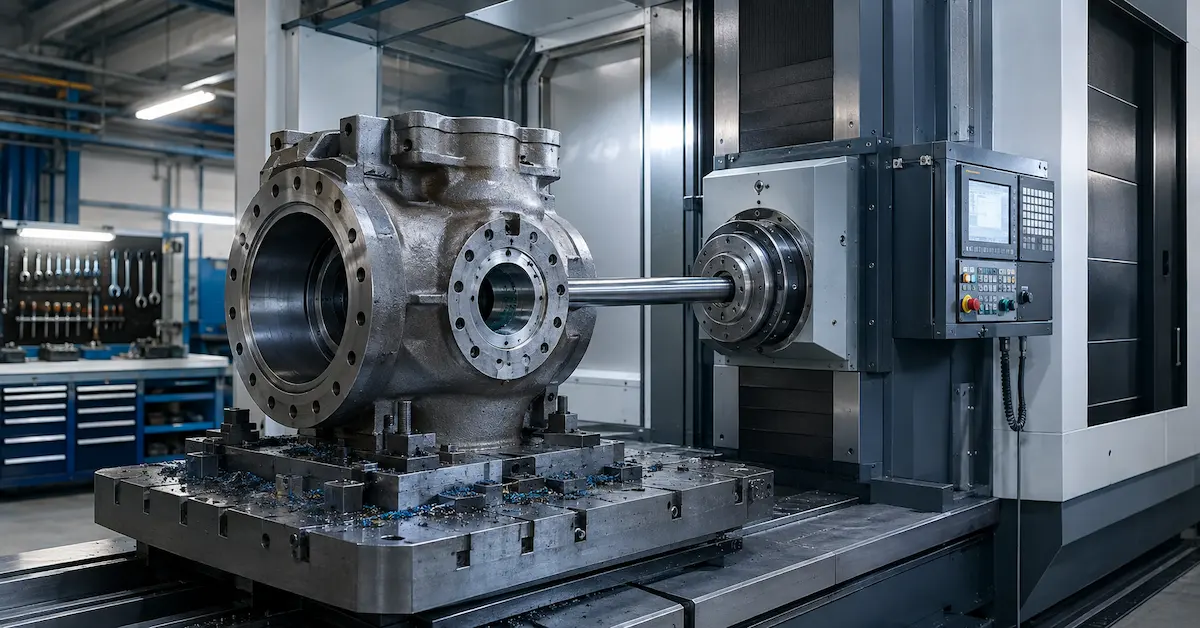
How Does a CNC Boring Machine Work?
A CNC boring machine uses programmed control systems to move cutting tools accurately inside existing holes to achieve the required dimensions and surface quality.
The process involves several important elements.
CNC Programming and Process Planning
Before machining begins,engineers analyze:
- Part drawings
- Hole dimensions
- Material characteristics
- Required tolerance
- Production volume
The CNC program controls:
- Tool movement
- Cutting depth
- Feed rate
- Spindle speed
- Tool compensation
Proper programming ensures:
- Stable machining
- Accurate hole positioning
- Consistent production results
Workpiece Positioning and Fixture Design
Large industrial components require stable positioning during boring operations.
A CNC boring machine supplier should consider:
- Workpiece weight
- Clamping method
- Reference surfaces
- Machining accessibility
Poor fixture design may cause:
- Hole deviation
- Vibration
- Reduced surface quality
- Inconsistent production
For precision boring, fixture stability is as important as machine capability.
Boring Tool Operation
During CNC boring, a boring bar or precision cutting tool removes material from an existing hole.
Important machining factors include:
- Tool rigidity
- Cutting speed
- Feed rate
- Tool overhang
- Coolant management
These factors directly affect:
- Hole accuracy
- Surface finish
- Tool life
Inspection and Quality Verification
After machining, manufacturers typically verify:
- Hole diameter
- Position accuracy
- Roundness
- Surface condition
For precision industries, inspection ensures that machined components meet assembly requirements.
CNC Boring Process Explained
A professional CNC boring machine supplier should provide process-oriented solutions instead of only recommending equipment.
Step 1: Analyze Component Requirements
The first step is understanding the part.
Important information includes:
- Component dimensions
- Hole locations
- Material
- Required accuracy
- Production quantity
Different components require different boring strategies.
For example:
A valve body may require:
- Accurate internal passages
- Threaded connections
- Multiple machining operations
A heavy machinery component may require:
- Large-diameter boring
- High rigidity
- Stable heavy cutting
Step 2: Develop Machining Strategy
Engineers evaluate:
- Rough boring
- Finish boring
- Tool selection
- Cutting parameters
- Fixture design
The goal is to achieve:
- Stable accuracy
- Efficient machining
- Reduced tool wear
- Reliable production
Step 3: CNC Programming
Programming controls:
- Tool positioning
- Hole depth
- Cutting sequence
- Compensation values
For complex components, accurate programming is essential for maintaining dimensional consistency.
Step 4: Production Validation
Before full production, the machining process should be tested.
Validation includes:
- Dimensional inspection
- Surface quality evaluation
- Process stability
- Repeatability testing
This helps manufacturers reduce production risks.
CNC Boring vs CNC Drilling
CNC boring and CNC drilling are related but serve different purposes.
| Factor | CNC Drilling | CNC Boring |
|---|---|---|
| Main function | Create new holes | Improve existing holes |
| Accuracy | Standard hole creation | Higher precision finishing |
| Tool | Drill bit | Boring tool/bar |
| Application | Initial hole production | Precision hole correction |
| Main focus | Hole creation speed | Hole accuracy and alignment |
In many industrial processes:
Drilling → Boring → Finishing
is a common machining sequence.
Drilling creates the initial hole, while boring achieves the final accuracy requirement.
CNC Boring vs CNC Milling
CNC boring and milling are often used together but have different purposes.
| Factor | CNC Boring | CNC Milling |
|---|---|---|
| Main purpose | Precision hole machining | Surface and feature machining |
| Accuracy focus | Hole diameter and alignment | Shape and surface quality |
| Tool | Boring bar | Milling cutter |
| Typical parts | Housings, blocks,large components | Complex surfaces and pockets |
| Main advantage | High hole accuracy | Flexible material removal |
For complex industrial parts, combining boring and milling operations in one machine can reduce:
- Multiple setups
- Manual transfer
- Positioning errors
Types of CNC Boring Machines
Different manufacturing applications require different boring machine configurations.
A professional CNC boring machine supplier should recommend equipment based on:
- Component size
- Machining complexity
- Accuracy requirements
- Production volume
Horizontal CNC Boring Machine
Horizontal boring machines are widely used for large and heavy components.
They are suitable for:
- Machinery housings
- Engine blocks
- Industrial structures
- Large mechanical parts
Advantages include:
- Strong cutting capability
- Better access to large components
- Multi-side machining capability
- Suitable for heavy production environments
Horizontal boring solutions are commonly selected when manufacturers need stable machining of large components.
Vertical CNC Boring Machine
Vertical boring machines are suitable for large circular components.
Typical applications include:
- Large flanges
- Rotational components
- Heavy industrial parts
Advantages include:
- Strong workholding capability
- Suitable for large diameters
- Stable machining performance
CNC Boring and Milling Machine
Some manufacturers require both boring and milling operations.
Combined CNC systems can perform:
- Boring
- Milling
- Drilling
- Tapping
Benefits include:
- Reduced setup operations
- Improved production efficiency
- Better positioning consistency
For manufacturers producing complex parts, multi-process machining can provide significant advantages.
Precision Factors of CNC Boring Machines
When selecting a CNC boring machine supplier, manufacturers should evaluate the factors affecting machining accuracy.
Machine Rigidity
A rigid structure helps reduce:
- Vibration
- Tool deflection
- Machining variation
Spindle Performance
The spindle influences:
- Cutting stability
- Tool rotation accuracy
- Surface quality
Tool System
Tool selection affects:
- Hole accuracy
- Surface finish
- Tool life
Thermal Stability
Temperature changes may influence:
- Machine accuracy
- Long-term repeatability
A professional supplier should consider these factors when recommending a CNC boring solution.
CNC Boring Machine Applications
CNC boring machines are widely used in industries where manufacturers require accurate hole machining, reliable alignment, and stable production performance.
Compared with standard drilling operations, CNC boring is usually selected when components require:
- Higher hole precision
- Better positional accuracy
- Improved surface finish
- Consistent batch production
A professional CNC boring machine supplier should understand the specific requirements of different industries and recommend equipment based on actual manufacturing conditions.
Automotive Component Manufacturing
Automotive manufacturers often require CNC boring solutions for precision components such as:
- Engine blocks
- Transmission housings
- Brake components
- Suspension parts
- Structural components
These applications require:
- Accurate hole positioning
- Stable machining repeatability
- Efficient production cycles
- Reliable quality control
For automotive production,boring accuracy directly affects:
- Component assembly
- Mechanical performance
- Product durability
A suitable CNC boring machine solution can help manufacturers improve production consistency while reducing machining variation.
Valve and Pump Manufacturing
Valve and pump industries are common applications for CNC boring machines.
Typical components include:
- Valve bodies
- Pump housings
- Hydraulic components
- Fluid control parts
These components often require:
- Precision internal passages
- Accurate bore dimensions
- Thread machining
- Multiple machining operations
Because sealing performance depends heavily on machining accuracy, CNC boring plays an important role in ensuring:
- Proper assembly
- Leak prevention
- Long-term reliability
Xinmei Intelligent provides CNC machining solutions for industrial components requiring drilling, boring, milling, and tapping processes.
Heavy Machinery Manufacturing
Large mechanical components often require powerful and stable CNC boring equipment.
Applications include:
- Machine bases
- Gear housings
- Large structural parts
- Industrial equipment frames
These parts typically require:
- Large machining capacity
- Strong machine rigidity
- Stable heavy cutting performance
For heavy machining applications,manufacturers should consider:
- Maximum workpiece size
- Machine rigidity
- Spindle capability
- Fixture requirements
Aerospace and Precision Component Manufacturing
Aerospace components require strict control over:
- Dimensional accuracy
- Surface quality
- Production consistency
CNC boring machines may be used for:
- Structural components
- Precision housings
- Aluminum alloy parts
Important requirements include:
- High positioning accuracy
- Stable thermal performance
- Advanced inspection capability
General Industrial Components
CNC boring is also widely used for:
- Mechanical housings
- Bearing supports
- Connector components
- Industrial assemblies
These applications often require manufacturers to balance:
- Machining accuracy
- Production efficiency
- Cost control
The right CNC boring machine supplier should help optimize the complete manufacturing process.
Advantages of CNC Boring Machines in Production
High Hole Accuracy
The main advantage of CNC boring is improved hole precision.
Compared with standard drilling, boring can achieve better control over:
- Diameter accuracy
- Hole alignment
- Roundness
- Surface finish
This is especially important for components requiring accurate assembly.
Stable Batch Production
CNC boring machines use programmed machining processes, helping manufacturers maintain consistency across large production volumes.
Benefits include:
- Reduced operator variation
- Repeatable machining results
- Predictable production quality
Machining of Large and Complex Components
CNC boring solutions are suitable for components that require:
- Large dimensions
- Deep holes
- Heavy cutting
- Multiple machining operations
This makes them valuable for industrial equipment manufacturing.
Integration With Other CNC Processes
Modern CNC systems can combine multiple operations, including:
- Boring
- Milling
- Drilling
- Tapping
This reduces:
- Workpiece transfer
- Additional setups
- Positioning errors
For manufacturers producing complex parts, integrated machining solutions can improve efficiency.
How to Choose a Reliable CNC Boring Machine Supplier
Selecting a CNC boring machine supplier requires evaluating more than equipment specifications.
A reliable supplier should provide:
- Machine technology
- Engineering support
- Process optimization
- Quality assurance
- Customization capability
- Long-term service
1.Evaluate Manufacturing Capability
A professional supplier should have experience in:
- CNC machine design
- Equipment assembly
- Precision calibration
- Production testing
Manufacturing capability directly affects:
- Machine reliability
- Accuracy stability
- Service life
2.Check Engineering and Process Support
The supplier should be able to analyze:
- Part drawings
- Material characteristics
- Machining requirements
- Production targets
Engineering support may include:
- Process planning
- Fixture recommendations
- Tool selection
- Cycle optimization
A supplier that understands manufacturing processes can provide more valuable solutions.
3. Consider Custom CNC Solutions
Not every production requirement can be solved with standard equipment.
A capable CNC boring machine supplier should provide customization options such as:
- Special machine configurations
- Dedicated fixtures
- Automated loading systems
- Integrated production solutions
Customization helps manufacturers achieve:
- Higher efficiency
- Lower labor dependency
- Better process stability
4. Review Quality Control Procedures
Quality control should cover the entire machine production process.
Important stages include:
Component Inspection
Checking:
- Component accuracy
- Material quality
- Manufacturing consistency
Machine Assembly
Verifying:
- Mechanical alignment
- Electrical integration
- Motion system accuracy
Final Testing
Testing:
- Machine operation
- Machining performance
- Accuracy stability
Xinmei Intelligent applies quality control procedures throughout equipment manufacturing, including assembly verification, precision inspection, and machine performance testing.
More information is available through the Xinmei quality assurance page.
5. Evaluate Automation Capability
Modern factories increasingly require automated manufacturing systems.
A CNC boring machine supplier should consider future automation possibilities.
Automation solutions may include:
- Robot loading
- Automatic fixture systems
- Production cells
- Inspection integration
Benefits include:
- Higher productivity
- Reduced manual operation
- More consistent quality
Xinmei Intelligent provides CNC manufacturing solutions designed for factories seeking equipment upgrades and intelligent production improvements.
CNC Boring Machine Supplier Evaluation Checklist
| Evaluation Factor | Questions to Consider |
|---|---|
| Machine capability | Can the equipment meet required machining accuracy? |
| Engineering support | Can the supplier optimize the machining process? |
| Manufacturing experience | Does the supplier understand industrial applications? |
| Customization | Can the machine be adapted for special requirements? |
| Quality control | How is machine accuracy verified? |
| Automation | Can the system support future expansion? |
| Service | Is installation and technical support available? |
Information Required Before Purchasing a CNC Boring Machine
To receive a suitable CNC boring solution,manufacturers should prepare:
Part Information
Including:
- Engineering drawings
- 3D models
- Material type
- Component dimensions
- Hole requirements
Production Information
Including:
- Monthly production volume
- Annual capacity requirements
- Current machining process
- Required cycle time
Technical Requirements
Including:
- Accuracy tolerance
- Surface finish requirements
- Automation expectations
- Inspection standards
Providing detailed information allows the supplier to recommend a more suitable machine configuration.
Why Choose Xinmei as Your CNC Boring Machine Supplier?
Xinmei Intelligent focuses on providing CNC manufacturing solutions for industrial customers.
The company supports applications involving:
- CNC boring
- CNC milling
- CNC drilling
- CNC tapping
- Special-purpose CNC equipment
- Automated manufacturing solutions
Xinmei's approach focuses on:
Production analysis → Process optimization → Equipment configuration → Manufacturing → Testing → Customer support
This helps customers receive solutions based on actual manufacturing needs rather than standard equipment recommendations.
Key advantages include:
Engineering-Oriented Solutions
Xinmei analyzes customer requirements and develops suitable machining approaches.
Customized Equipment Capability
Solutions can be adapted according to:
- Component requirements
- Production volume
- Machining processes
- Automation goals
Quality-Focused Manufacturing
Equipment performance is verified through:
- Assembly inspection
- Precision testing
- Production validation
Long-Term Technical Support
Support includes:
- Installation guidance
- Machine commissioning
- Operation training
- Technical assistance
Learn more about Xinmei Intelligent through the About Us page.
FAQ
1. What is a CNC boring machine?
A CNC boring machine is a computer-controlled machine tool used to enlarge and finish existing holes with high precision and consistent quality.
2. What is the difference between CNC drilling and CNC boring?
CNC drilling creates new holes, while CNC boring improves existing holes by increasing accuracy, alignment, and surface quality.
3. What industries use CNC boring machines?
CNC boring machines are widely used in automotive, valve, pump, heavy machinery, aerospace, and industrial component manufacturing.
4. How accurate is CNC boring?
Accuracy depends on machine rigidity, spindle performance, tooling, fixture design, programming, and inspection processes.
5. Can CNC boring machines process large components?
Yes.Horizontal and vertical CNC boring machines are commonly used for large industrial components requiring stable machining performance.
6. What is the difference between horizontal and vertical CNC boring machines?
Horizontal boring machines are often suitable for large and complex components, while vertical boring machines are commonly used for large diameter and rotational parts.
7. Can CNC boring machines perform milling and drilling?
Many modern CNC machining systems can combine boring with milling, drilling, and tapping operations.
8. How do I choose a CNC boring machine supplier?
Evaluate manufacturing capability, engineering experience, customization ability, quality control, automation support, and after-sales service.
9. Can CNC boring machines be customized?
Yes. Suppliers can provide customized fixtures, machine configurations, automation systems, and special-purpose solutions.
10.What information should I provide when requesting a CNC boring machine quotation?
Provide part drawings, materials, dimensions, accuracy requirements, production volume, current process information, and automation expectations.
Conclusion
Choosing the right CNC boring machine supplier is essential for manufacturers requiring precision hole machining, stable production, and long-term equipment reliability.
A professional supplier should provide more than a machine. The ideal partner should offer:
- Engineering expertise
- Reliable CNC technology
- Process optimization
- Customized solutions
- Quality assurance
- Automation capability
- Technical support
For industrial manufacturers, the best CNC boring solution is the one that matches the complete production process.
Xinmei Intelligent provides CNC boring, milling, drilling, tapping, and customized CNC machining solutions for industrial applications.
Manufacturers evaluating CNC boring equipment can share their part drawings, production requirements, and machining challenges through the Xinmei Contact Us page to discuss a suitable CNC solution.