+86 13163919000
 info@xinmeiintelligent.com


Quick Answer: When sourcing CNC machining services, buyers should evaluate more than price per component. A reliable request for quotation (RFQ) must define material, geometry, tolerances, inspection requirements, batch quantities, lead times, and acceptance criteria. For repeat metal parts, first-article inspection and production stability are especially important. If outsourcing causes persistent quality or capacity problems, manufacturers should also evaluate dedicated CNC equipment.
For companies manufacturing valve bodies, door-control hardware, automotive components, and industrial metal parts, poor sourcing decisions can lead to dimensional variation, assembly problems, delayed shipments, and unexpected inspection costs.
The key is to determine whether a CNC machining supplier can consistently deliver acceptable components—not merely produce a successful sample.
This guide provides a practical RFQ framework, supplier evaluation checklist, inspection requirements, and manufacturing risk assessment for repeat-production metal components.
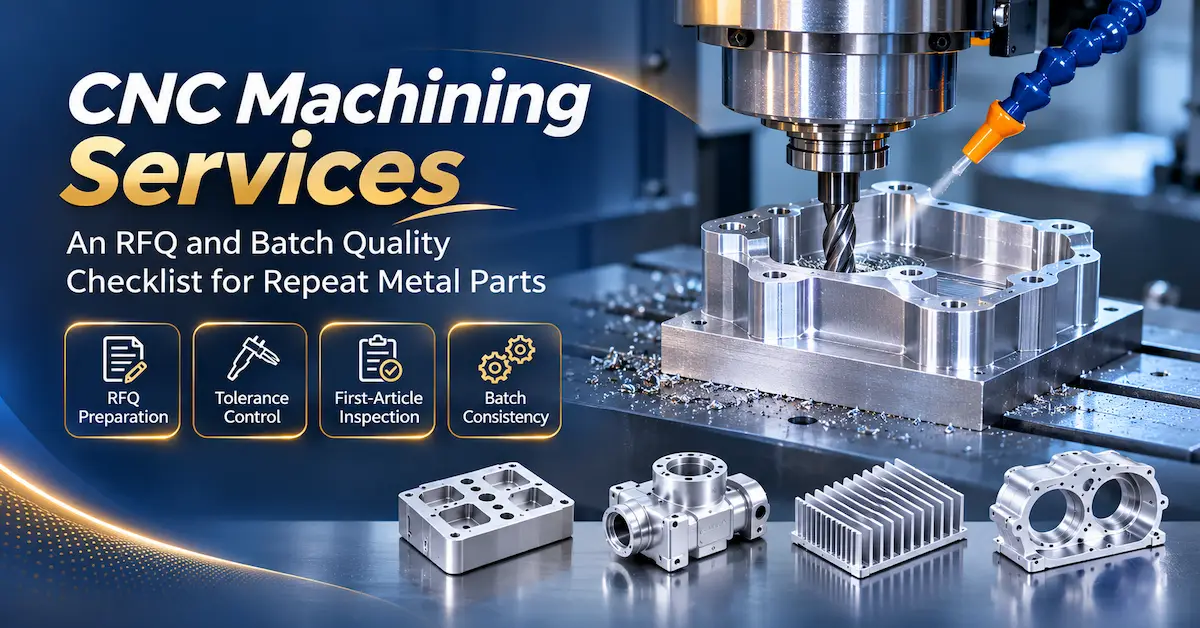
Key Engineering Takeaways
-
A complete drawing-based RFQ reduces quotation differences and technical misunderstandings.
-
CNC machining tolerances must be linked to functional requirements rather than unnecessarily tight specifications.
-
First-article inspection confirms initial conformity but does not establish long-term production stability.
-
Fixture consistency, cutting-tool management, and process monitoring influence batch quality.
-
Supplier comparisons should use the total cost per accepted component.
-
High-volume repeat orders require realistic capacity and lead-time verification.
-
Persistent outsourced production problems may justify evaluating specialized CNC machining equipment.
1. What Do CNC Machining Services Include?
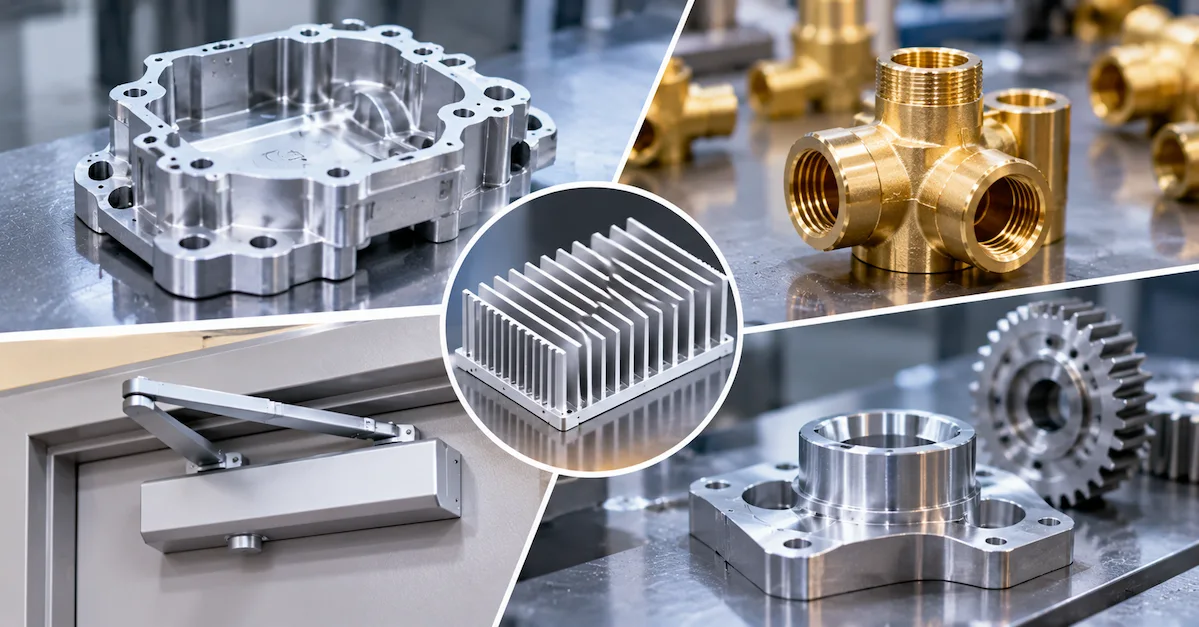
CNC machining services generally involve manufacturing customer-designed components using computer-controlled machine tools.
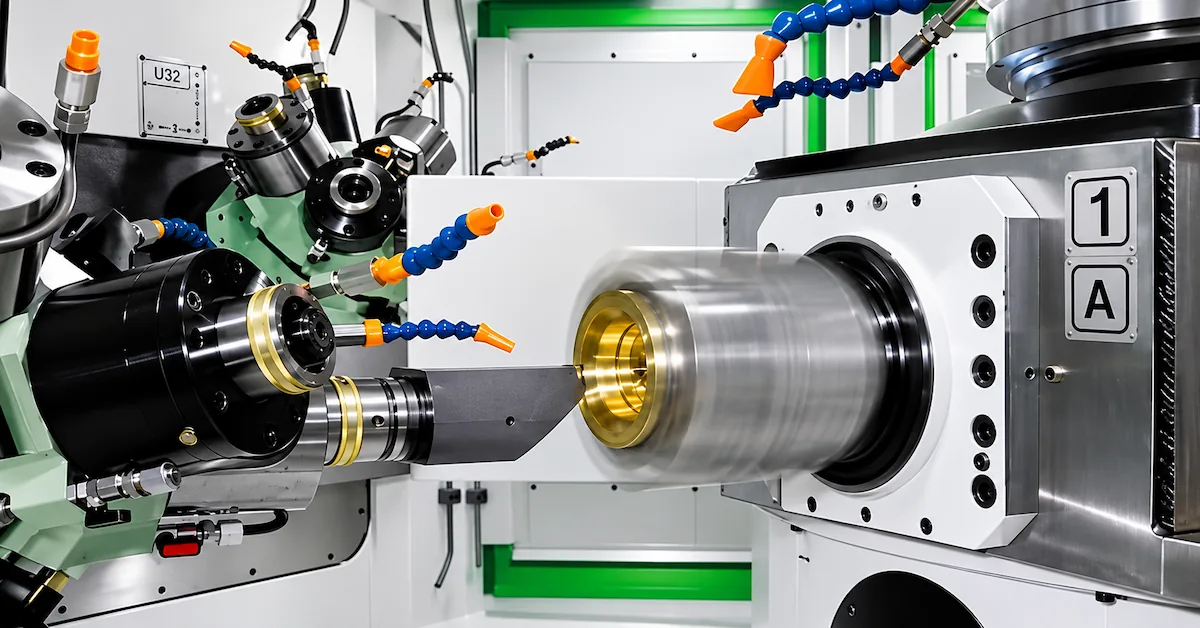
Depending on a supplier's equipment and capabilities, services may include CNC turning, milling, drilling, tapping, boring, and related manufacturing operations.
Common Machining Operations
| Process | Typical function | Industrial applications |
|---|---|---|
| CNC turning | External and internal rotational features | Valve fittings, shafts, cylindrical components |
| CNC milling | Flat surfaces, slots, pockets, contours | Metal housings, mounting surfaces |
| CNC drilling | Producing precision holes | Valve bodies, brackets, connectors |
| CNC tapping | Producing internal threads | Plumbing fittings, industrial hardware |
| CNC boring | Improving hole geometry | Bearing housings, precision bores |
| Deburring | Removing unwanted edges and burrs | Intersecting passages, assembled components |
A machining service provider may offer these operations individually or combine them into a production workflow.
However, equipment lists alone do not establish whether a supplier can meet the required tolerances, production volume, or inspection standards.
Which Buyers Benefit Most?
Outsourced CNC machining can be appropriate for companies developing prototypes, producing irregular batches, or lacking the equipment required for certain operations.
Manufacturers with repeat orders face additional questions:
-
Can the supplier reproduce the same dimensions across multiple batches?
-
Can capacity increase without affecting quality?
-
Are fixture and tooling arrangements controlled?
-
What happens when a drawing changes?
-
How quickly can production problems be corrected?
For repeat metal parts, these questions should influence supplier selection.
2. How to Prepare a CNC Machining Services RFQ
A technically complete RFQ is the foundation of accurate quotation and successful procurement.
Sending only a component photograph or approximate dimensions can result in incomplete pricing.
CNC Machining RFQ Checklist
| RFQ requirement | Information to provide | Why it matters |
|---|---|---|
| 2D engineering drawing | Dimensions, datums, tolerances | Establishes acceptance requirements |
| 3D model | STEP or another agreed format | Supports process planning |
| Material | Exact alloy, grade, condition | Affects cutting tools and machining parameters |
| Blank condition | Casting, forging, extrusion, bar stock | Influences stock allowance and fixturing |
| Critical features | Bores, threads, sealing faces | Identifies functional dimensions |
| Surface requirements | Roughness, finish, deburring | Defines finishing and inspection |
| Quantity | Prototype, first order, monthly demand | Affects pricing and production planning |
| Inspection | First article, sampling, specific reports | Determines quality-control scope |
| Post-processing | Cleaning, coating, surface treatment | Prevents omitted costs |
| Delivery | Destination, packaging, required schedule | Supports realistic quotation |
Why Must Critical Dimensions Be Identified?
Not every dimension on a component requires the same manufacturing control.
For example, a valve body might contain a critical sealing surface, precisely located connection holes, and nonfunctional exterior surfaces.
Applying unnecessarily tight tolerances to every feature can increase machining and inspection costs.
A better approach is to identify critical-to-quality (CTQ) characteristics according to the component's functional requirements.
These may include bore position, flatness, perpendicularity, thread geometry, or surface texture.
The drawing should establish the actual specifications. Suppliers should not independently relax functional tolerances to reduce cost.
3. How Do Materials and Part Geometry Affect CNC Machining Quotes?
Materials influence tooling, cutting conditions, chip management, and achievable production efficiency.
Common Materials in Industrial CNC Machining
| Material group | Typical applications | Main machining considerations |
|---|---|---|
| Brass and copper alloys | Faucets, valve bodies, fittings | Burr control, thread quality, surface protection |
| Aluminum alloys | Housings, brackets, lightweight parts | Clamping deformation and surface marks |
| Carbon steel | Industrial hardware, mechanical parts | Tool wear and cutting forces |
| Stainless steel | Corrosion-resistant components | Heat generation, tool selection, machining stability |
| Cast iron | Valve housings, mechanical bases | Abrasive wear, chip and dust management |
Machinability varies significantly within each material group.
A quotation should therefore identify the actual material grade rather than use generic descriptions such as "metal" or "steel."
Why Are Cast and Forged Blanks Important?
Many industrial components begin as castings or forgings.
Their initial geometry may vary because of manufacturing tolerances, draft angles, surface irregularities, or stock allowance.
A machining supplier must plan how the blank will be located and clamped while preserving enough material for the required finished dimensions.
For repeat production, inconsistent blank positioning can create dimensional variation even when CNC machine positioning remains stable.
This makes fixture design and datum selection important supplier evaluation criteria.
4. What Should Buyers Check in CNC Fixture and Tooling Plans?
Fixtures locate, support, and clamp components during machining.
They directly influence repeatability and the relationship between finished features.
Common Workholding Risks
Poor fixture design may lead to:
-
Inconsistent hole positions.
-
Excessive workpiece deformation.
-
Chatter and poor surface finish.
-
Repeated setup adjustments.
-
Increased scrap during shift changes.
-
Longer loading and unloading times.
For example, a valve housing requiring holes on several faces may need multiple setups or a specially designed fixture.
Each repositioning creates additional opportunities for datum error.
Questions to Ask a Machining Supplier
Ask whether the supplier uses dedicated, modular, or general-purpose fixtures.
Also determine how locating surfaces are checked, how clamping forces are controlled, and how workpiece variation is accommodated.
For higher-volume programs, request evidence that fixtures can repeatedly locate representative blanks without deformation or interference.
XINMEI's CNC Fixtures and Workholding Guide explains the relationship between workholding, machining accuracy, and batch consistency.
Although the guide focuses on manufacturing equipment, these principles are equally useful when evaluating an external machining process.
5. How to Compare CNC Machining Service Quotations
A low quoted unit price does not always mean a low total manufacturing cost.
Different suppliers may include different items in their quotations.
CNC Machining Quote Comparison
| Cost element | Supplier A | Supplier B | Buyer verification |
|---|---|---|---|
| Raw material | Included | Separate | Same grade and blank condition? |
| Machining | Included | Included | Same operations and tolerances? |
| Dedicated fixture | One-time charge | Amortized | Who owns and maintains it? |
| First-article inspection | Extra | Included | Same report scope? |
| Routine inspection | Sampling only | Defined plan | Same acceptance requirements? |
| Deburring and cleaning | Not specified | Included | Agreed cleanliness and edge quality? |
| Packaging | Standard | Protective packaging | Suitable for finished surfaces? |
| Freight | Excluded | Excluded | Same delivery terms? |
Illustrative Quotation Calculation
Assume an annual requirement of 5,000 accepted components.
| Cost item | Supplier A | Supplier B |
|---|---|---|
| Machining price per part | $12.80 | $14.20 |
| One-time tooling charge | $3,000 | $0 |
| Additional inspection per part | $0.60 | Included |
| First-year cost for 5,000 accepted parts | $70,000 | $71,000 |
| First-year cost per accepted part | $14.00 | $14.20 |
These figures are hypothetical and exclude freight, financing, and additional quality-related costs.
Supplier A appears cheaper by $1.40 per part based on machining price alone, but the first-year difference narrows to $0.20 per part after the stated charges.
If suppliers have different rejection rates, those differences must also be accounted for using consistent definitions of accepted quantity and who bears rework or replacement costs.
The comparison illustrates why procurement teams should normalize quotations before selecting a supplier.
6. How to Verify First-Article Inspection and Batch Quality
First-article inspection provides evidence that an initial production setup can produce components meeting specified requirements.
It should be based on an agreed inspection plan and the applicable engineering drawing.
Recommended First-Article Review
For repeat metal components, evaluate:
-
Critical dimensions and datum relationships.
-
Thread specifications and inspection methods.
-
Surface texture and visual requirements.
-
Burrs around intersecting features.
-
Material identification, where required.
-
Inspection equipment and measurement methods.
-
Actual measurement results.
-
Identification of any deviations or concessions.
The number of parts inspected and the report format should be agreed according to project requirements.
Does One Good Sample Prove Production Capability?
No.
A successful first article confirms the result under the tested conditions. It does not establish that the supplier can maintain quality over thousands of components.
Batch stability depends on fixture repeatability, tool wear, machine condition, temperature, operators, and inspection practices.
SPC and Process Capability
Statistical process control (SPC) helps manufacturers monitor variation over time.
Where appropriate, process capability indices such as Cp and Cpk can help assess whether a stable machining process is capable of meeting specified dimensional limits.
However, these indices should not be interpreted without evaluating process stability, measurement quality, sample size, and distribution assumptions.
The NIST Engineering Statistics Handbook provides authoritative guidance on statistical process monitoring and capability assessment.
For recurring high-volume components, request relevant inspection trends or process-control evidence rather than relying only on a supplier's stated precision.
7. How to Evaluate a CNC Machining Supplier's Quality System
Supplier certification may provide useful evidence of organizational quality management, but it should not replace actual part inspection.
ISO 9001 addresses quality management system requirements and process improvement.
As of November 2026, ISO 9001:2026 is the current published edition, with transition arrangements for existing certificates issued against the previous edition.
The official ISO 9001:2026 guidance explains the standard's purpose and current revision.
Quality Verification Checklist
| Evaluation item | Recommended evidence |
|---|---|
| Company identification | Legal manufacturer and production location |
| Quality system | Relevant certification, if claimed |
| Machine capability | Available process and equipment information |
| Inspection capability | Measurement methods and equipment |
| Document control | Current drawing revision and production instructions |
| Nonconforming products | Defined segregation and disposition procedures |
| Corrective action | Root-cause and prevention records |
| Traceability | Batch and material identification where required |
| Production stability | Inspection trends and agreed capability evidence |
A quality-management certificate does not guarantee that every manufactured part conforms to its drawing.
Buyers still need appropriate acceptance requirements and inspection records.
8. What Causes CNC Machining Quality Problems in Repeat Orders?
Production problems often develop after sample approval.
Tool wear, fixture movement, material variation, and process adjustments can change results over time.
Common Machining Problems and Corrective Directions
| Problem | Possible cause | Recommended investigation |
|---|---|---|
| Hole position variation | Inconsistent locating | Fixture datums and clamping |
| Thread defects | Tool wear or incorrect cutting conditions | Tapping parameters and tool life |
| Poor sealing surface | Tool deflection or vibration | Rigidity and finishing strategy |
| Batch-to-batch variation | Setup differences | Setup control and inspection records |
| Excessive burrs | Cutting conditions and tool wear | Tooling and deburring process |
| Long production delays | Capacity or scheduling constraints | Available machine hours and bottlenecks |
| Unexpected scrap | Unstable process or inadequate inspection | SPC, root-cause analysis |
What Should Buyers Do When Defects Repeat?
Repeated failures should trigger a structured investigation.
Review the relevant workpiece drawing, fixture design, tool condition, machining parameters, material condition, and measurement method.
For parts requiring several drilling and tapping operations, the machine configuration may also affect consistency.
A specialized multi-spindle system may help improve process integration when the workpiece geometry and production volume justify it.
For example, XINMEI's CNC Horizontal Lifting Six-Spindle Drilling and Tapping Machine is designed for multi-spindle drilling and tapping applications in batch production.
This is a machine-equipment option, not a contract machining service.
9. How to Verify Machining Capacity and Delivery Reliability
CNC machining services should be evaluated for sustained production capability, not only initial sample turnaround.
A supplier may have enough capacity to deliver 50 prototypes but struggle with recurring monthly orders.
Capacity Questions for Repeat Production
-
How many machines are suitable for the specified part?
-
What is the realistic complete cycle time?
-
How are tooling and fixture changeovers handled?
-
What production hours are allocated to the project?
-
Which operations form the main bottleneck?
-
How are inspection and rework capacity planned?
-
What happens if monthly demand increases?
-
Is the delivery commitment based on accepted components or total production?
Why Does Full Cycle Time Matter?
Machining time is only part of the production cycle.
Loading, clamping, tool changes, unloading, and inspection may affect output.
For a production program, the supplier should explain how the proposed equipment and process support the requested quantity under realistic operating conditions.
Avoid accepting capacity figures based solely on theoretical cutting speed.
For manufacturers producing repeat metal components, XINMEI's CNC Vertical Transform Type Multi-Spindle Combined Machine Tool is an equipment option worth evaluating when several machining operations must be coordinated. Buyers should compare the complete production cycle, fixture requirements, and achievable output under representative operating conditions.
10. When Do Outsourced CNC Machining Problems Indicate a Need for Better Equipment?
Outsourcing is often appropriate when demand is uncertain or production volumes are limited.
However, some recurring problems indicate that the manufacturing process may need more suitable machinery, fixtures, or automation.
Production Improvement Triggers
| Production problem | Possible equipment direction |
|---|---|
| Repeated drilling and tapping across many parts | Multi-spindle drilling and tapping equipment |
| Complex parts with several machining directions | Suitable multi-axis or horizontal machining center |
| Repetitive fixed-sequence operations | Special-purpose CNC machine |
| Excessive manual loading and unloading | CNC robotic loading system |
| High-volume production with repeated setups | Multi-station integrated machining |
| Frequent product variations | Flexible CNC machining center |
This is not a universal recommendation to replace outsourcing.
The decision should consider stable demand, total manufacturing cost, engineering resources, available factory infrastructure, and long-term production requirements.
For manufacturers machining complex metal components with multiple accessible faces, XINMEI's Flexible High-Speed Horizontal Machining Center provides a relevant equipment option for evaluation. The final machine configuration should be selected according to workpiece geometry, machining operations, tolerances, and production requirements.
How XINMEI Fits Into This Decision
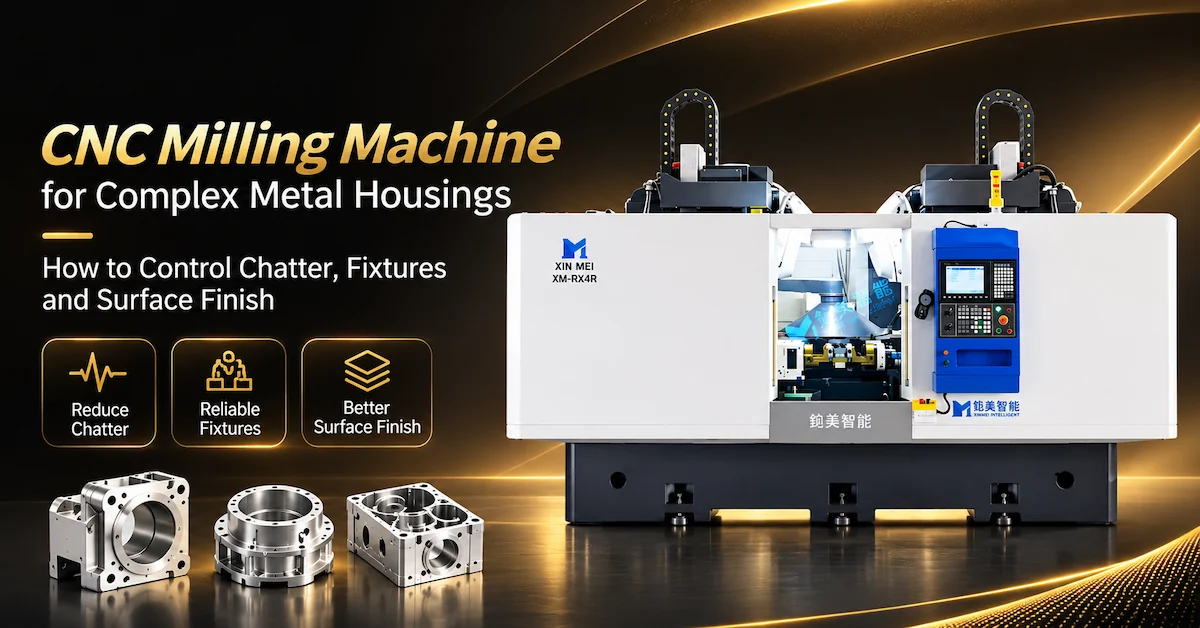
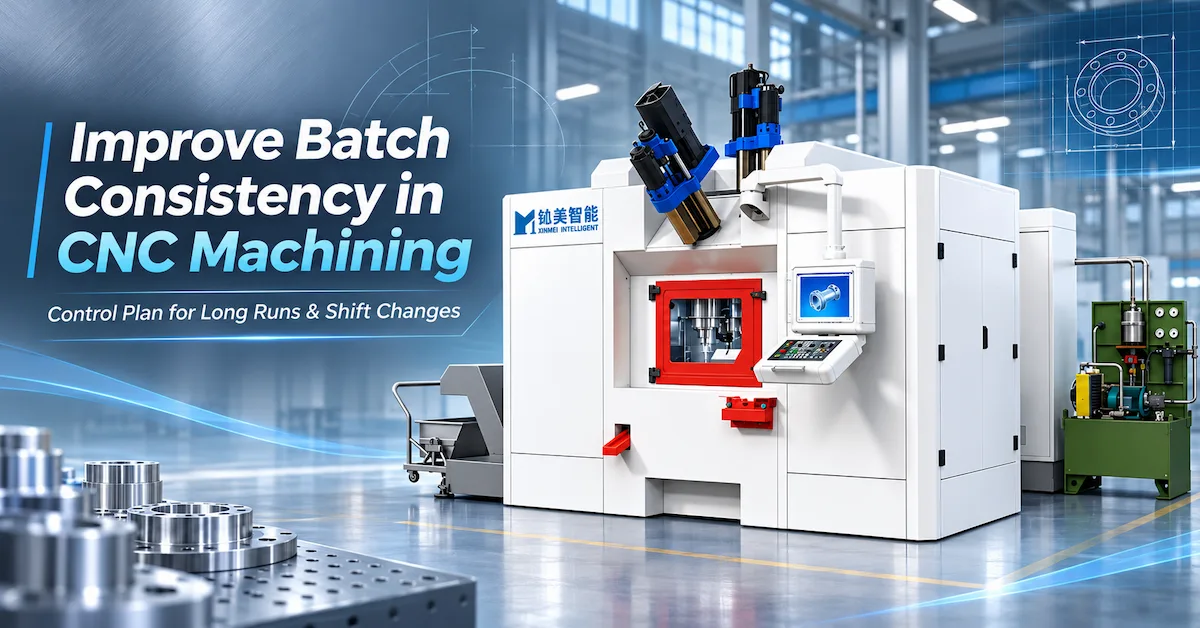
XINMEI Intelligent manufactures CNC equipment for industrial metal-component production.
Its capabilities cover machining centers, multi-spindle drilling and tapping machines, special-purpose equipment, and industrial automation systems.
For stable, high-volume production programs involving repeated machining operations, XINMEI's Horizontal 5-Station Rotary Turning Machine Center is another equipment option to consider. Buyers should assess station utilization, fixture requirements, workpiece compatibility, and overall production efficiency before selecting a multi-station solution.
Manufacturers dealing with persistent outsourcing bottlenecks can evaluate XINMEI CNC Machining Centers or Special Purpose Machines.
For stable repeat production, a dedicated machine configuration may help simplify operations and improve process control.
The actual suitability and performance must be evaluated using component drawings, machining requirements, and representative trials.
11. How to Prepare a CNC Equipment Review for Repeat Metal Parts
If a factory is considering expanding internal machining capacity, the equipment RFQ should build on the information already collected during CNC machining service sourcing.
CNC Equipment Evaluation Requirements
| Requirement | Information for the equipment manufacturer |
|---|---|
| Workpiece | 2D drawings and 3D models |
| Material | Alloy, grade and blank condition |
| Required operations | Turning, drilling, tapping, milling, boring |
| Critical dimensions | Tolerances, datums and surface requirements |
| Production volume | Monthly and annual demand |
| Current production problems | Scrap, rework, lead-time or capacity issues |
| Target cycle time | Required output based on complete operations |
| Workholding | Current fixture issues or desired changeovers |
| Inspection | Critical features and acceptance methods |
| Automation | Loading, unloading and integration needs |
| Acceptance testing | Workpiece trials and agreed performance criteria |
A machine supplier should use these details to assess equipment configuration, machining sequence, fixture requirements, and achievable production performance.
Request an Engineering Review from XINMEI
XINMEI supports CNC machine and production-system selection for industrial metal parts, including valve components, door-control hardware, and other applicable manufacturing applications.
For a meaningful technical discussion, provide the component drawing, material, monthly demand, required operations, and the bottlenecks affecting your current process.
For factories seeking to reduce repetitive manual handling and improve production coordination, XINMEI's CNC + Robot Integrated Automation Lines offer a relevant automation solution to evaluate. Buyers should provide their existing machine configuration, loading requirements, production targets, and integration constraints when requesting an engineering assessment.
Need to improve repeat-production machining capacity?
Contact XINMEI for CNC Equipment Selection and Production Planning
Frequently Asked Questions About CNC Machining Services
1. What are CNC machining services?
CNC machining services involve producing customer-designed components using computer-controlled manufacturing equipment. Common operations include turning, milling, drilling, tapping, and boring. The exact capabilities depend on the service provider.
2. How do I get an accurate CNC machining quote?
Provide complete drawings, 3D models, material specifications, tolerances, required quantities, surface requirements, inspection expectations, and delivery information. Ask the supplier to identify any assumptions or excluded costs.
3. What determines CNC machining service prices?
Important factors include material, component complexity, machining time, batch quantity, tooling, fixtures, inspection, post-processing, scrap, and logistics. Prices should be compared on a consistent scope.
4. How can I verify CNC machining quality?
Use drawing-based first-article inspection, applicable dimensional measurement records, agreed acceptance criteria, and production-quality monitoring. For repeat orders, review batch trends rather than relying on one successful sample.
5. What tolerances can CNC machining services achieve?
Achievable tolerances depend on machine capability, material, geometry, tooling, fixtures, process conditions, and inspection methods. Buyers should specify functional requirements and request evidence for critical dimensions.
6. Is ISO 9001 certification necessary for a CNC machining supplier?
ISO 9001 certification is not universally required, although some customers make it a contractual condition. It provides evidence about a quality management system, not guaranteed conformity of every part.
7. What is first-article inspection in CNC machining?
First-article inspection verifies specified characteristics on initial production components using agreed measurement methods. It supports production approval but does not independently prove sustained batch capability.
8. How can suppliers reduce CNC machining defects?
They can improve fixture consistency, tool-life management, material control, cutting conditions, inspection planning, and corrective action procedures. The appropriate measures depend on the actual defect mechanism.
9. When should manufacturers consider dedicated CNC equipment?
Dedicated equipment may be worth evaluating when component demand is stable, repeated operations dominate production, and current machining arrangements create quality, labor, or capacity bottlenecks. The decision requires an application-specific cost and engineering assessment.
10. Does XINMEI provide contract CNC machining services?
XINMEI's published business focuses on manufacturing CNC machine tools, special-purpose equipment, and industrial automation solutions rather than selling outsourced finished-part machining services. Manufacturers seeking equipment for their own machining operations can contact XINMEI with drawings and production requirements.
Technical References and Further Reading
-
NIST/SEMATECH Engineering Statistics Handbook: Process stability, statistical process control, and capability assessment.
-
ISO 9001:2026: Quality management systems and organizational process requirements.
-
XINMEI CNC Fixtures and Workholding: Workpiece location, clamping, and machining consistency.
-
XINMEI CNC Machining Centers: Equipment configurations for industrial metal components.
These sources support the technical evaluation framework. Actual supplier capability, quoted costs, part tolerances, and equipment performance must be verified for each project.
Conclusion
Selecting reliable CNC machining services requires much more than comparing machining quotations.
For repeat metal parts, procurement teams should develop complete RFQs, identify critical functional dimensions, assess fixtures and tooling, verify first-article inspection, and review evidence of batch stability.
Supplier quality systems, production planning, and transparent cost breakdowns help reduce uncertainty, but they do not replace drawing-based inspection and practical process verification.
When recurring production problems involve unstable setup conditions, inefficient machining sequences, or insufficient capacity, manufacturers may also benefit from evaluating more suitable CNC equipment.
XINMEI Intelligent manufactures CNC machining centers, special-purpose machines, and automation systems for industrial metal-component production.
For factories planning to strengthen internal production or expand repeat-part manufacturing, contact XINMEI with your workpiece drawings, machining requirements, and production targets to discuss an appropriate CNC equipment solution.