+86 13163919000
 info@xinmeiintelligent.com


TL;DR: Choosing the right CNC machine for metal parts depends on workpiece geometry, machining operations, production volume, and setup requirements. Flexible machining centers are often suitable for changing product designs, multi-spindle machines can improve compatible repetitive operations, and multi-station systems may offer advantages for stable high-volume production. However, more spindles or stations do not automatically guarantee lower costs or better machining accuracy.
For automotive component manufacturers, valve producers, door-control hardware factories, and industrial equipment suppliers, machine selection should start with the actual component drawing rather than advertised spindle speed.
This engineering guide compares three production approaches, explains their technical limitations, and provides practical methods for evaluating machining efficiency, accuracy, manufacturing cost, and equipment acceptance.
Explore XINMEI CNC Machining Centers | Request a CNC Machine Recommendation
Key Engineering Takeaways
-
Workpiece geometry determines machine suitability. Hole directions, machining faces, datum relationships, and critical tolerances influence equipment selection.
-
Single-setup machining can reduce handling. Fewer repositioning operations may improve efficiency, provided fixture rigidity and tool access remain adequate.
-
Multi-spindle systems benefit compatible operations. Multiple spindles offer advantages when machining tasks can be performed concurrently or efficiently coordinated.
-
Multi-station equipment supports repeated production. Indexed stations can distribute operations across a manufacturing cycle but may require greater setup investment.
-
Batch size changes the economic decision. A flexible machine may be faster overall for small batches, while dedicated equipment can become attractive at higher volumes.
-
Machine precision is not finished-part precision. Fixtures, cutting tools, materials, temperature, and process control affect actual component quality.
-
Production testing is essential. Buyers should validate machining results, complete cycle times, and accepted output before purchasing.
1. What Is a CNC Machine for Multi-Operation Metal Parts?
A CNC machine is a computer-controlled manufacturing machine that performs programmed operations such as drilling, tapping, milling, boring, and turning.
In multi-operation metal manufacturing, a component requires more than one machining process before it can meet its final specifications.
For example, a valve body may require:
-
Milling a reference surface.
-
Drilling the main passage.
-
Boring a precision internal diameter.
-
Tapping connection threads.
-
Cross-drilling a side passage.
-
Chamfering and deburring critical edges.
The challenge is determining how these operations should be distributed across the machine, tooling, and workholding system.
What Determines the Correct Machine Configuration?
Five factors are particularly important:
-
Geometry: Number and orientation of features requiring machining.
-
Tolerance: Dimensional and geometric requirements.
-
Material: Alloy, blank condition, and cutting characteristics.
-
Production volume: Batch size and repeated demand.
-
Flexibility: Frequency of product and process changes.
A highly specialized machine may be efficient for one standardized component but less practical for frequently changing products.
A flexible machining center offers broader process adaptability but may not achieve the shortest cycle for every repeated operation.
Engineering principle: The best CNC equipment is the configuration that meets the drawing requirements with acceptable production time, cost, and process stability.
2. How Do Single-Setup, Multi-Spindle, and Multi-Station Machining Work?
These three approaches describe different aspects of a manufacturing system.
They are not mutually exclusive. A machine may use several spindles, multiple stations, and a fixture arrangement designed to minimize reclamping.
Single-Setup Machining
Single-setup machining means completing multiple operations while maintaining the workpiece in one established clamping arrangement.
This can reduce repeated handling and datum establishment.
However, the machine must provide access to all necessary features.
Multi-Spindle Machining
A multi-spindle CNC machine uses multiple machining spindles.
Depending on the machine design, the spindles may operate simultaneously or follow coordinated sequences.
This configuration may reduce processing time for compatible holes, threads, and other repeated operations.
Multi-Station Machining
A multi-station machine distributes machining tasks across different workstations.
In a rotary indexed system, workpieces move between stations while individual operations are performed.
Once the system reaches steady-state production, completed parts may be released at intervals determined by the station arrangement and bottleneck.
Quick Reference: CNC Machine Comparison
| Engineering factor | Flexible single-setup machining | Multi-spindle machining | Indexed multi-station machining |
|---|---|---|---|
| Main objective | Reduce repositioning while retaining flexibility | Coordinate multiple machining spindles | Distribute operations across stations |
| Product flexibility | Usually higher | Configuration-dependent | Often lower for dedicated systems |
| Best production type | Mixed or moderate batches | Repeated compatible operations | Stable high-volume components |
| Workholding | Usually one primary fixture per setup | Fixture must support spindle access | Station-specific or indexed fixtures |
| Main advantage | Flexible operations and fewer setups | Potential reduction in processing time | Potential high steady-state throughput |
| Main limitation | Tool access and cycle time | Spindle compatibility | Setup complexity and station balance |
| Key purchasing risk | Poor fixture accessibility | Unused spindle capacity | Underutilization or long changeovers |
The correct selection depends on the actual manufacturing requirements, not the general ranking of machine types.
3. How Does Workpiece Geometry Determine CNC Machine Selection?
Workpiece geometry directly influences tool access, fixture positioning, machining sequence, and suitable machine architecture.
Consider the Machining Directions
A component with features primarily accessible from one direction may be suitable for a vertical machining configuration.
A component with several side-facing bores may require repositioning, horizontal spindle access, or a different fixture arrangement.
For complex components, engineers should map each machining feature to its required tool approach direction.
Example: Valve Housing Machining Requirements
| Workpiece feature | Operation | Selection consideration |
|---|---|---|
| Primary bore | Drilling and boring | Spindle access and bore alignment |
| Threaded port | Drilling and tapping | Thread geometry and tool selection |
| Side passage | Cross-drilling | Additional machining direction |
| Mounting face | Milling | Datum relationship |
| Internal intersection | Deburring | Tool access and chip removal |
| External edges | Chamfering | Final finishing requirement |
Why Are Datums Important?
Machining datums establish the reference system used to locate and inspect features.
If critical holes are machined from unrelated positioning references, dimensional variation may increase.
A suitable fixture should reflect the drawing's functional datum requirements where practical.
XINMEI's CNC Fixtures and Workholding Guide explains how locating and clamping conditions influence machining performance.
Important: Completing more operations without reclamping is beneficial only if the fixture provides adequate rigidity and access to the required features.
4. How Does the CNC Machining Process Work Step by Step?
A reliable CNC production process connects workpiece preparation, programming, fixture design, cutting operations, and verification.
Step 1: Analyze the Component Drawing
Identify the material, geometric features, tolerances, surface requirements, and production quantity.
Separate critical-to-function dimensions from less demanding features.
Step 2: Establish the Machining Sequence
Determine which operations should be completed first and which can share the same setup.
The sequence must preserve appropriate reference surfaces and tool accessibility.
Step 3: Design the Workholding System
Select locating points, support positions, and clamping methods that maintain workpiece stability.
For thin-walled parts, consider the possibility of deformation caused by excessive clamping force.
Step 4: Select Cutting Tools and Spindles
Choose suitable drills, taps, boring tools, milling cutters, and holders.
The spindle configuration must support the required machining directions and cutting conditions.
Step 5: Develop and Verify CNC Programs
Create the toolpaths, machining coordinates, operation sequences, and relevant machine functions.
Verify the program and machining setup before production release.
Step 6: Conduct Initial Machining Trials
Machine representative components and inspect the features specified in the drawing.
Review any problems involving tool interference, vibration, chip removal, or fixture stability.
Step 7: Validate Production Performance
Measure complete machining cycles, setup requirements, workpiece quality, and accepted production output.
A short demonstration cycle is not sufficient evidence of stable mass production.
For further technical information, see XINMEI's CNC Machining Efficiency and Process Planning Guide.
5. When Is a Multi-Spindle CNC Machine Better Than a Conventional Machining Center?
Multi-spindle machines are particularly worth considering when the required operations can be performed through compatible spindle arrangements.
Suitable Multi-Spindle Applications
Examples may include:
-
Repeated drilling operations.
-
Multiple threaded connections.
-
Compatible hole patterns.
-
Standardized automotive components.
-
Valve and industrial hardware machining.
-
Large production batches with stable designs.
Why Can Multi-Spindle Machining Be Faster?
When operations can be performed concurrently, the processing time may be lower than completing every operation sequentially.
However, simultaneous cutting requires suitable tool spacing, fixture support, spindle access, and machine capacity.
If the spindles cannot process compatible features efficiently, the expected advantage may be limited.
Relevant XINMEI Equipment
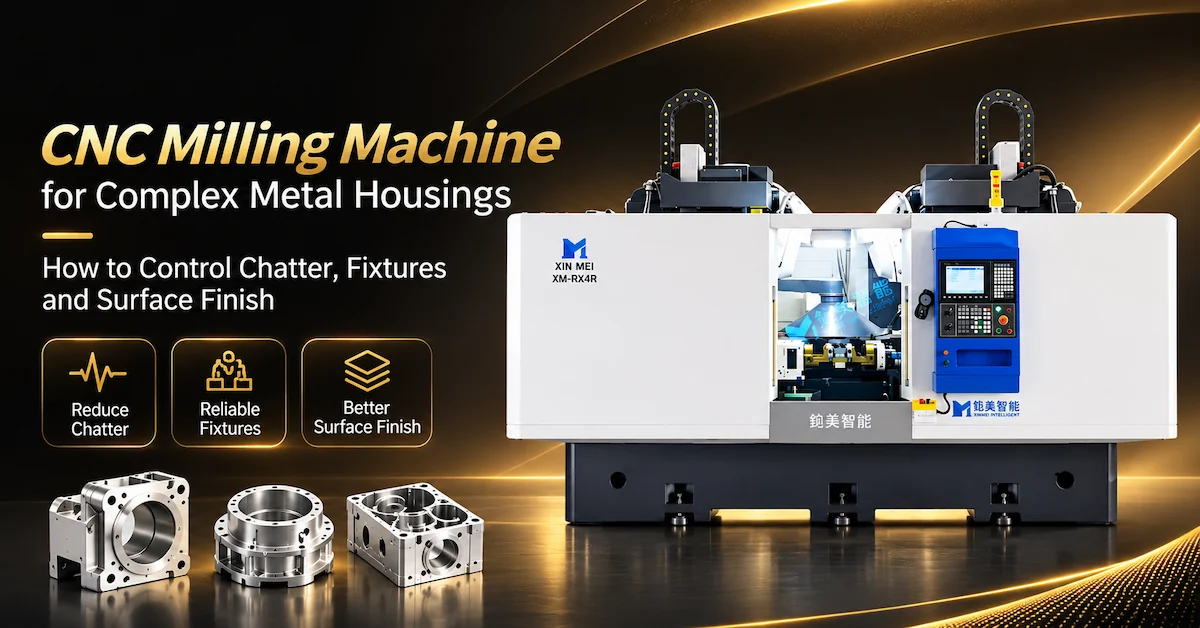
XINMEI's CNC Horizontal Lifting Six Spindle Drilling and Tapping Machine Tool is a relevant example of industrial multi-spindle drilling and tapping equipment.
Manufacturers should evaluate its configuration against the component drawings and target production process.
A six-spindle machine should not be assumed to machine six finished parts simultaneously. Actual output depends on the number of workpieces processed, spindle functions, operation sequence, and machine configuration.
When Is Multi-Spindle Equipment Less Suitable?
Potential limitations include frequently changing products, incompatible machining directions, long setup times, and insufficient production demand.
The investment should be justified through representative cycle-time and cost comparisons.
6. When Should Manufacturers Choose Multi-Station CNC Machines?
A multi-station machining system may be attractive when manufacturing repeated components through a stable process.
How Does Indexed Production Work?
In an indexed system, different operations are assigned to separate stations.
A simplified sequence might include:
-
Station A: Initial drilling.
-
Station B: Precision boring.
-
Station C: Thread machining.
-
Station D: Secondary milling.
-
Station E: Final machining or release.
The system indexes workpieces through the required operations.
Once processing reaches steady state, several workpieces may occupy different stations simultaneously.
Main Technical Advantages
-
Distribution of operations across stations.
-
Reduced transfer between unrelated machines.
-
Potentially higher steady-state throughput.
-
Repeatable machining sequences.
-
Opportunities for integrated workpiece handling.
Important Engineering Limitations
A multi-station system may be constrained by its slowest station, indexing time, fixture access, and product changeover requirements.
Adding more stations does not guarantee higher output if material handling or a particular machining operation remains the bottleneck.
XINMEI's CNC Vertical Transform Type Multi Spindle Combined Machine Tool is a relevant product for evaluating integrated multi-spindle machining.
The company also offers a Horizontal 5 Station Rotary Turning Machine Center within its special-purpose equipment range.
Specific station functions, tooling compatibility, and cycle times must be confirmed for each application.
7. How Do Batch Size and Cycle Time Affect the Best CNC Machine Choice?
A dedicated machine may have a shorter steady-state processing interval but require a longer changeover.
For this reason, the best equipment for mass production may not be the best equipment for small batches.
Illustrative Engineering Comparison
Consider a manufacturer evaluating three possible machining configurations.
The following values are hypothetical and are not actual XINMEI equipment performance data.
| Parameter | Flexible CNC | Multi-spindle CNC | Multi-station CNC |
|---|---|---|---|
| Complete cycle or release interval | 145 sec | 110 sec | 75 sec |
| Changeover time | 15 min | 45 min | 120 min |
| Production flexibility | Higher | Medium | Lower |
A simplified estimation formula is:
Batch time = Changeover time + (Batch quantity × Cycle or release interval)
For indexed systems, this formula is only a preliminary estimate and does not capture startup filling, final clearing, machine interruptions, or other line-level losses.
Comparison A: 20 Components
| Configuration | Estimated batch time |
|---|---|
| Flexible CNC | 63.3 minutes |
| Multi-spindle CNC | 81.7 minutes |
| Multi-station CNC | 145.0 minutes |
Under these assumptions, the flexible machine has the shortest estimated batch time.
Comparison B: 500 Components
| Configuration | Estimated batch time |
|---|---|
| Flexible CNC | 1,223.3 minutes |
| Multi-spindle CNC | 961.7 minutes |
| Multi-station CNC | 745.0 minutes |
At higher production volume, the dedicated multi-station system becomes more attractive under the same assumptions.
Where Is the Estimated Break-Even Point?
Comparing the flexible and multi-station configurations:
15 + (145 × Q ÷ 60) = 120 + (75 × Q ÷ 60)
Solving for batch quantity:
Q = 90 components
This is an illustrative timing crossover, not an equipment investment break-even calculation.
Actual economic break-even must also include equipment purchase, tooling, maintenance, labor, quality losses, and operating costs.
Engineering conclusion: Batch size can change which machine configuration is most efficient, even when the workpiece and machining operations remain the same.
8. Which CNC Machining Defects and Limitations Should Buyers Evaluate?
Machine selection should account for machining defects and production risks rather than focusing only on theoretical speed.
Common Engineering Problems
| Problem | Possible cause | What to verify |
|---|---|---|
| Hole position variation | Workholding or datum inconsistency | Fixture and locating method |
| Bore dimensional drift | Tool wear or thermal effects | Tool condition and process data |
| Poor surface finish | Tool vibration or cutting conditions | Rigidity, tooling, cutting parameters |
| Thread defects | Incorrect tool or tapping process | Thread requirements and tool setup |
| Excessive burrs | Tool condition and machining sequence | Deburring and chip management |
| Tool interference | Restricted access or poor setup | Toolpath and collision clearance |
| Long changeovers | Complex fixtures or tooling | Setup procedure and product mix |
| Low line output | Unbalanced stations | Complete production cycle |
Why Machine Rigidity Matters
Machine rigidity influences the relationship between cutting forces, vibration, and the actual tool-workpiece interaction.
However, increasing rigidity alone cannot correct every machining problem.
Tool overhang, fixture stability, material variation, and machining parameters may also affect the result.
Why More Axes or Spindles Are Not Always Better
Additional machine functions can increase capability but also introduce cost and configuration complexity.
Buyers should only pay for functions that provide practical value for their workpieces and production requirements.
9. How Do Machine Accuracy Standards Apply to CNC Equipment Acceptance?
Machine accuracy should be assessed separately from the final dimensional quality of machined components.
ISO 230-2:2014 and CNC Positioning Performance
ISO 230-2:2014, Test code for machine tools — Part 2: Determination of accuracy and repeatability of positioning of numerically controlled axes, provides methods for testing linear and rotary machine axes.
These methods can support acceptance testing and verification of machine positioning performance.
However, passing an axis-positioning test does not guarantee that every finished part will meet all drawing requirements.
What Should Buyers Validate?
| Acceptance area | Recommended verification |
|---|---|
| Machine configuration | Agreed spindle, axes, control and tooling |
| Positioning performance | Applicable axis accuracy tests |
| Fixture performance | Reliable workpiece location |
| Finished-part dimensions | Drawing-based measurements |
| Surface condition | Specified appearance or texture |
| Machining cycle | Complete operation timing |
| Product repeatability | Repeated component tests |
| Production output | Accepted parts under agreed conditions |
| Documentation | Test records and operating information |
Why Are Actual Workpiece Trials Necessary?
The interaction between the machine, fixture, tool, and material determines the final result.
Buyers should require representative machining trials instead of relying solely on catalogue accuracy figures.
XINMEI publishes information about its equipment verification and inspection approach on its Quality Assurance page.
Project-specific accuracy, inspection results, and acceptance commitments should be agreed before purchase.
10. Engineering Application Example: Choosing a CNC Machine for a Valve Body
Consider a hypothetical manufacturer producing metal valve housings with several holes, threads, and internal passages.
This example illustrates an engineering selection method and does not represent an actual customer project or verified XINMEI production result.
Manufacturing Requirements
The component requires:
-
A main precision bore.
-
Two threaded connections.
-
A cross-drilled passage.
-
A reference mounting face.
-
Deburring of internal intersections.
Option A: Flexible Machining Center
This option may be appropriate if the manufacturer produces several valve-body models with frequent changes.
The main advantage is flexibility across workpieces and machining programs.
The key concern is whether the component requires several setups.
Option B: Multi-Spindle Machine
This option may be suitable if the hole and thread operations are compatible with the spindle arrangement.
The key benefit is the potential to process repeated features more efficiently.
The main concern is fixture accessibility and whether spindle utilization justifies the investment.
Option C: Multi-Station Equipment
This option may be attractive if the manufacturer produces one or a small number of stable valve-body designs at high volume.
Operations can potentially be assigned to different stations.
The main concerns are changeover time, station balancing, maintenance, and initial investment.
Engineering Decision Summary
| Production scenario | Recommended evaluation priority |
|---|---|
| Multiple changing valve designs | Flexible machining center |
| Standardized repeated hole patterns | Multi-spindle CNC machine |
| Stable high-volume valve components | Multi-station or special-purpose system |
| Frequent changeovers | Flexible fixtures and tooling |
| Repetitive manual handling bottleneck | CNC automation integration |
Main conclusion: The same type of workpiece can justify different equipment depending on production volume, model variation, and operational requirements.
11. How Can Buyers Calculate CNC Machine Manufacturing Costs?
Equipment purchase price is only one part of the investment.
A meaningful cost evaluation should include tooling, fixtures, labor, maintenance, setup, inspection, and production losses.
Total Cost Considerations
| Cost category | Evaluation focus |
|---|---|
| Equipment | Machine configuration and capital investment |
| Tooling | Cutting tools, holders and replacements |
| Fixtures | Custom workholding and maintenance |
| Labor | Setup, operation and supervision |
| Changeover | Time lost between batches |
| Maintenance | Preventive maintenance and spare parts |
| Quality | Scrap, inspection and rework |
| Automation | Robotic handling and system integration |
The most useful operating metric is often:
Cost per accepted component = Total relevant manufacturing cost ÷ Accepted component quantity
A high-speed machine may not provide the lowest unit cost if it has long setup times or produces unacceptable quality losses.
Likewise, an inexpensive machine may become more costly over time if it requires excessive handling or repeated machining operations.
12. How Does XINMEI Support CNC Machine Selection?
Fujian Xinmei Machinery Technology Co., Ltd. (XINMEI) manufactures CNC equipment and industrial automation solutions for metal-component production.
Its published product range includes machining centers, multi-spindle drilling and tapping equipment, rotary combined machines, and special-purpose systems.
Relevant Equipment Options
| XINMEI product | Potential application |
|---|---|
| Vertical CNC Drilling and Tapping Machine | Drilling and tapping of suitable metal components |
| Six-Spindle Drilling and Tapping Machine | Compatible repeated hole and thread machining |
| Vertical Multi-Spindle Combined Machine | Integrated multi-process machining |
| Horizontal 5 Station Rotary Turning Machine Center | Application-specific multi-station processing |
These products represent different machining configurations rather than interchangeable solutions.
For an equipment evaluation, buyers should supply workpiece drawings, material specifications, critical tolerances, production quantities, and target cycle times.
XINMEI can then review which available machine configurations may be suitable for the application.
CNC Equipment Request for Quotation Checklist
Provide:
-
Workpiece drawings or 3D models.
-
Material grade and blank condition.
-
Required machining operations.
-
Critical dimensions and inspection criteria.
-
Monthly and annual production volume.
-
Typical batch size and model changes.
-
Existing machining process and bottlenecks.
-
Target accepted output per shift.
-
Fixture and automation requirements.
-
Factory conditions and project schedule.
Specific equipment configurations, machining performance, and commercial terms must be confirmed during engineering evaluation.
Need help selecting a CNC machine for your metal components?
Contact XINMEI for a Customized Equipment Recommendation
Frequently Asked Questions About CNC Machines
1. Which CNC machine is best for multi-operation metal parts?
The best machine depends on component geometry, machining directions, batch size, tolerances, and product variation. Flexible machining centers, multi-spindle systems, and multi-station machines should be compared against the same manufacturing requirements.
2. What is the difference between single-setup and multi-spindle CNC machining?
Single-setup machining refers to completing operations without reclamping the workpiece. Multi-spindle machining refers to using multiple machining spindles. A machine can incorporate both approaches.
3. When should manufacturers choose a multi-station CNC machine?
A multi-station machine may be suitable when production volumes are high, component designs are stable, and machining operations can be efficiently distributed across stations.
4. Are multi-spindle CNC machines always faster?
No. Their advantage depends on whether multiple spindles can perform compatible operations efficiently. Fixture limitations, machine indexing, loading, and other process requirements can reduce the expected benefit.
5. Can one CNC machine perform drilling, tapping, milling and boring?
Many CNC machining centers and combined machines can support several of these operations. Actual capability depends on spindle orientation, tool configuration, travel, control functions, and workholding.
6. How does workpiece material affect CNC machine selection?
Material influences cutting tools, spindle requirements, machining parameters, chip removal, and wear behavior. The machine must be suitable for the specific material and required manufacturing process.
7. How do buyers compare CNC machine cycle times?
Compare complete machining cycles or steady-state part-release intervals using the same timing definitions. Include changeovers, handling, tool changes, and relevant production losses.
8. Does a higher-precision CNC machine guarantee accurate parts?
No. Machine accuracy is important, but finished-part accuracy also depends on fixtures, tools, materials, thermal behavior, process conditions, and measurement.
9. What should be included in CNC machine factory acceptance testing?
Acceptance testing should include the agreed machine configuration, applicable machine-axis checks, representative workpieces, critical dimensions, production cycles, and documented inspection results.
10. How can manufacturers request a CNC machine from XINMEI?
Manufacturers can submit their workpiece drawings, materials, machining requirements, target production volume, and factory constraints through the XINMEI Contact Us page for an application-specific equipment discussion.
Technical References and Further Reading
The following sources provide technical context for CNC equipment selection and manufacturing performance:
-
ISO 230-2:2014: Test code for machine tools — Determination of accuracy and repeatability of positioning of numerically controlled axes.
-
ISO 22400-2:2014: Automation systems and integration — Key performance indicators for manufacturing operations management.
-
XINMEI CNC Machining Centers: Published CNC drilling, tapping, and machining-center equipment range.
-
XINMEI Special Purpose Machines: Published dedicated and multi-operation machine configurations.
-
XINMEI Quality Assurance: Equipment inspection and verification information.
These references support general engineering principles. They do not establish universal machine performance guarantees or substitute for project-specific validation.
Conclusion
Choosing the right CNC machine for multi-operation metal components requires a detailed understanding of workpiece geometry, machining requirements, production volume, and manufacturing cost.
A flexible machining center can provide greater adaptability for changing parts. Multi-spindle equipment may offer advantages for compatible repeated operations, while multi-station systems can support efficient processing of stable, high-volume component families.
However, equipment complexity does not automatically guarantee better production results.
Manufacturers should compare complete machining cycles, fixture requirements, technical limitations, accepted output, and total manufacturing costs before purchasing.
Actual machine performance should be verified using representative components and agreed acceptance procedures.
XINMEI Intelligent provides CNC machining centers, multi-spindle equipment, special-purpose machines, and industrial automation solutions for metal-component manufacturing.
If your factory is planning new CNC equipment, expanding production capacity, or replacing an inefficient machining process, contact XINMEI with your workpiece drawings and production requirements to discuss a suitable CNC manufacturing solution.