+86 13163919000
 info@xinmeiintelligent.com

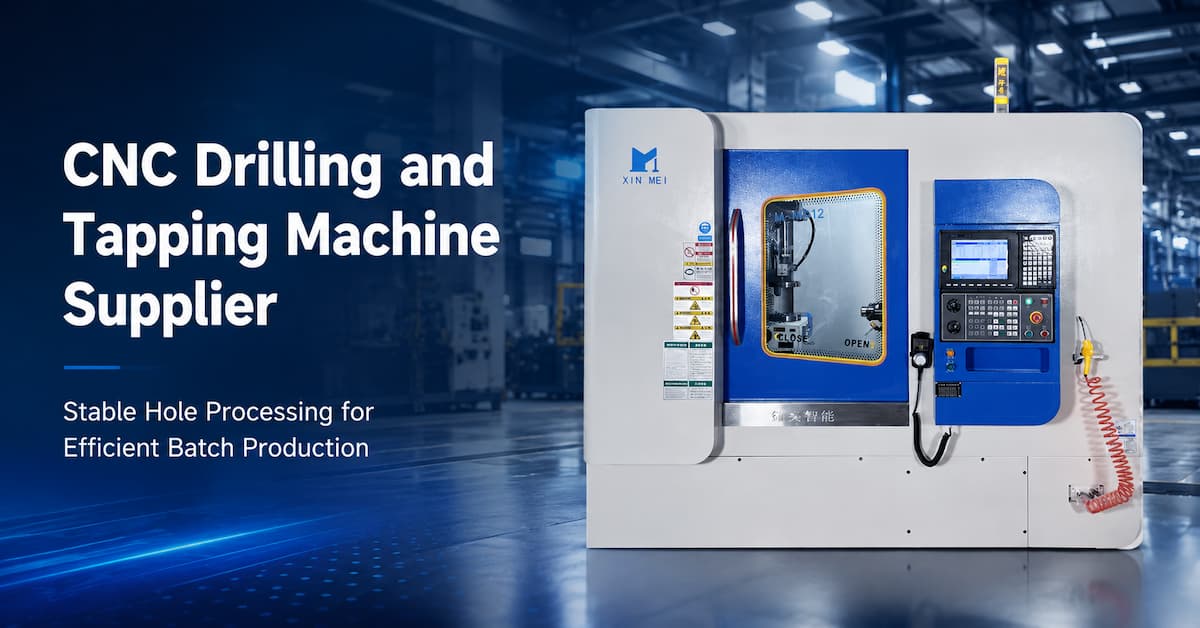
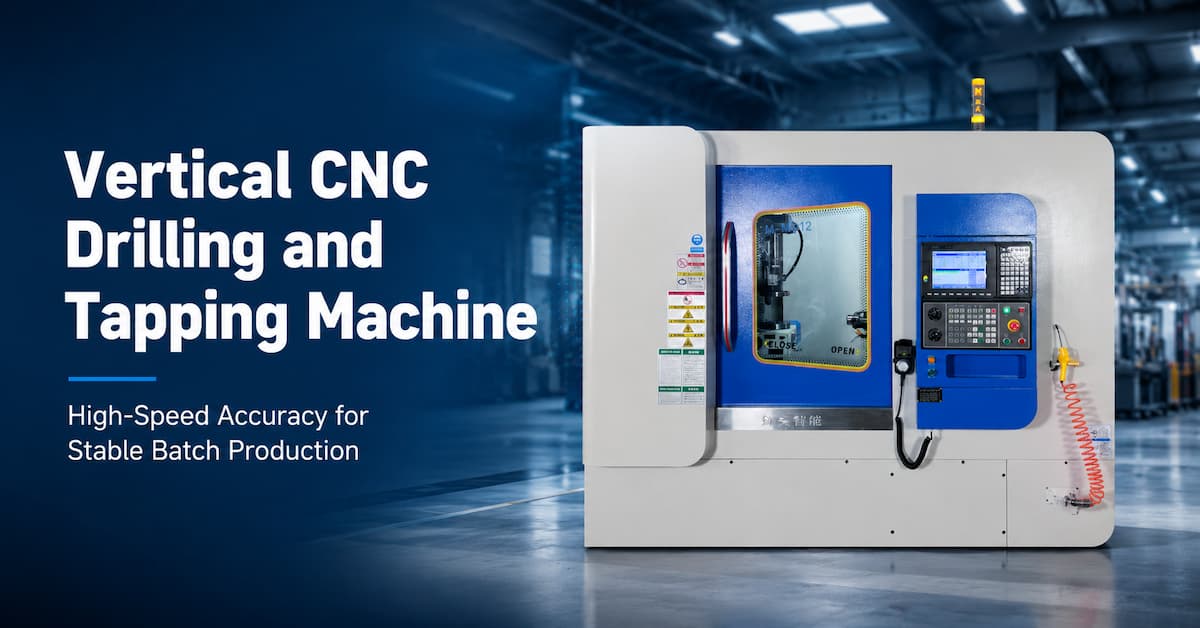
A Vertical CNC Drilling and Tapping Machine is designed for manufacturers that need fast, accurate, and repeatable hole processing on metal parts. In many factories, drilling and tapping may look like simple machining steps, but they often decide whether a part can be assembled smoothly, sealed correctly, or delivered without quality complaints.
For industries such as automotive parts, sanitary hardware, valves, door control hardware, bearing housings, and precision connectors, unstable hole position or poor thread quality can cause serious production problems. A manual or semi-manual process may work for small orders, but once the factory enters batch production, consistency becomes the real challenge.
Xinmei Intelligent provides CNC equipment and intelligent production solutions for manufacturers that need stable machining, efficient process flow, and customized production support. You can view related CNC machines and production solutions on the Xinmei products page.
What Is a Vertical CNC Drilling and Tapping Machine?
A Vertical CNC Drilling and Tapping Machine is a CNC machine tool used for vertical-direction drilling, tapping, chamfering, countersinking, and related hole-processing operations. It is especially suitable for parts that require multiple holes, threaded holes, accurate positioning, and repeatable batch machining.
Compared with traditional drilling equipment, a CNC-controlled drilling and tapping machine can manage spindle speed, feed rate, tool path, hole depth, tapping cycle, and machining sequence more accurately. This helps reduce human error and improves machining consistency.
The machine is commonly used for:
- Drilling threaded holes
- Tapping internal threads
- Chamfering hole edges
- Countersinking
- Multi-hole positioning
- Batch processing of metal parts
- Repeated machining of standard workpieces
For factories, the machine is not only a piece of equipment. It is a way to make hole processing more controllable, repeatable, and suitable for mass production.
Why Hole Processing Quality Matters in Manufacturing
Hole processing affects many downstream production steps. If the hole position is wrong, the part may not assemble correctly. If the thread is unstable, bolts or fittings may loosen. If the tapping depth is inconsistent, sealing or locking performance may be affected.
In real production, poor drilling and tapping can lead to:
- Higher rejection rate
- More manual rework
- Tap breakage and downtime
- Assembly failure
- Poor product consistency
- Delivery delays
- Increased tool consumption
- Customer complaints
This is why many factories upgrade from manual drilling to CNC drilling and tapping equipment. A Vertical CNC Drilling and Tapping Machine helps control the process from the beginning, rather than finding problems during final inspection.
Typical Applications of Vertical CNC Drilling and Tapping Machines
A vertical CNC drilling and tapping machine is widely used in factories that process repeatable metal parts. It is especially useful when parts require accurate hole positions and stable internal threads.
| Industry | Common Parts | Machining Needs |
|---|---|---|
| Auto & motorcycle parts | Brake pump parts, steering components, cylinder heads, shock absorber parts | Accurate holes, stable threads, batch consistency |
| Bathroom & sanitary hardware | Faucet bodies, angle valves, water meter parts, stainless steel parts | Clean hole processing, stable sealing-related threads |
| Valve manufacturing | Ball valves, filter valves, globe valves, manifolds | Threaded holes, precise positioning, stable clamping |
| Door control hardware | Door closer bodies, floor spring bodies, lock cores, gear parts | Repeat drilling and tapping for assembly holes |
| Bearing housings | Bearing block bases and mechanical housings | Accurate hole position and strong fixture stability |
| Aerospace connectors | Connector bodies and pin-related components | Precision machining and consistent positioning |
For these industries, the value of a CNC drilling and tapping machine is not only speed. The bigger value is stable quality across repeated production.
Main Advantages for Batch Production
1. Better Hole Position Accuracy
CNC control helps maintain accurate tool movement and repeatable positioning. This is important for parts with multiple holes or strict assembly requirements.
When hole position changes from part to part, assembly becomes difficult. A vertical CNC drilling and tapping machine reduces this risk by using programmed machining paths and stable workholding.
2. More Stable Thread Quality
Thread quality depends on spindle control, feed synchronization, tool condition, and material behavior. CNC tapping cycles help control the process more precisely than manual tapping.
Stable thread quality can reduce assembly problems and improve the reliability of final products.
3. Higher Production Efficiency
For repeat parts, CNC drilling and tapping can shorten cycle time and reduce operator dependency. Once the program and fixture are confirmed, the process can run more consistently.
This is valuable for factories with daily batch orders or high-volume production pressure.
4. Lower Labor Dependency
Manual drilling and tapping require skilled workers, and the result may vary between operators. CNC equipment helps standardize the process and reduce reliance on individual skill.
For factories facing labor shortages or rising labor costs, this is a practical production upgrade.
5. Stronger Process Control
A CNC drilling and tapping process is easier to standardize. Production managers can control machining steps, tool changes, fixture positioning, and quality checkpoints more clearly.
This helps the factory build a more predictable production system.
What Buyers Should Check Before Purchasing
Before buying a Vertical CNC Drilling and Tapping Machine, buyers should avoid focusing only on machine price. The machine must match the workpiece, material, tolerance, production volume, and future automation needs.
| Buying Factor | Why It Matters | What to Confirm |
| Workpiece material | Different materials need different cutting conditions | Aluminum, brass, steel, stainless steel, or other metals |
| Hole size and depth | Affects spindle power and tool selection | Maximum hole diameter and tapping specification |
| Part shape | Affects fixture design | Can the supplier design stable clamping? |
| Production volume | Determines automation level | Manual loading, semi-automatic, or robot loading |
| Accuracy requirement | Affects machine structure and process planning | Hole position tolerance and thread consistency |
| Tooling plan | Affects cycle time and cost | Drilling, tapping, chamfering, and countersinking sequence |
| After-sales support | Affects long-term operation | Installation, training, spare parts, and technical service |
A reliable supplier should ask for drawings, samples, material, production targets, and current problems before recommending a machine.
Why Fixture Design Is Critical
Fixture design is often one of the most important parts of a drilling and tapping project. Even a strong CNC machine cannot deliver stable accuracy if the workpiece is not clamped correctly.
A good fixture should:
- Hold the part firmly
- Avoid surface damage
- Reduce loading time
- Keep every part in the same position
- Support quick changeover when needed
- Match the machining direction and tool path
For example, a valve body, faucet body, brake pump part, and door closer body may all require different fixture solutions. This is why buyers should choose a supplier with engineering experience, not only machine assembly capability.
Xinmei Intelligent supports customized CNC equipment and production solutions based on real workpiece requirements. Buyers can learn more about the company background and manufacturing focus through the Xinmei About Us page.
Vertical CNC Drilling and Tapping Machine vs Manual Drilling
| Comparison Item | Manual Drilling / Tapping | Vertical CNC Drilling and Tapping Machine |
| Accuracy | Depends heavily on operator skill | Controlled by CNC program and fixture |
| Batch consistency | Hard to keep stable | Better repeatability |
| Labor demand | Higher | Lower after setup |
| Cycle time | Less predictable | More stable and measurable |
| Thread quality | Operator-dependent | More controlled tapping process |
| Scalability | Limited | Better for batch production |
| Automation potential | Low | Can support automated production upgrades |
If your factory only processes occasional small quantities, manual operation may still be acceptable. But if your orders are repeated, batch-based, and quality-sensitive, CNC drilling and tapping equipment provides stronger long-term value.
When Should a Factory Upgrade to CNC Drilling and Tapping?
A factory should consider upgrading when it faces one or more of these issues:
- Current production cannot meet delivery demand
- Too many workers are needed for drilling and tapping
- Hole position varies between batches
- Thread quality is unstable
- Tap breakage causes frequent downtime
- Manual loading and clamping slow down production
- Customers require more consistent quality
- The factory plans to build an automated production line
In these cases, a Vertical CNC Drilling and Tapping Machine can help improve production control and reduce hidden costs caused by unstable machining.
Why Choose Xinmei Intelligent
Xinmei Intelligent focuses on CNC machining equipment and intelligent production line solutions for industrial manufacturers. The company provides equipment and solutions for drilling, tapping, milling, robotic loading and unloading, grinding and polishing automation, and customized machine tools.
For buyers looking for a vertical CNC drilling and tapping solution, Xinmei can support the project from workpiece analysis to process planning and machine configuration.
Xinmei solutions are suitable for manufacturers that need:
- Stable drilling and tapping for metal parts
- Custom fixtures based on workpiece shape
- CNC process planning for batch production
- Higher machining consistency
- Reduced manual operation
- Automation upgrades for future capacity growth
- Practical support from samples to mass production
If you are not sure whether your part needs a single machine, semi-automatic equipment, or a full CNC automation line, Xinmei can help evaluate your drawings and production goals.
How to Get a More Accurate Quotation
To receive a practical machine recommendation, prepare the following information before contacting the supplier:
- Product drawings or samples
- Material type
- Hole diameter and depth
- Thread specification
- Number of holes per part
- Required tolerance
- Current machining method
- Daily or monthly output target
- Need for manual or automated loading
- Factory layout or available space
With this information, the supplier can recommend a machine configuration that fits your real production needs instead of giving a generic quotation.
You can submit your project requirements through the Xinmei contact page.
FAQ
1. What is a Vertical CNC Drilling and Tapping Machine used for?
It is used for CNC drilling, tapping, chamfering, countersinking, and repeatable hole processing on metal parts.
2. What materials can it process?
It can be used for many metal materials, including aluminum, brass, steel, stainless steel, and other industrial metal parts, depending on machine configuration and tooling.
3. Is it suitable for batch production?
Yes. A vertical CNC drilling and tapping machine is especially suitable for repeat parts that require stable hole position, thread quality, and cycle time.
4. Can the machine be customized for my parts?
Yes. Fixture design, tooling layout, spindle configuration, CNC program, and automation options can be customized based on drawings, samples, and production requirements.
5. How do I know if I need this machine or a machining center?
If your main process is repeated drilling and tapping, a dedicated machine may be more efficient. If your parts require complex milling and multiple machining operations, a machining center may be more suitable.
Conclusion
A Vertical CNC Drilling and Tapping Machine can help manufacturers improve hole accuracy, thread consistency, cycle time, and batch production stability. For factories producing valves, sanitary hardware, automotive parts, door control components, bearing housings, or precision metal parts, this type of equipment can become an important step toward more efficient manufacturing.
The right machine should not be selected only by price. It should be chosen based on workpiece structure, material, tolerance, fixture design, production volume, and future automation needs.
Xinmei Intelligent provides CNC equipment and intelligent manufacturing solutions for factories that want to move from unstable manual processing to more stable, repeatable, and scalable production. Visit the Xinmei blog page for more CNC machining insights, or contact Xinmei Intelligent to discuss your drilling and tapping project.