+86 13163919000
 info@xinmeiintelligent.com

For manufacturers producing standardized metal components in medium or large quantities, the main challenge is not simply machining faster. The real challenge is increasing output while maintaining stable dimensions, repeatable hole positions, reliable threads, and predictable cycle times.
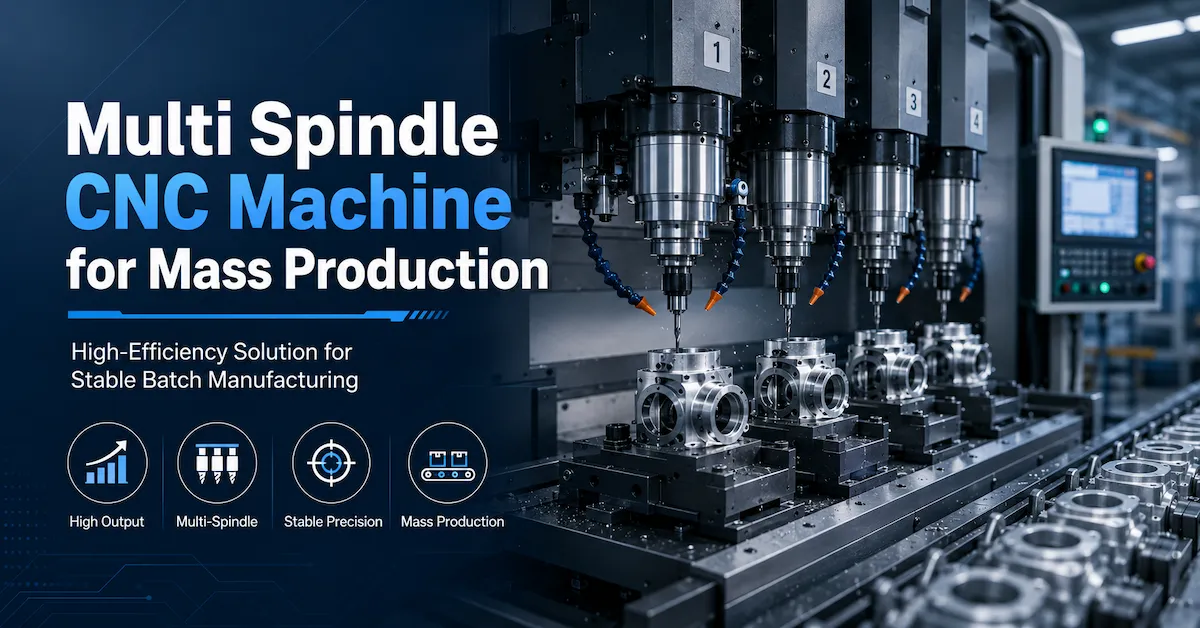
A multi spindle CNC machine for mass production addresses this requirement by allowing multiple spindles or machining units to work simultaneously. Instead of completing one operation at a time, the machine can process several workpieces or multiple features within the same production cycle.
This parallel machining approach can reduce cycle time, lower handling requirements, and help factories expand capacity without adding the same number of standalone machines and operators.
Xinmei Intelligent provides CNC machines, special-purpose equipment, robotic loading systems, and integrated production solutions for automotive parts, valves, bathroom hardware, door control products, connectors, and industrial metal components. Buyers can review relevant equipment through the Xinmei product center.
What Is a Multi Spindle CNC Machine?
A multi spindle CNC machine is equipped with two or more spindles or machining heads that operate simultaneously or in a coordinated sequence.
Depending on the machine configuration, it may perform:
- Drilling
- Tapping
- Milling
- Boring
- Turning
- Chamfering
- Surface machining
- Multi-hole processing
The main value of a multi spindle CNC machine for mass production is parallel processing. When several operations occur at the same time, the effective machining time allocated to each finished part can be reduced.
Common machine configurations include:
- Multiple vertical drilling and tapping heads
- Horizontal multi-spindle machining units
- Multi-station rotary-table machines
- Combined turning, drilling, milling, and tapping systems
- Dedicated CNC machines for one product family
- Multi-spindle cells with robotic loading and unloading
The correct configuration depends on the workpiece drawing, material, machining operations, production volume, and required flexibility.
Why Choose a Multi Spindle CNC Machine for Mass Production?
A multi spindle CNC machine for mass production is especially valuable when a factory has stable repeat orders and its current capacity is limited by long cycle times, repeated loading, or excessive workpiece transfer.
Higher Output per Cycle
Several spindles can process different workpieces or machining features simultaneously. This allows the factory to complete more parts during each machine cycle.
For manufacturers with stable monthly orders, higher output per cycle can help increase capacity without continuously adding machines.
Shorter Effective Cycle Time
A single-spindle machine completes operations sequentially. A multi-spindle system can complete several operations in parallel.
For example, one spindle may drill while another taps or machines a second workpiece. This reduces the total time required to finish each batch.
Lower Cost per Part
Higher output, fewer transfers, and reduced manual handling can lower the machine-hour and labor cost allocated to each finished component.
The actual saving depends on:
- Current cycle time
- Production volume
- Number of operators
- Machine utilization
- Fixture loading time
- Tool consumption
- Automation level
More Consistent Batch Quality
CNC control, stable fixtures, and synchronized machining reduce variation caused by different operators or production shifts.
This is important when customers require consistent dimensions and assembly performance across thousands of parts.
Reduced Workpiece Handling
Combining several processes in one machine or cell can reduce:
- Repeated loading
- Manual positioning
- Transfers between equipment
- Waiting between operations
- Work-in-process inventory
Fewer transfers also reduce the risk of positioning errors and surface damage.
Which Parts Are Suitable for Multi-Spindle Machining?
A multi spindle CNC machine for mass production is most suitable for components with stable geometry, repeatable operations, and predictable order volumes.
| Industry | Typical components | Common machining requirements |
|---|---|---|
| Automotive | Brake pump bodies, steering parts, housings | Drilling, tapping, boring, multi-face machining |
| Valve manufacturing | Ball valve bodies, manifolds, filter valves | Port drilling, threading, sealing-surface machining |
| Bathroom hardware | Faucet bodies, angle valves, fittings | Drilling, tapping, milling, boring |
| Door control | Door closer bodies, floor spring parts | Multi-hole machining, tapping, milling |
| Electrical connectors | Connector housings, pins, terminals | Precision drilling and repeat positioning |
| Industrial hardware | Hinges, brackets, bearing supports | Batch drilling, tapping, milling, chamfering |
The industry name alone should not determine machine selection. The supplier must evaluate the actual workpiece and process.
Two components from the same industry may require different spindle arrangements, fixtures, tools, and automation systems.
Multi Spindle CNC Machine vs Single-Spindle CNC Machine
| Comparison | Single-spindle CNC machine | Multi-spindle CNC machine |
| Processing method | Operations completed sequentially | Several operations completed simultaneously |
| Production output | Moderate | High for repeat parts |
| Cycle time | Usually longer | Shorter through parallel machining |
| Flexibility | Better for changing products | Better for stable product families |
| Fixture complexity | Generally lower | Requires coordinated fixture design |
| Initial investment | Lower | Higher |
| Cost per part | Higher in large batches | Lower when volume is sufficient |
| Best application | Prototypes and flexible batches | Stable medium- and high-volume production |
A single-spindle machine may be more practical for changing products and small orders. A multi-spindle machine provides greater value when production is stable and cycle-time reduction is important.
Important Machine Configurations to Evaluate
Number and Arrangement of Spindles
More spindles do not automatically mean better production efficiency.
The supplier should determine:
- How many operations can run simultaneously
- Whether spindles process one or several workpieces
- Tool-access requirements
- Part spacing
- Required spindle power and speed
- Maintenance accessibility
A correctly balanced machine may outperform a more complicated design with unnecessary machining heads.
Machine Rigidity
Simultaneous cutting creates combined machining forces. The machine frame, spindle units, guides, and fixtures must remain stable under these loads.
Good rigidity supports:
- Reduced vibration
- Stable hole position
- Better surface quality
- Longer tool life
- Repeatable accuracy
Spindle Performance
Spindle selection should consider:
- Workpiece material
- Hole diameter
- Thread size
- Cutting depth
- Required torque
- Tool type
- Expected operating hours
A high spindle speed is not always the priority. Steel, stainless steel, brass, aluminum, and cast iron require different cutting conditions.
Fixture Design
Fixture design is critical because several workpieces or operations may be processed simultaneously.
A good fixture should:
- Position each workpiece accurately
- Maintain consistent clamping force
- Prevent deformation
- Provide tool access
- Release chips and coolant
- Support fast loading
- Confirm correct clamping
- Work reliably with robotic handling
An unstable fixture can eliminate the productivity advantage of the machine.
Multi-Station and Multi-Spindle Configurations
Different production goals require different machine layouts.
Multiple Spindles Processing Multiple Parts
Each spindle processes a separate workpiece at the same time.
This configuration is suitable when the factory needs to multiply the output of one repeated process.
Multiple Spindles Processing One Part
Different spindles machine several features of the same component simultaneously.
This may be suitable for parts with multiple holes or machining positions that can be accessed at the same time.
Rotary-Table Multi-Station Machine
Workpieces move through several stations while each station performs a different process.
A production sequence may include:
- Loading
- Drilling
- Tapping
- Milling
- Chamfering
- Inspection
- Unloading
This approach supports continuous production when the workpiece and process remain stable.
Combined CNC Machine
A combined machine may integrate turning, drilling, tapping, milling, or boring in one system.
This reduces transfers between separate machines and improves process continuity.
When Is a Multi Spindle CNC Machine for Mass Production a Good Investment?
Before purchasing a multi spindle CNC machine for mass production, manufacturers should evaluate whether production demand justifies a dedicated high-output solution.
The investment is generally more suitable when:
- Orders are stable and repeatable
- The same product family is produced regularly
- Current cycle time limits capacity
- Several machines currently perform similar operations
- Manual loading requires too many operators
- Product transfers create delays
- Quality varies between production shifts
- Factory space limits equipment expansion
- The cost per part needs to be reduced
It may be less suitable when:
- Order quantities are low
- Product designs change frequently
- Setup changes are required every day
- Future demand is uncertain
- Parts have highly variable blank conditions
In these situations, flexible CNC equipment may provide better value.
How Automation Improves Multi-Spindle Production
A multi-spindle machine can be integrated with:
- Robotic loading and unloading
- Automatic feeders
- Conveyors
- Rotary material tables
- Hydraulic or pneumatic fixtures
- Cleaning stations
- Inspection systems
- Part-marking equipment
Automation helps maintain a stable production rhythm and reduces the time machines spend waiting for operators.
However, the robot and machine must be balanced correctly. A fast robot cannot improve output when the machining cycle, fixture, or material-feeding system is the actual bottleneck.
The supplier should evaluate the complete cycle:
- Raw-part pickup
- Workpiece positioning
- Fixture clamping
- Machining
- Unclamping
- Finished-part removal
- Inspection
- Part placement
What Buyers Should Check Before Choosing a Supplier
| Evaluation area | Questions to ask |
| Workpiece analysis | Has the supplier reviewed the drawing, material, and tolerance? |
| Process planning | Which operations can run simultaneously? |
| Spindle layout | Why is the proposed spindle number suitable? |
| Fixture design | How will all workpieces be positioned and clamped? |
| Cycle-time estimate | What steps are included in the calculation? |
| Accuracy | How is repeatability maintained during simultaneous cutting? |
| Tool management | How will tool wear and replacement be controlled? |
| Automation | Can robotic loading be integrated now or later? |
| Changeover | How long does a different product setup require? |
| Service | Are installation, training, and remote support included? |
A professional supplier should provide a complete machining proposal rather than only a machine specification sheet.
Why Choose Xinmei Intelligent?
Xinmei Intelligent focuses on CNC equipment, special-purpose machines, robotic handling, and intelligent production-line solutions.
For multi-spindle projects, Xinmei can support:
- Workpiece drawing analysis
- Machining-process planning
- Spindle configuration
- Machine structure selection
- Fixture design discussion
- Tooling recommendations
- Robotic loading integration
- Cycle-time evaluation
- Installation and commissioning
- Operator training
- Future line expansion
Xinmei supports manufacturers in automotive parts, valves, bathroom hardware, door control, connectors, bearing housings, and other precision metal industries.
Learn more about the company through the Xinmei About Us page.
Information Needed Before Requesting a Quotation
To receive a practical proposal, buyers should provide:
- 2D and 3D product drawings
- Workpiece samples
- Material type
- Blank dimensions
- Critical tolerances
- Required machining operations
- Current cycle time
- Target output per shift
- Number of product models
- Existing equipment
- Factory layout
- Preferred automation level
- Local power and installation conditions
Providing this information helps the engineering team calculate the correct machine layout, spindle quantity, fixture system, and production capacity.
You can submit project information through the Xinmei Contact Us page.
FAQ
What is a multi spindle CNC machine for mass production?
A multi spindle CNC machine for mass production uses several spindles or machining heads to process multiple parts or features simultaneously, helping factories shorten cycle time and increase output.
How many spindles should a CNC machine have?
The correct number depends on the workpiece, machining operations, target output, fixture layout, and available space. More spindles are only useful when the process can effectively run in parallel.
What industries use multi-spindle CNC machines?
Common industries include automotive, valves, bathroom hardware, door control, connectors, bearing housings, and general industrial hardware.
Can multi-spindle CNC machines process different materials?
Yes. They can process brass, aluminum, steel, stainless steel, cast iron, and other metals when the machine, spindle, tools, and cutting parameters are configured correctly.
Can robotic loading be added?
Yes. Multi-spindle equipment can be integrated with robots, automatic feeders, conveyors, and fixture-confirmation systems.
Is a multi-spindle CNC machine suitable for small batches?
It is generally more suitable for repeatable medium- or high-volume production. Flexible single-spindle equipment may be better for frequently changing small batches.
What affects the price of a multi-spindle machine?
Price depends on spindle quantity, machine structure, processing complexity, fixture design, control system, automation level, inspection equipment, and required output.
Conclusion
A multi spindle CNC machine for mass production can help manufacturers shorten cycle time, increase capacity, reduce part handling, and maintain stable batch quality.
The best solution is not automatically the machine with the most spindles. It is the machine whose spindle layout, fixture, tooling, automation, and production rhythm match the actual workpiece and order volume.
For factories producing stable automotive parts, valve components, bathroom hardware, door control products, connectors, or industrial metal parts, a properly designed multi-spindle CNC system can lower unit manufacturing costs and support scalable growth.
Explore available CNC equipment through the Xinmei product center, review more manufacturing guidance through the Xinmei blog, or send your drawings and output requirements through the Contact Us page.