+86 13163919000
 info@xinmeiintelligent.com

For manufacturers producing precision metal components, machining accuracy directly affects product quality, assembly performance, and production reliability.
Whether producing automotive parts, valve bodies, sanitary hardware, connectors, bearing housings, or industrial components, maintaining stable CNC accuracy is one of the most important production goals.
Many factories focus on machine specifications when purchasing CNC equipment, but machining accuracy depends on much more than the machine itself. Machine structure, fixture stability, cutting tools, programming, thermal control, maintenance, and process optimization all influence the final result.
Understanding how to improve CNC machining accuracy helps manufacturers reduce defects, improve batch consistency, and build a more reliable production process.
Xinmei Intelligent provides CNC equipment and intelligent manufacturing solutions designed for precision machining, automated production, and stable industrial manufacturing.
Explore related CNC equipment through the Xinmei products page.
Why CNC Machining Accuracy Matters
CNC machining accuracy determines whether a manufactured part meets its required dimensions, tolerances, and functional requirements.
Poor machining accuracy may lead to:
- Assembly problems
- Leakage issues
- Poor fitting performance
- Increased rework
- Higher scrap rates
- Customer complaints
- Unstable production batches
For example:
- Valve components require accurate holes and sealing surfaces
- Faucet bodies require stable threads and internal passages
- Automotive parts require precise dimensions for assembly
- Connectors require strict tolerance control
For these applications, accuracy is not only a quality requirement. It directly affects production efficiency and customer satisfaction.
Therefore, manufacturers need to continuously evaluate how to improve CNC machining accuracy throughout the entire production process.
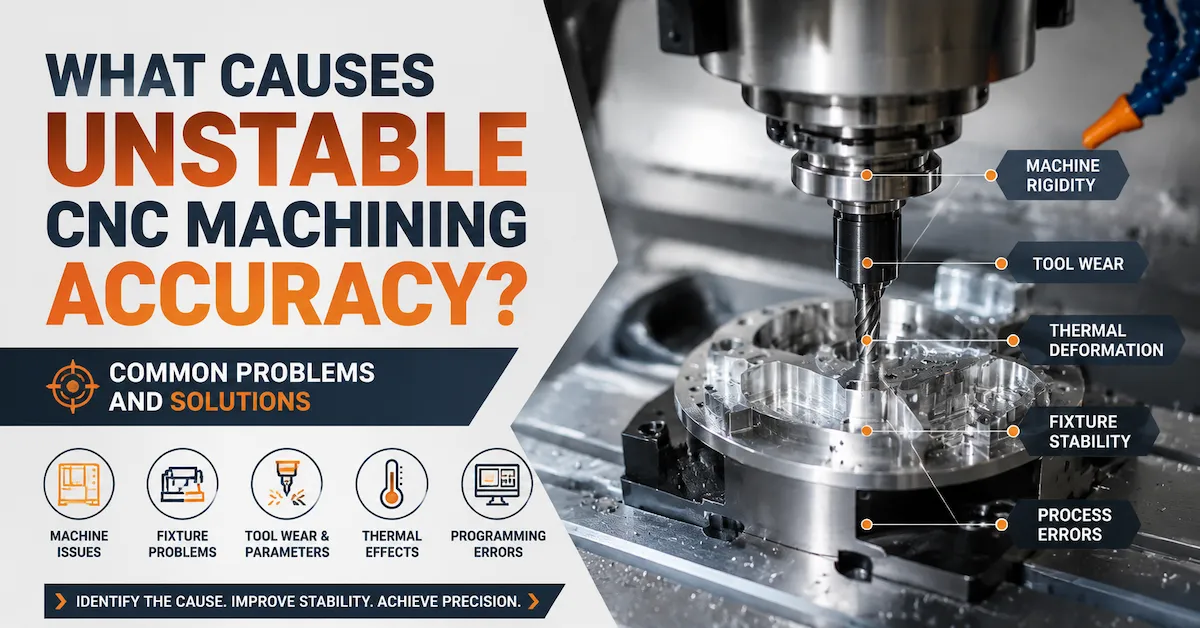
Main Factors Affecting CNC Machining Accuracy
CNC accuracy is influenced by multiple factors working together.
Machine Rigidity and Structural Stability
Machine rigidity is one of the most important factors affecting machining accuracy.
A rigid CNC machine helps reduce:
- Vibration
- Tool movement
- Cutting deformation
- Surface quality variation
Important structural factors include:
- Machine bed design
- Guideway structure
- Spindle support
- Frame strength
- Assembly accuracy
During heavy cutting or long production cycles, weak machine structures may cause gradual accuracy loss.
When selecting CNC equipment, manufacturers should consider not only speed but also long-term structural stability.
Fixture Design and Workpiece Positioning
A high-quality CNC machine cannot achieve stable accuracy without a reliable fixture.
The fixture determines how accurately the workpiece is positioned during machining.
A good fixture should:
- Provide repeatable positioning
- Maintain stable clamping force
- Prevent workpiece deformation
- Allow proper tool access
- Reduce setup variation
- Support automated loading
For irregular components such as valve bodies, faucet bodies, door closer parts, and automotive housings, customized fixture design is especially important.
Many machining problems are actually caused by unstable workholding rather than the CNC machine itself.
Tool Selection and Tool Wear Control
Cutting tools directly affect machining accuracy.
Incorrect tools or worn tools may cause:
- Dimension variation
- Poor surface finish
- Increased cutting force
- Tool vibration
- Unexpected defects
Manufacturers should monitor:
- Tool material
- Tool geometry
- Cutting speed
- Feed rate
- Tool life
- Replacement timing
Proper tool management helps maintain stable machining performance during large production runs.
CNC Programming Optimization
CNC programs control how the machine performs machining operations.
Programming factors affecting accuracy include:
- Tool path design
- Cutting sequence
- Feed rate
- Spindle speed
- Tool compensation
- Approach and retract movement
Optimized programming can reduce unnecessary movement, improve surface quality, and maintain consistent dimensions.
For complex parts, experienced process engineers can significantly improve machining stability.
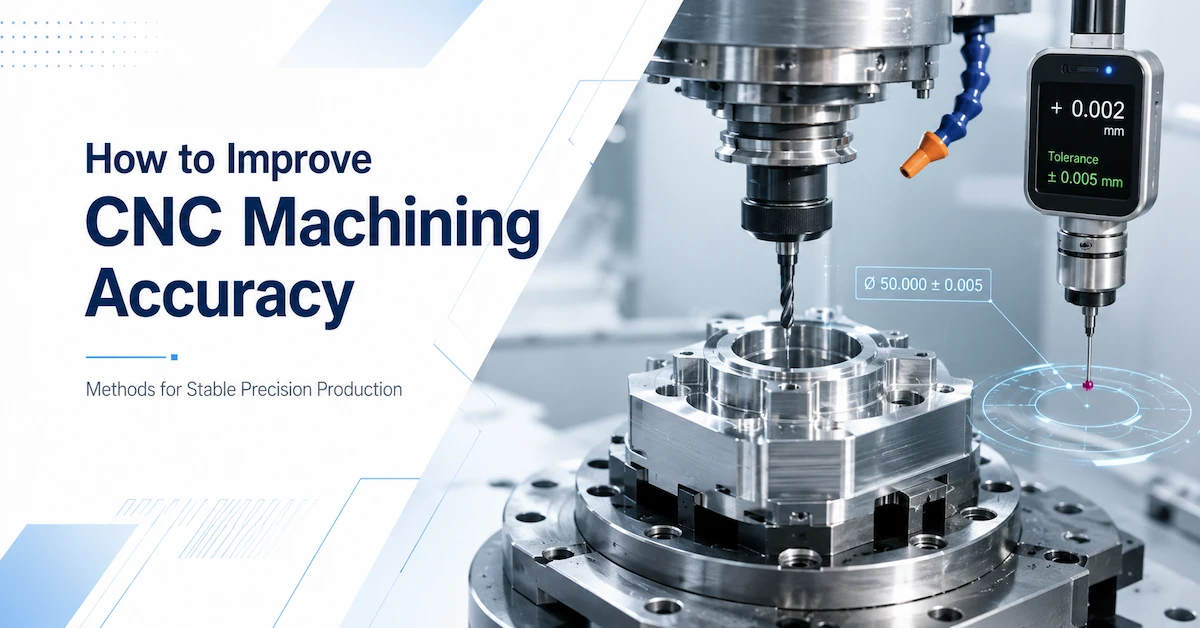
How to Improve CNC Machining Accuracy Step by Step
When manufacturers analyze how to improve CNC machining accuracy, they should evaluate the entire machining process instead of focusing on only one factor.
Step 1: Verify Machine Accuracy
Before optimizing production, confirm the basic machine condition.
Check:
- Axis positioning accuracy
- Repeatability
- Spindle runout
- Guideway condition
- Leveling status
- Thermal stability
A machine that is already losing accuracy cannot be corrected only through programming changes.
Step 2: Improve Workpiece Clamping
Review:
- Fixture structure
- Locating points
- Clamping force
- Workpiece deformation
- Loading consistency
Stable positioning is essential for repeatable production.
Step 3: Optimize Cutting Parameters
Adjust:
- Cutting speed
- Feed rate
- Cutting depth
- Coolant flow
- Tool selection
The correct parameters reduce vibration and improve tool performance.
Step 4: Control Thermal Deformation
Temperature changes can affect CNC accuracy.
Sources include:
- Spindle heat
- Motor heat
- Cutting heat
- Workshop temperature changes
Solutions include:
- Machine warm-up procedures
- Cooling systems
- Thermal compensation
- Stable workshop conditions
Step 5: Monitor Tool Condition
Regular tool inspection prevents unexpected accuracy problems.
Useful methods include:
- Tool-life tracking
- Cutting-force monitoring
- Regular measurement
- Automatic tool compensation
The Role of CNC Machine Selection in Accuracy
Choosing the right CNC equipment is an important part of improving accuracy.
Different applications require different machine characteristics.
| Application | Recommended Equipment Focus |
|---|---|
| High precision components | Strong rigidity and stable positioning |
| Heavy cutting parts | High structural strength and spindle torque |
| Large batch production | Stable cycle time and automation capability |
| Multi-face machining | Horizontal machining capability |
| Repeated drilling and tapping | Dedicated CNC drilling solutions |
A machine designed for the wrong application may struggle to maintain accuracy even with experienced operators.
When evaluating how to improve CNC machining accuracy, equipment selection should match the actual production requirements.
How Automation Improves CNC Accuracy
Automation does not directly replace machining technology, but it helps create a more stable production environment.
A CNC automation system can improve accuracy by reducing:
- Manual loading differences
- Positioning errors
- Operator variation
- Production interruptions
Automation solutions may include:
- Robotic loading and unloading
- Automatic fixtures
- Part inspection systems
- Production monitoring
For factories producing large quantities of repeat components, automation helps maintain consistent machining conditions.
Xinmei Intelligent provides CNC automation solutions including robotic loading systems and intelligent production-line integration.
Learn more about the robot loading and unloading solution.
Quality Control Methods for CNC Accuracy
A reliable precision machining process requires continuous quality control.
Common methods include:
First Piece Inspection
The first completed part should be measured and verified before mass production begins.
In-Process Inspection
Checking critical dimensions during production helps detect problems early.
Final Inspection
Finished parts should be inspected according to customer requirements.
Process Monitoring
Monitoring:
- Tool condition
- Machine status
- Production data
helps identify accuracy changes before they create large batches of defective parts.
Common Mistakes That Reduce CNC Accuracy
Ignoring Fixture Problems
Some factories adjust CNC programs repeatedly while the real problem is unstable clamping.
Using Incorrect Cutting Parameters
Aggressive cutting conditions may increase vibration and reduce accuracy.
Poor Machine Maintenance
Lack of maintenance can affect:
- Axis movement
- Spindle performance
- Repeatability
Overlooking Tool Wear
A worn tool can gradually change dimensions without obvious warning.
Choosing Equipment Only by Price
Low-cost equipment may create higher long-term costs through:
- More adjustments
- Lower efficiency
- Higher scrap rates
- Frequent maintenance
How to Choose a CNC Machine Manufacturer for Accuracy Requirements
When purchasing CNC equipment, manufacturers should evaluate suppliers based on their ability to support precision production.
Important factors include:
Engineering Capability
The supplier should understand:
- Machining processes
- Material behavior
- Fixture design
- Accuracy requirements
Machine Quality
Evaluate:
- Machine structure
- Component selection
- Assembly process
- Testing procedures
Application Experience
Ask whether the supplier has experience with:
- Similar parts
- Similar tolerances
- Similar industries
Technical Support
A professional supplier should provide:
- Installation
- Training
- Process support
- Maintenance guidance
Xinmei Intelligent supports manufacturers with CNC equipment selection, process planning, automation integration, and production optimization.
Learn more through the Xinmei About Us page.
Information Needed Before Requesting a CNC Solution
To receive a suitable recommendation, prepare:
- Product drawings
- Material information
- Required tolerance
- Surface requirements
- Production volume
- Current machining problems
- Existing equipment
- Automation requirements
Detailed production information allows suppliers to provide more accurate solutions.
Submit project requirements through the Xinmei Contact Us page.
FAQ
How to improve CNC machining accuracy?
To improve CNC machining accuracy, manufacturers should optimize machine rigidity, fixture design, tooling selection, CNC programming, thermal control, and quality monitoring.
What affects CNC machining accuracy most?
Major factors include machine structure, workpiece positioning, tool condition, cutting parameters, programming quality, and environmental conditions.
Can automation improve CNC accuracy?
Yes. Automation reduces manual variation, improves loading consistency, and helps maintain stable production conditions.
Why is fixture design important for CNC accuracy?
Fixtures determine workpiece positioning and stability. Poor fixtures can cause dimensional variation even with high-quality CNC machines.
How does tool wear affect machining accuracy?
Worn tools change cutting conditions and may cause dimension errors, poor surface finish, and unstable production quality.
Should manufacturers upgrade machines to improve accuracy?
Sometimes. If the current machine lacks rigidity, repeatability, or required capability, upgrading equipment may provide better long-term results.
Conclusion
Understanding how to improve CNC machining accuracy helps manufacturers create more stable, efficient, and reliable production processes.
Machining accuracy depends on many factors, including machine structure, fixture design, tooling, programming, maintenance, thermal control, and quality management.
For factories producing precision metal components, improving accuracy is not a single adjustment. It requires a complete approach covering equipment selection, process optimization, and production control.
Xinmei Intelligent provides CNC machining equipment and automation solutions designed for manufacturers seeking higher precision, stable production, and long-term manufacturing efficiency.
Contact Xinmei Intelligent to discuss your CNC machining requirements and develop a precision production solution.