 +86 13163919000
 info@xinmeiintelligent.com

Choosing the right horizontal machining center manufacturer is a critical decision for factories that need stable precision, higher cutting efficiency, and reliable batch production. For many manufacturers, the problem is not only whether a machine can cut metal. The real question is whether the machine can maintain accuracy, rigidity, tool life, and production rhythm during long-term operation.
A horizontal machining center is often used for workpieces that require multi-face machining, heavy cutting, high efficiency, and repeatable accuracy. It is widely used in automotive parts, valve bodies, hydraulic components, bearing housings, aerospace connectors, door control parts, and precision industrial components.
Xinmei Intelligent provides CNC equipment and intelligent production solutions for manufacturers that need stable machining performance and scalable production capacity. You can explore related CNC equipment on the Xinmei products page.
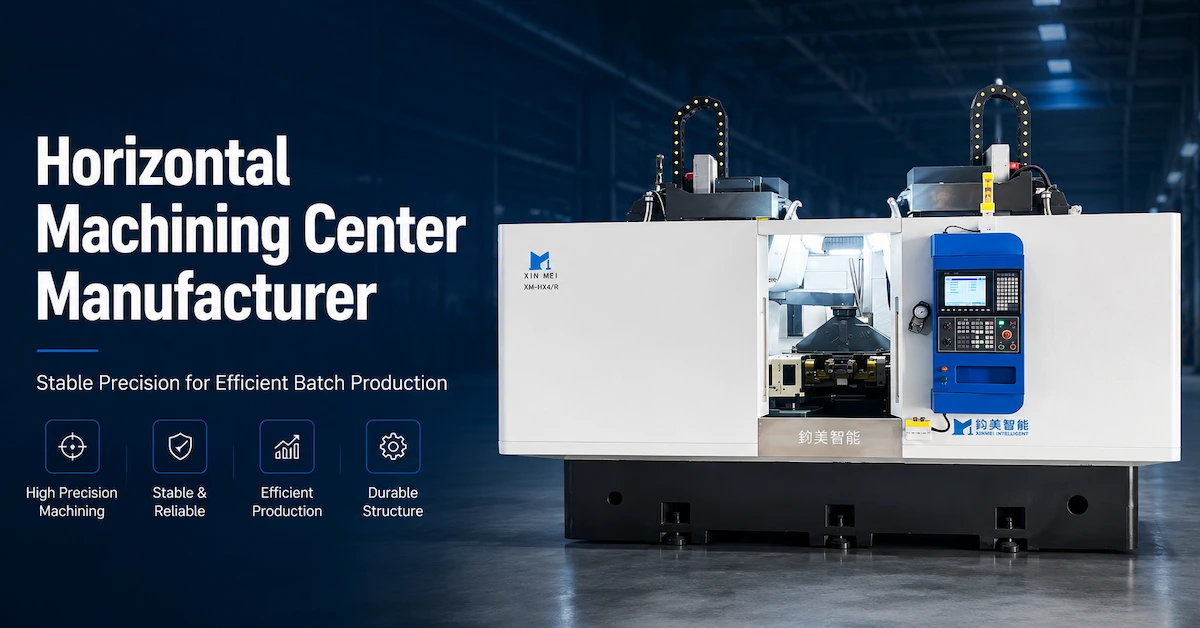
What Is a Horizontal Machining Center?
A horizontal machining center is a CNC machine tool with a horizontally oriented spindle. Compared with a vertical machining center, the horizontal structure is often better suited for multi-side machining, deeper cavities, larger workpieces, and continuous chip removal.
In many production environments, a horizontal CNC machining center is used when factories need:
- Stable machining accuracy
- Better chip evacuation
- Multi-face processing
- Stronger rigidity for heavy cutting
- Higher batch production efficiency
- Reduced clamping frequency
- Automated pallet or fixture integration
- Long-term continuous operation
A professional horizontal machining center manufacturer should understand not only the machine structure, but also the customer’s workpiece, material, tolerance, machining sequence, fixture design, and production volume.
Why Manufacturers Choose Horizontal Machining Centers
For factories producing repeatable metal parts, efficiency often depends on how many machining steps can be completed with stable clamping and reliable positioning.
A horizontal machining center can help reduce repeated clamping, improve process continuity, and support multi-side machining more efficiently. This is especially useful for parts with complex holes, side faces, deep structures, or multiple machining directions.
Common production problems that lead buyers to choose horizontal machining centers include:
- Too many setups on vertical machines
- Poor chip removal during deep machining
- Low efficiency for multi-face parts
- Inconsistent accuracy after repeated clamping
- Long cycle time for batch orders
- Difficulty maintaining stable precision
- High labor dependency during production transfer
- Need for automated or semi-automated production lines
A horizontal machining center helps factories build a more stable and efficient machining process, especially when parts are produced in medium or large batches.
Common Applications of Horizontal Machining Centers
Horizontal machining centers are suitable for industries that require rigid machining, consistent accuracy, and stable production output.
| Industry | Typical Parts | Machining Needs |
|---|---|---|
| Automotive parts | Steering components, brake pump parts, cylinder heads, transmission parts | Multi-face machining, hole accuracy, stable output |
| Valve manufacturing | Ball valves, filter valves, globe valves, manifolds | Side hole machining, sealing surfaces, threaded features |
| Bearing housings | Bearing block bases and mechanical housings | High rigidity, accurate bore alignment, batch consistency |
| Door control hardware | Door closer bodies, floor spring bodies, gear housings | Multi-face machining and stable fixture positioning |
| Aerospace connectors | Connector bodies and precision structural parts | Tight tolerance, repeatability, clean surface quality |
| Hydraulic and pneumatic parts | Valve blocks, pump bodies, connection components | Deep holes, precision faces, high consistency |
For these parts, machining quality affects assembly performance, sealing reliability, and final product function. This is why selecting the right horizontal machining center manufacturer matters.
Horizontal Machining Center vs Vertical Machining Center
Some buyers are unsure whether to choose a horizontal or vertical machining center. Both machine types are useful, but they serve different production needs.
| Comparison Item | Horizontal Machining Center | Vertical Machining Center |
| Spindle direction | Horizontal | Vertical |
| Best for | Multi-face parts, cavities, heavy cutting, batch production | Flat parts, simple top-side machining, flexible small batches |
| Chip removal | Generally better due to gravity | Chips may stay on the workpiece surface |
| Clamping efficiency | Better for multi-side machining with proper fixtures | May require more repeated clamping |
| Production efficiency | Strong for repeat parts and batch production | Flexible for different part types |
| Initial investment | Usually higher | Usually lower |
| Automation potential | Strong with pallets, fixtures, and production lines | Also possible, but often used more flexibly |
For factories that mainly process simple flat surfaces, a vertical machining center may be enough. But for multi-face parts, deeper cavities, and long-term batch production, a horizontal machining center can provide stronger efficiency and stability.
Key Factors Buyers Should Check Before Choosing a Manufacturer
Before purchasing equipment, buyers should evaluate the manufacturer from both machine quality and engineering support perspectives.
| Evaluation Factor | Why It Matters | What to Ask the Manufacturer |
| Machine rigidity | Affects vibration, accuracy, and surface quality | Is the machine structure suitable for heavy cutting? |
| Spindle performance | Affects cutting speed, torque, and tool life | What spindle speed and torque options are available? |
| Worktable capacity | Determines suitable part size and weight | Can the machine handle our workpiece dimensions? |
| Accuracy retention | Affects long-term production consistency | How does the machine maintain accuracy over time? |
| Fixture design | Controls repeatable positioning | Can you design fixtures for our specific parts? |
| Chip removal system | Affects continuous machining stability | How does the machine manage chips during production? |
| Automation compatibility | Supports future production upgrades | Can robot loading or pallet systems be integrated? |
| Service support | Affects long-term uptime | Do you provide installation, training, and after-sales support? |
A reliable horizontal machining center manufacturer should not recommend a machine only by catalog size. The supplier should first understand the product drawings, material, tolerance, production rhythm, and current machining problems.
Why Rigidity and Accuracy Retention Matter
For horizontal machining centers, rigidity is one of the most important performance factors. A rigid structure helps reduce vibration, improve cutting stability, protect tool life, and maintain surface quality.
Accuracy retention is equally important. A machine may perform well during testing, but the real challenge is maintaining precision during continuous production.
Buyers should pay attention to:
- Machine bed structure
- Spindle stability
- Linear guide or box way configuration
- Servo system performance
- Thermal stability
- Fixture rigidity
- Toolholder and cutting tool matching
- Machine assembly quality
For factories running repeated batch orders, long-term stability is often more valuable than short-term maximum speed.
The Role of Fixture Design in Horizontal Machining
A horizontal machining center can improve efficiency, but only when the fixture is properly designed. For multi-face parts, fixture design directly affects clamping stability, positioning accuracy, machining accessibility, and loading efficiency.
A good fixture should:
- Hold the workpiece firmly
- Support multi-side machining
- Reduce repeated clamping
- Avoid deformation
- Improve loading and unloading efficiency
- Maintain repeatable positioning
- Match the machine travel and spindle access
For example, valve bodies, bearing housings, brake pump parts, and door closer bodies all require different fixture strategies. A good manufacturer should be able to evaluate the workpiece and recommend a practical fixture solution.
Xinmei Intelligent supports CNC equipment and intelligent production planning based on real manufacturing requirements. Buyers can learn more about the company’s engineering background through the Xinmei About Us page.
When Should a Factory Invest in a Horizontal Machining Center?
A factory should consider a horizontal machining center when it faces one or more of these conditions:
- Parts require multi-face machining
- Current vertical machining process needs too many setups
- Chip removal affects machining stability
- Batch orders require higher efficiency
- Workpieces need stronger clamping and rigidity
- Production managers want more stable cycle time
- The factory plans to integrate automation
- Repeated clamping causes accuracy variation
- Long-term precision and reliability are important
The right machine should improve real production efficiency, not only increase equipment quantity.
Why Choose Xinmei Intelligent
Xinmei Intelligent provides CNC equipment and intelligent manufacturing solutions for factories that need efficient, high-precision, and stable production. For buyers looking for a horizontal machining center manufacturer, Xinmei can support equipment selection, process planning, fixture discussion, and automation upgrade evaluation.
Xinmei’s CNC solutions are suitable for manufacturers that need:
- Horizontal CNC machining centers for batch production
- Stable high-speed machining
- Strong machine rigidity
- Custom fixture planning
- Support for automotive, valve, door control, bearing housing, and precision metal parts
- Integration with automated loading and production systems
- Practical support from samples to mass production
For buyers comparing CNC equipment suppliers, the best choice is not only a machine with attractive specifications. It is a manufacturer that can understand your production challenges and help build a stable machining process.
How to Prepare Before Requesting a Quotation
To receive a practical machine recommendation, prepare the following information before contacting a supplier:
- Product drawings or samples
- Workpiece material
- Part size and weight
- Machining surfaces and hole positions
- Required tolerance
- Current machining process
- Existing production bottlenecks
- Expected daily or monthly output
- Need for manual, semi-automatic, or automated loading
- Workshop layout and available machine space
With this information, the manufacturer can recommend the right machine configuration, spindle specification, fixture concept, and automation level.
You can submit project requirements through the Xinmei contact page.
FAQ
1. What is a horizontal machining center used for?
A horizontal machining center is used for multi-face machining, drilling, milling, boring, tapping, and precision processing of metal parts that require stable accuracy and efficient chip removal.
2. What industries use horizontal machining centers?
Common industries include automotive parts, valve manufacturing, bearing housings, door control hardware, aerospace connectors, hydraulic parts, and precision metal component manufacturing.
3. Is a horizontal machining center better than a vertical machining center?
It depends on the workpiece. A horizontal machining center is often better for multi-face parts, cavities, heavy cutting, and batch production. A vertical machining center is usually more suitable for simpler top-side machining and flexible small-batch work.
4. Can horizontal machining centers support automation?
Yes. Horizontal machining centers can be integrated with robotic loading, pallet systems, automatic fixtures, and intelligent production lines depending on the factory’s production goals.
5. What information is needed before quotation?
You should provide drawings, samples, material, part size, tolerance, machining process, expected output, and automation requirements.
Conclusion
Choosing the right horizontal machining center manufacturer can help your factory improve machining stability, reduce repeated clamping, strengthen batch production efficiency, and maintain long-term precision.
For manufacturers producing automotive parts, valves, bearing housings, door control parts, hydraulic components, or precision metal structures, a horizontal machining center can be an important step toward more efficient and scalable production.
Xinmei Intelligent provides CNC machines and intelligent automation solutions for factories that want to improve machining efficiency, precision, and production reliability. Visit the Xinmei blog page for more manufacturing insights, or contact Xinmei Intelligent to discuss your horizontal machining center project.