+86 13163919000
 info@xinmeiintelligent.com

CNC Lathes: A Foundation for Basic Turning Operations
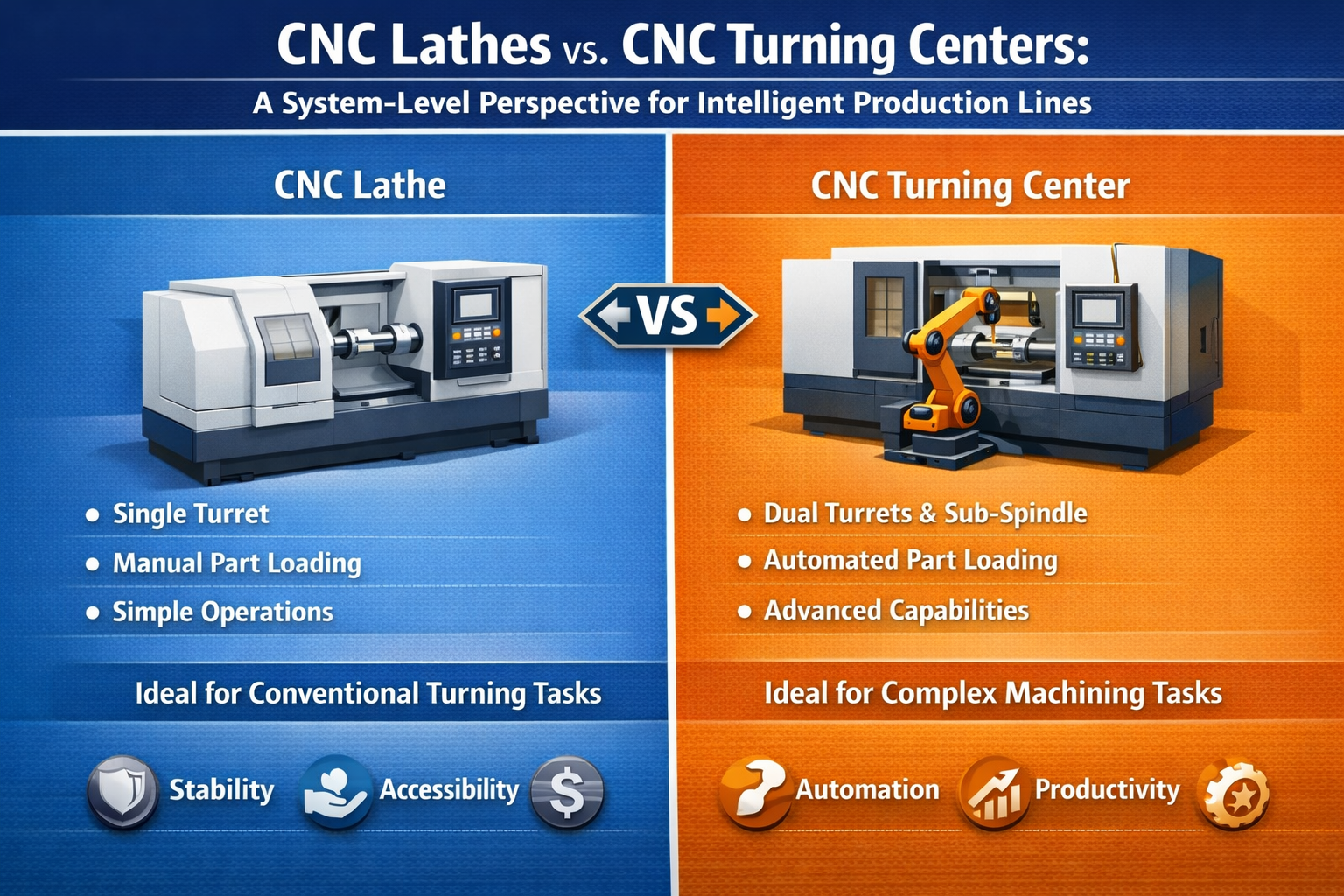
CNC lathes are widely used for fundamental turning processes such as facing, external turning, grooving, and simple threading. They are commonly applied in:
-
Small to medium batch production
-
Parts with relatively simple geometries
-
Workshops with limited automation requirements
CNC lathes offer improved repeatability over manual lathes, but in many cases, additional operations still require secondary machines or manual intervention, leading to increased handling and longer cycle times.
CNC Turning Centers: A Platform for Process Integration
CNC turning centers expand upon the capabilities of CNC lathes by integrating advanced features such as:
-
Automatic tool changers
-
Live tooling for drilling and milling
-
Multi-axis control
-
Higher process stability and precision
These capabilities enable multiple machining operations to be completed in a single setup, making turning centers especially suitable for high-volume, high-precision manufacturing environments.
From an intelligent manufacturing perspective, turning centers function not merely as machines, but as process integration platforms within a larger production system.
Beyond the Machine: Turning Equipment in Intelligent Production Lines
In modern factories, efficiency gains are no longer achieved by upgrading individual machines alone. Instead, performance improvements come from optimizing the entire production workflow.
In industries such as plumbing and sanitary ware, door control hardware, fire-fighting valves, locks, and auto & motorcycle parts, components often require a combination of:
-
Turning
-
Drilling
-
Tapping
-
Milling
-
Secondary finishing
When turning centers are integrated with CNC drilling, tapping, and milling compound machines—or CNC combined boring, milling, drilling, and tapping machines—they become a core element of a flexible, intelligent, and visualized production line.
Application Scenarios: Choosing the Right Configuration
When CNC Lathes Are Appropriate
-
Prototype or small-batch production
-
Simple part designs
-
Low automation requirements
When CNC Turning Centers Are Essential
-
Medium to large batch production
-
Parts with multiple machining features
-
High precision and consistency demands
-
Integration into automated or semi-automated production lines
For manufacturers planning long-term automation upgrades, CNC turning centers are typically selected as part of a systematic production line strategy, rather than as standalone equipment.
System-Level Advantages of Turning Center Integration
When evaluated within an intelligent production line, CNC turning centers offer several system-level benefits:
-
Reduced workpiece handling and repositioning
-
Shorter takt times
-
Improved dimensional consistency
-
Higher overall equipment efficiency (OEE)
-
Easier scalability for future automation
These advantages translate directly into lower unit costs, higher output stability, and better energy efficiency—key objectives for high-end manufacturing enterprises.
Designing Intelligent Production Lines for Real Manufacturing Needs
At Fujian Xinmei Machinery Technology Co., Ltd., we believe that equipment selection must always serve the broader objective of intelligent production line optimization.
Rather than focusing solely on machine specifications, effective production line design considers:
-
Process integration and layout planning
-
Automation compatibility
-
Visualization and production monitoring
-
Industry-specific machining requirements
This system-oriented approach enables manufacturers to move from isolated machining operations toward flexible, intelligent, and scalable manufacturing solutions.
Choosing a Long-Term Manufacturing Partner
Selecting CNC lathes or turning centers is not simply a purchasing decision—it is a strategic step in building a future-ready manufacturing system.
With extensive experience in equipment manufacturing, R&D, and production line application, Xinmei Machinery provides intelligent production line solutions tailored to real industrial scenarios. Our focus on flexibility, intelligence, and visualization helps customers achieve high-efficiency, high-precision, and high-capacity automated upgrades.
Conclusion: Think System, Not Just Equipment
CNC lathes and CNC turning centers each play important roles in modern machining. However, true manufacturing competitiveness is achieved when these technologies are properly integrated into intelligent production lines.
By shifting decision-making from machine-level comparisons to system-level planning, manufacturers can build production lines that are efficient, scalable, and ready for the future of intelligent manufacturing.