+86 13163919000
 info@xinmeiintelligent.com


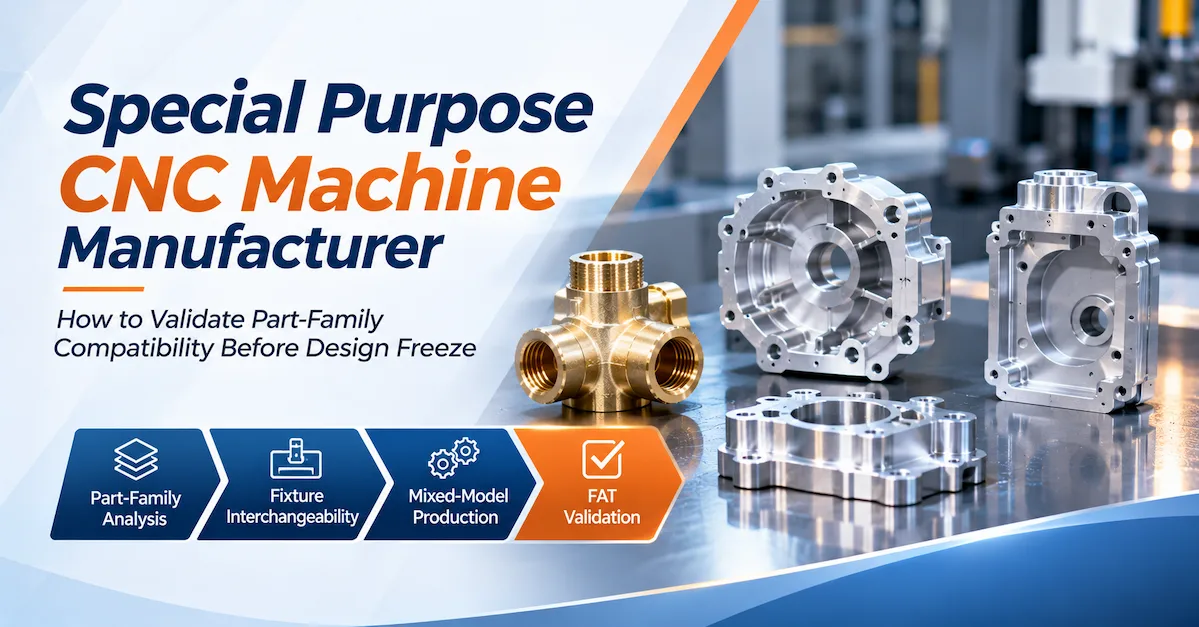
Quick Answer: A reliable special purpose CNC machine manufacturer should help buyers establish which component variants a customized machine can process before its design is finalized. This requires evaluating workpiece geometry, locating references, fixture interchangeability, spindle access, tooling, machining sequences, and production requirements. Design reviews establish the proposed compatibility, while subsequent machining trials and factory acceptance testing verify actual performance.
Dedicated CNC equipment can improve production efficiency by integrating repetitive machining operations. However, a machine designed exclusively around today's component may become difficult or expensive to modify when a new product variant enters production.
For automotive component suppliers, valve manufacturers, door-control hardware factories, and sanitary hardware producers, long-term product compatibility is therefore an essential equipment purchasing consideration.
This guide explains how to define a supported part family, evaluate custom machine configurations, and establish measurable acceptance requirements before committing to equipment manufacturing.
Explore XINMEI Special Purpose CNC Machines
Key Engineering Takeaways
-
A special-purpose machine should be designed around an explicitly defined range of components.
-
Similar external dimensions do not necessarily mean that two workpieces share the same machining requirements.
-
Fixture interchangeability must preserve locating accuracy, rigidity, and tool accessibility.
-
Machine compatibility should be evaluated before design freeze and verified through representative machining trials.
-
Mixed-model production capacity must account for changeovers, inspections, and production interruptions.
-
Future product variants should be treated as engineering options rather than automatically supported components.
-
Equipment quotations should define the cost and scope of additional fixture sets, tooling, programming, and validation.
1. What Should a Special Purpose CNC Machine Manufacturer Provide?
A special purpose CNC machine manufacturer designs and builds machining equipment around specific workpieces, manufacturing operations, and production objectives.
Unlike a general-purpose machine tool, dedicated equipment may integrate several cutting units, customized fixtures, rotary stations, or automated handling systems within a coordinated configuration.
The engineering objective is to match machine architecture to a defined manufacturing application.
For buyers producing multiple related component models, the manufacturer should also establish the limits of the proposed machine's flexibility.
Dedicated CNC Machines vs. Flexible CNC Equipment
| Evaluation factor | Dedicated CNC machine | Flexible CNC machining center |
|---|---|---|
| Primary objective | Repeated, application-specific production | Broader machining flexibility |
| Workpiece range | Defined component or part family | Wider range within machine capabilities |
| Fixtures | Often application-specific | General-purpose or dedicated fixtures |
| Operation sequence | Optimized around selected parts | More adaptable programming |
| Product changes | May require engineering modifications | Often easier to accommodate |
| Investment justification | Stable and repeatable demand | Variable production requirements |
The appropriate choice depends on the actual component family rather than production volume alone.
Who Should Consider Dedicated CNC Equipment?
Special-purpose machines are particularly relevant to manufacturers producing repeatable industrial components with stable machining requirements.
Factories producing unrelated prototypes, frequently changing geometries, or uncertain production quantities may benefit more from flexible machining centers.
2. What Is a Part Family in Special-Purpose CNC Machining?
A part family is a group of components sharing sufficiently similar manufacturing characteristics to support a common production system.
These characteristics may include material, overall geometry, locating surfaces, machining directions, cutting operations, and fixture requirements.
Components that look similar may still require significantly different machining arrangements.
For example, two valve housings may have similar external shapes but different port angles, internal thread sizes, or sealing-face locations.
A machine designed for one housing may not automatically support the other.
Common Industrial Part Families
| Industry | Typical component family | Compatibility considerations |
|---|---|---|
| Automotive | Steering gear components | Mounting geometry, bore positions and machining directions |
| Door control | Door closer bodies | Housing length, internal passages and end features |
| Valve manufacturing | Valve bodies and fittings | Port arrangement, thread sizes and sealing surfaces |
| Sanitary hardware | Faucet and angle valve bodies | Casting geometry, positioning and internal features |
| Industrial connectors | Connector housings | Hole patterns, locating references and material |
A qualified special purpose CNC machine manufacturer should evaluate these differences before determining the machine layout.
3. How to Build a CNC Part-Family Compatibility Matrix
A compatibility matrix converts product variations into measurable engineering requirements.
Rather than asking whether a machine can process several models, buyers should identify what changes between those models.
Part-Family Compatibility Checklist
| Engineering parameter | Information to compare |
|---|---|
| Overall dimensions | Minimum and maximum length, width and height |
| Workpiece weight | Loading and fixture requirements |
| Material grade | Cutting loads, tooling and process conditions |
| Blank geometry | Casting, forging or pre-machined condition |
| Locating surfaces | Shared and model-specific datums |
| Machining direction | Vertical, horizontal and angled features |
| Hole geometry | Diameter, depth and position |
| Thread specifications | Size, pitch and required tool access |
| Surface requirements | Functional faces and specified finish |
| Critical tolerances | Drawing-defined dimensional relationships |
| Production demand | Quantity and frequency for each model |
| Changeover requirements | Fixtures, tools, offsets and programs |
Four Compatibility Levels
Each component variant can be assigned a proposed compatibility status:
Level 1 — Program change only: The existing fixture and tooling arrangement can accommodate the component, subject to verification.
Level 2 — Fixture or tooling change: The machine structure remains unchanged, but approved fixture elements or cutting tools must be exchanged.
Level 3 — Engineering modification: Additional spindle access, machining units, handling equipment, or other structural changes may be necessary.
Level 4 — Outside the supported range: The proposed machine cannot accommodate the component without substantial redesign or alternative equipment.
This classification should be documented during engineering review and confirmed through appropriate testing.
4. Why Fixture Interchangeability Matters in Custom CNC Machine Design
Fixtures are fundamental to part-family manufacturing because they determine how each component is located, supported, and clamped.
A common fixture base with interchangeable locating elements may support several related component models.
However, interchangeable fixtures must maintain the required machining references after repeated changes.
Common Fixture Strategies
| Fixture strategy | Suitable application | Main limitation |
|---|---|---|
| Dedicated fixture | One stable component model | Limited compatibility with other parts |
| Replaceable locating elements | Similar components with dimensional variations | Requires repeatable installation |
| Modular fixture system | Several related part models | More complex setup verification |
| Separate fixture sets | Different component geometries | Additional storage and changeover time |
| Automated fixture system | Validated repeat production | Higher integration complexity |
What Should Buyers Verify?
Fixture engineering should address:
-
Repeatable locating after replacement.
-
Workpiece support during machining.
-
Clamping compatibility across blank variations.
-
Accessibility for cutting tools.
-
Chip evacuation around locating surfaces.
-
Compatibility with manual or robotic loading.
-
Wear and replacement requirements.
Fixture compatibility should not be established solely by whether a component physically fits.
A different workpiece may fit inside the fixture while creating unacceptable clamping deformation or blocking access to a critical feature.
XINMEI's CNC Fixtures and Workholding Guide provides additional information about the relationship between workholding and machining consistency.
5. How Should Machine Structure and Components Be Evaluated?
A special purpose CNC machine manufacturer must evaluate machine configuration against the complete supported component range.
A larger workpiece may require additional travel, while a deeper bore may require longer tooling. A different material may introduce more demanding cutting loads.
Technical Specification Review
| Machine specification | Part-family verification requirement |
|---|---|
| Linear axis travel | Access to the required machining features |
| Rotary movement | Compatibility with required workpiece orientations |
| Spindle speed and torque | Suitability for the supported materials and tools |
| Spindle arrangement | Access to required machining directions |
| Tool-holder clearance | No interference with fixtures or components |
| Tool-changing capacity | Required tools for each approved variant |
| Fixture envelope | Accommodation of all supported component sizes |
| CNC controller | Management of part-specific programs and offsets |
| Loading system | Compatibility with component geometry and weight |
| Chip management | Suitability for the intended materials and operations |
| Safety configuration | Appropriate safeguarding for each approved setup |
The required numerical specifications must be established through the actual project.
Maximum machine travel, spindle speed, or spindle quantity should not be interpreted as proof of finished-part compatibility.
Material and Tooling Considerations
Brass, aluminum alloys, carbon steel, and stainless steel may require different cutting-tool geometries, operating conditions, and chip-management strategies.
Even when two components have identical dimensions, changing the material may affect spindle requirements, cutting stability, tool consumption, and cycle time.
Buyers should therefore include material changes within the compatibility matrix rather than treating them as simple programming adjustments.
6. Which Special-Purpose CNC Machine Configuration Supports Multiple Models?
Different equipment architectures offer different opportunities for process integration and model compatibility.
XINMEI Intelligent develops industrial machining equipment for applications including door-control hardware, automotive components, valves, and other precision metal parts.
Its published special-purpose machine range includes dedicated component machines, multi-spindle systems, and multi-station composite equipment.
XINMEI Special Purpose CNC Equipment Comparison
| Equipment | Published equipment direction | Key compatibility question |
|---|---|---|
| Door Closer Special Purpose Machine Tool | Integrated machining of door closer components | Can different housing lengths share the proposed locating system? |
| Automotive Steering Gear CNC Machining Center | Dedicated steering component machining | Can related component models use compatible fixtures and tool access? |
| CNC Vertical Transform Type Multi-Spindle Combined Machine Tool | Rotary multi-spindle process integration | Can spindle tasks accommodate each approved machining sequence? |
| Vertical-Horizontal Multi-Station Turntable Composite Machine | Combined machining orientations and rotary stations | Can every model be processed without interference or unacceptable station imbalance? |
These equipment descriptions reflect the published product positioning. Actual model compatibility must be confirmed through project-specific engineering evaluation.
Why Multi-Spindle Equipment Requires Careful Planning
Multi-spindle equipment can integrate several operations into a coordinated system.
However, when a new component requires additional machining time at one station, the overall production cycle may change.
For rotary or synchronized multi-station machines, buyers should investigate whether the longest operation creates a new bottleneck.
This is particularly important when the machine will produce several related components in different batch quantities.
7. Engineering Example: Evaluating Three Valve Housing Variants
Consider a hypothetical valve manufacturer planning to purchase a dedicated CNC machine for three related valve housing models.
The components have similar functions but different machining requirements.
Illustrative Compatibility Matrix
| Requirement | Model A | Model B | Model C |
|---|---|---|---|
| Material | Brass | Brass | Brass |
| Main locating geometry | Reference design | Shared | Modified |
| Port direction | Two standard directions | Same as A | Additional angled port |
| Thread size | Standard | Larger thread | Different thread |
| Fixture requirement | Base fixture | Replaceable locating elements | New fixture concept |
| Machining program | Base program | Modified program | Additional operation |
| Preliminary compatibility | Base configuration | Conditional | Engineering review required |
Model B may be compatible through fixture inserts, tooling changes, and an approved machining program.
Model C introduces a different machining direction and locating geometry. It may require an additional operation or a different machine configuration.
The manufacturer should not classify Model C as compatible until tool access, fixture design, machine movement, and safety requirements have been assessed.
This example is hypothetical and does not represent an actual XINMEI customer project or guaranteed equipment performance.
8. How to Evaluate Mixed-Model Production Capacity
Dedicated CNC machine productivity should be calculated using the expected combination of component models.
A machine that performs efficiently on one component may deliver different output when operating with frequent model changes.
Illustrative Production Calculation
Assume a machine processes two approved component variants:
-
Model A: 200 components at a 60-second cycle.
-
Model B: 100 components at a 90-second cycle.
-
Each model change requires 12 minutes.
| Production factor | Grouped production | Frequent model changes |
|---|---|---|
| Model A processing time | 200 min | 200 min |
| Model B processing time | 150 min | 150 min |
| Number of changeovers | 2 | 6 |
| Total changeover time | 24 min | 72 min |
| Total scheduled processing time | 374 min | 422 min |
Under these assumptions, frequent model changes increase processing and changeover time by 48 minutes, even though the individual machining cycles remain unchanged.
The calculation excludes maintenance, additional inspection, downtime, and rejected components. It illustrates planning principles rather than published machine performance.
What Should a Manufacturer Confirm?
Ask for individual model cycle estimates, changeover procedures, inspection requirements after changeover, and any restrictions on model sequencing.
The production target should reflect the customer's actual order mix, not merely the fastest component.
9. What Should Be Approved Before CNC Machine Design Freeze?
Design freeze is the formal approval of the machine's engineering baseline before major manufacturing commitments proceed.
It does not eliminate every future design change. Instead, it establishes an agreed configuration against which changes can be evaluated.
Recommended Engineering Approval Milestones
| Project stage | Expected approval or deliverable |
|---|---|
| Requirements review | Approved drawings and part-family matrix |
| Concept design | Proposed machine structure and process sequence |
| Fixture review | Locating, clamping and interchangeability concept |
| Tool-access review | Machining envelope and interference assessment |
| Configuration approval | CNC, spindle and major component selection |
| Safety review | Preliminary hazards and protective measures |
| Design freeze | Approved engineering baseline |
| Machine manufacturing | Fabrication, assembly and integration |
| Machining trials | Representative component validation |
| FAT | Documented acceptance against agreed requirements |
Before design freeze, the buyer and manufacturer should agree which variants are included, conditionally supported, excluded, or reserved for future development.
For high-risk requirements, additional engineering studies or prototype fixture trials may be appropriate before approval.
Why Safety Must Be Reviewed When the Design Changes
Changes to fixtures, workpiece size, machining units, or automatic loading may introduce new hazards.
ISO 12100:2010 provides internationally recognized principles for machinery risk assessment and risk reduction.
Its relevance is particularly important when a customized machine is modified beyond its originally approved configuration.
Applicable legal and safety requirements must be evaluated for the final machine and destination market.
10. How to Verify Part-Family Compatibility During FAT
Factory Acceptance Testing (FAT) should demonstrate whether the manufactured equipment satisfies the agreed purchase requirements.
For a multi-model special-purpose machine, testing only the easiest component may leave important compatibility risks unresolved.
Representative FAT Test Matrix
| Test category | Recommended verification |
|---|---|
| Base component | Complete machining sequence |
| Largest approved component | Clearance, handling and tool accessibility |
| Smallest approved component | Fixture support and locating stability |
| Most demanding machining feature | Drawing-defined quality requirements |
| Fixture interchange | Repeatable installation and alignment |
| Model changeover | Complete procedure and measured time |
| First part after changeover | Dimensional and functional conformity |
| Repeated production | Agreed batch stability assessment |
| Safety functions | Relevant checks for approved configurations |
| Documentation | Supported models and configuration records |
Machine Precision vs. Finished-Part Accuracy
ISO 230-2:2014 provides methods for measuring the positioning accuracy and repeatability of numerically controlled machine-tool axes.
However, good axis positioning results do not automatically establish the dimensional accuracy of every component variant.
Finished-part quality also depends on the fixture, tooling, material condition, cutting process, and measurement method.
Both machine-level testing and actual workpiece trials should therefore be included where relevant.
XINMEI's Quality Assurance information describes engineering review, material verification, assembly inspection, and final machine validation.
Project-specific test quantities, tolerances, conformity documents, and acceptance conditions should be agreed before ordering.
11. What Determines the Cost of a Multi-Model Special-Purpose CNC Machine?
The cost of customized CNC equipment depends on more than the machine's base configuration.
Supporting several component variants may require additional engineering, fixtures, tools, programs, handling systems, and validation work.
Main Customization Cost Factors
| Cost factor | Purchasing consideration |
|---|---|
| Machine configuration | Required machining units and movement ranges |
| Additional fixture sets | Number and complexity of supported variants |
| Tooling | Dedicated cutting tools and holders |
| CNC programming | Model-specific machining sequences |
| Automation | Loading and handling compatibility |
| Engineering changes | Modifications requested after approval |
| Testing | Representative trials and inspection reports |
| Spare parts | Replacement locating and wear components |
| Commissioning | Installation, training and site verification |
Buyers should request separate pricing for the base machine, currently approved variants, optional configurations, and potential future expansion.
This makes it easier to compare quotations and avoid paying for unnecessary flexibility.
How Long Does Customized Equipment Manufacturing Take?
Lead time depends on engineering complexity, configuration approval, component availability, fixture development, assembly, programming, and acceptance testing.
Additional part variants or drawing changes may affect the project schedule.
Request a milestone-based delivery plan instead of relying on a single estimated shipment date.
12. How to Request a Customized CNC Machine From XINMEI
XINMEI Intelligent is an industrial CNC equipment manufacturer based in Fujian, China, with a published portfolio of machining centers, special-purpose machines, and industrial automation systems.
For manufacturers evaluating dedicated equipment, an effective technical inquiry should define both present and planned production requirements.
Special Purpose CNC Machine RFQ Checklist
| Information required | Details to provide |
|---|---|
| Component drawings | 2D drawings and available 3D models |
| Part-family information | Current and planned component variants |
| Material | Grade, blank condition and material differences |
| Machining operations | Milling, drilling, tapping, boring or turning |
| Critical characteristics | Datums, tolerances and functional surfaces |
| Production demand | Monthly quantities for each variant |
| Current process | Existing equipment and setup sequence |
| Production problems | Scrap, handling, changeovers or capacity limitations |
| Automation requirements | Manual or automatic loading preferences |
| Acceptance requirements | Sample trials and inspection criteria |
| Factory conditions | Available space, utilities and installation needs |
| Project schedule | Required production start and delivery expectations |
For confidential component designs, buyers should establish appropriate confidentiality arrangements before exchanging sensitive engineering information.
Planning to manufacture several related metal components on one dedicated CNC system?
Contact XINMEI for a Part-Family Compatibility Review and CNC Equipment Quotation
Provide representative drawings and production targets so the equipment discussion can begin with actual machining requirements.
Frequently Asked Questions
1. What is a special purpose CNC machine manufacturer?
A special purpose CNC machine manufacturer develops machining equipment around defined industrial components, process sequences, and production objectives. The equipment may include dedicated fixtures, multiple cutting units, rotary stations, and application-specific automation.
2. Can one special-purpose CNC machine process multiple component models?
Yes, when the machine is engineered and validated for the required component family. Compatibility depends on geometry, materials, fixtures, machining access, tooling, and production requirements.
3. What is part-family compatibility in CNC machining?
Part-family compatibility describes the ability of one manufacturing system to process a defined group of related components under approved configurations and acceptance conditions.
4. Can future component models be added after purchasing a CNC machine?
Potentially. Some variants may require only programming or fixture changes, while others may require structural modifications. Future compatibility should be assessed rather than assumed.
5. How can CNC machine changeover time be reduced?
Manufacturers can evaluate interchangeable fixtures, standardized locating references, predefined tool sets, controlled machining programs, and documented setup procedures. Actual improvements must be verified through representative changeover trials.
6. Are multi-spindle CNC machines suitable for mixed-model production?
They can be suitable when supported models share compatible machining requirements. Buyers should evaluate spindle accessibility, operation allocation, station balance, tooling, and changeover restrictions.
7. How much does a customized special-purpose CNC machine cost?
Pricing depends on machine structure, machining units, fixtures, tooling, automation, engineering, and testing scope. An accurate quotation requires component drawings and defined production requirements.
8. What should be included in a special-purpose CNC machine FAT?
The FAT should address agreed machine functions, representative component machining, dimensional inspection, cycle time, fixture interchangeability, changeover performance, and relevant safety checks.
9. Does machine positioning accuracy guarantee compatibility with every part model?
No. Machine positioning is only one aspect of manufacturing capability. Workholding, tool access, machining loads, material condition, and component geometry also influence finished-part results.
10. How do I choose a reliable special purpose CNC machine manufacturer?
Evaluate the supplier's application engineering, machine manufacturing capabilities, fixture knowledge, configuration transparency, compatibility assessment, testing procedures, and after-sales support. Request a proposal based on actual part drawings rather than general catalogue specifications.
Technical References
-
ISO 230-2:2014 — Machine-tool axis positioning accuracy and repeatability.
-
ISO 12100:2010 — Machinery risk assessment and risk reduction.
-
XINMEI Special Purpose Machines — Industrial CNC equipment configurations.
-
XINMEI Quality Assurance — Engineering review, manufacturing inspection, and final validation.
Conclusion
Selecting a reliable special purpose CNC machine manufacturer requires a clear understanding of both current machining requirements and future product variations.
For factories manufacturing related valve bodies, automotive components, door closer housings, and other industrial metal parts, compatibility should be defined before the machine design is finalized.
A documented part-family matrix, suitable fixture strategy, verified tooling access, realistic mixed-model production plan, and representative acceptance tests can help reduce equipment modification risks and support long-term manufacturing value.
XINMEI Intelligent provides special-purpose CNC machining equipment, multi-spindle machines, multi-station composite systems, and industrial automation solutions for applicable production requirements.
If your company is planning to invest in customized CNC equipment, contact XINMEI with your component drawings, part-family information, machining requirements, and production targets to discuss a suitable equipment configuration.