+86 13163919000
 info@xinmeiintelligent.com


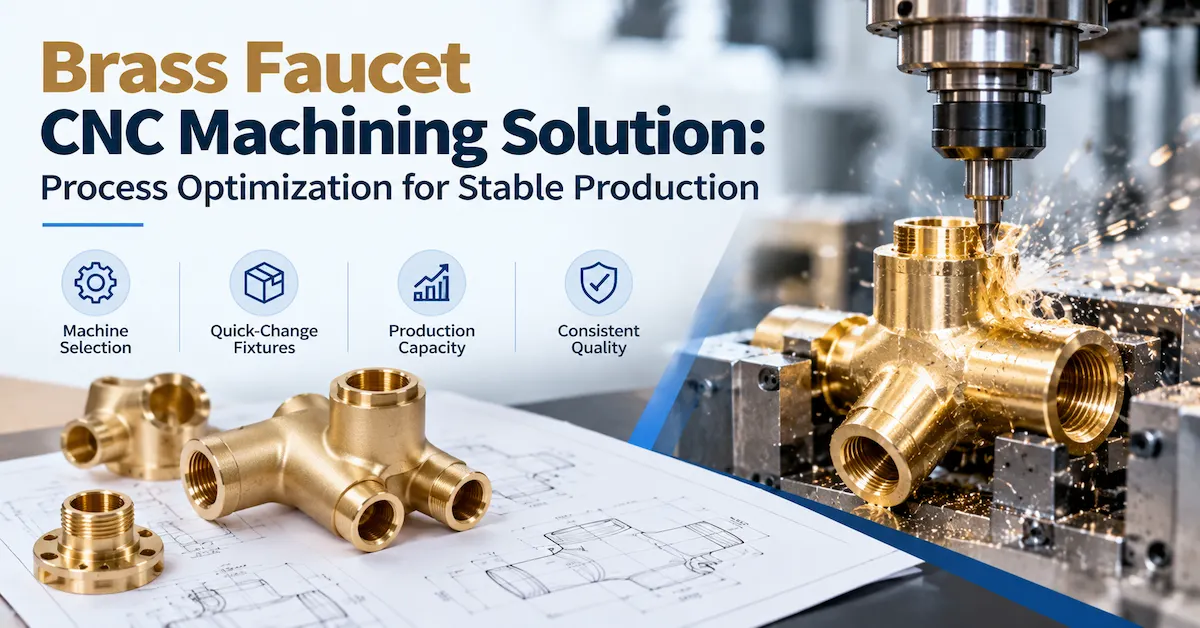
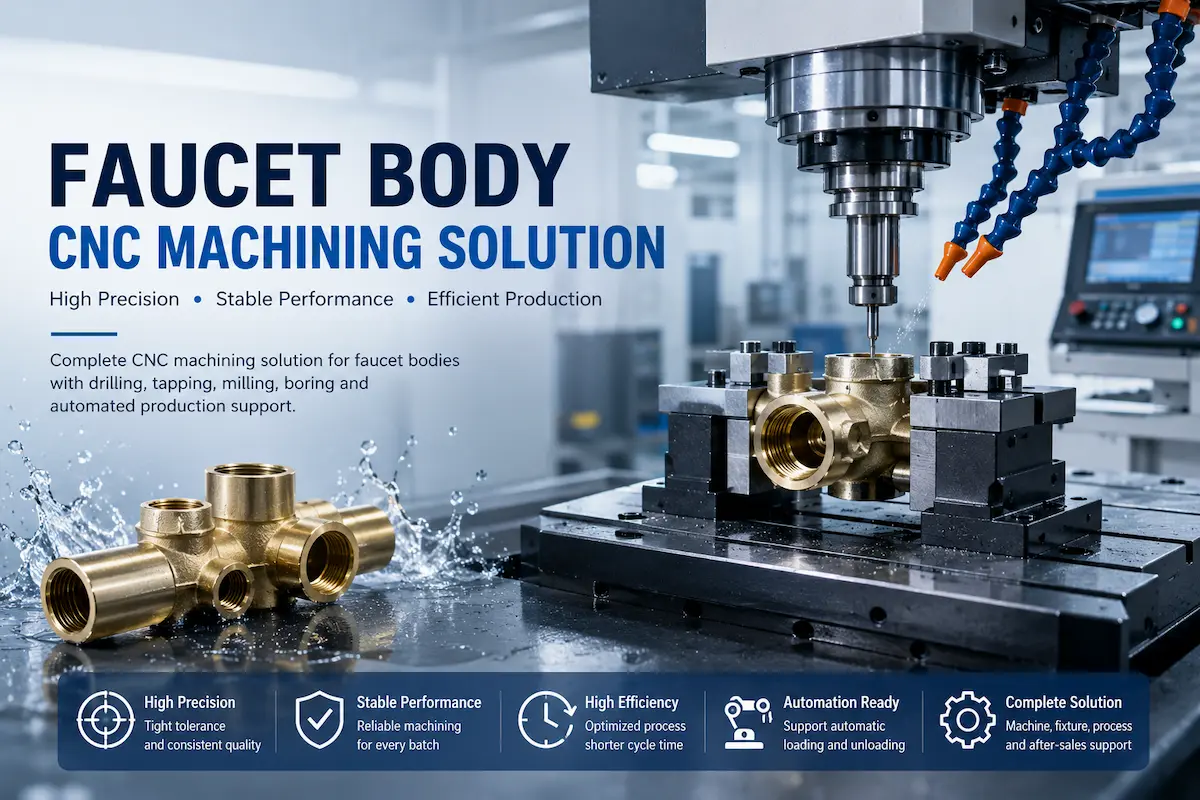
A sanitary ware CNC production line should be designed around the complete manufacturing process, not simply the number of CNC machines installed. For faucet and angle-valve manufacturers, stable production depends on coordinating drilling, tapping, milling, workpiece positioning, material transfer, inspection, and station cycle times.
A factory may own several high-performance CNC machines but still experience low output because one machining station takes longer than the others. Excessive manual handling, repeated clamping, inconsistent brass castings, and poorly positioned inspection stations can create additional production bottlenecks.
The right production-line solution combines suitable CNC equipment, balanced machining operations, reliable fixtures, and appropriate automation. It should deliver an agreed quantity of accepted components under realistic operating conditions.
This guide explains how sanitary ware manufacturers can plan production-line layouts, compare CNC equipment, calculate output capacity, and evaluate customized manufacturing solutions before making an investment.
Explore XINMEI Bathroom Hardware Machining Solutions | Request a CNC Production Line Proposal
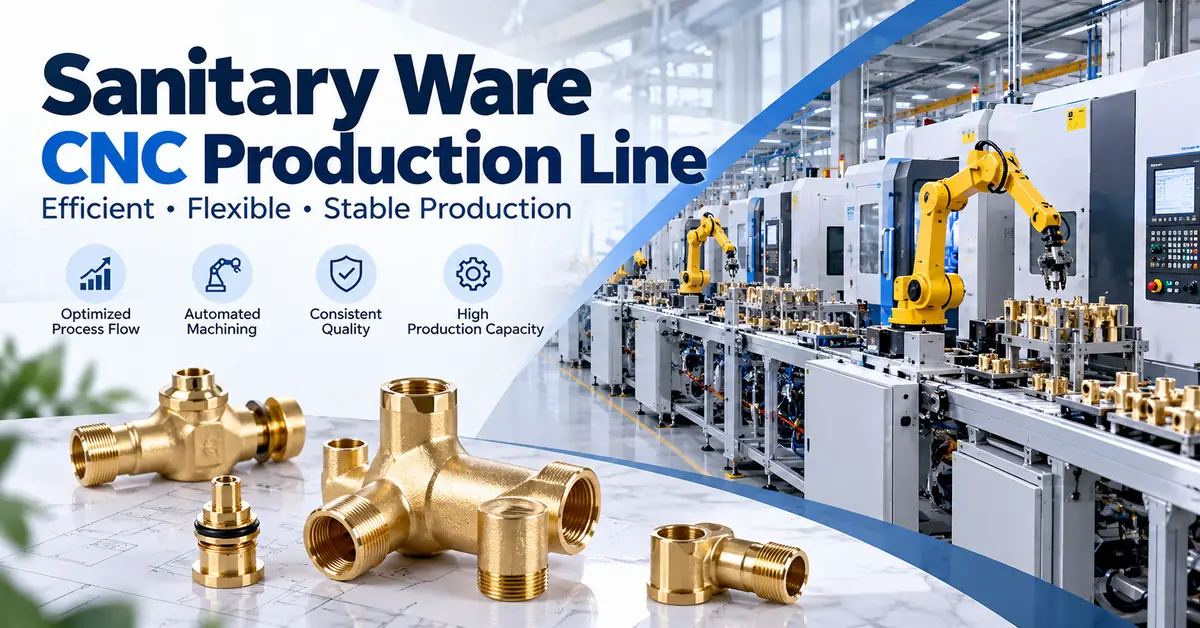
1. What Is a Sanitary Ware CNC Production Line?
A sanitary ware CNC production line is an integrated manufacturing system that coordinates CNC machining operations and supporting processes for bathroom hardware components such as faucets, angle valves, valve housings, and water meter parts.
Depending on the product, the system may include CNC drilling and tapping machines, machining centers, dedicated fixtures, robotic loading systems, material-transfer equipment, and quality-inspection stations.
The purpose is to transform incoming metal blanks into dimensionally acceptable machined components through a repeatable production process.
What Makes a Production Line Different From a Standalone CNC Machine?
A standalone machine performs defined machining operations. A production line coordinates multiple operations and the movement of workpieces between them.
An effective line must control:
-
Machining sequence and workpiece positioning.
-
Station cycle times and production bottlenecks.
-
Loading, unloading, and workpiece transfers.
-
Tool changes, fixture adjustments, and maintenance.
-
Inspection, rejection, and rework handling.
-
Production data and process consistency.
The sanitary ware CNC production line must therefore be evaluated as one manufacturing system rather than a collection of independent machines.
Which Factories Benefit Most?
Integrated CNC production lines are particularly relevant to manufacturers with repeatable machining processes, established product designs, and sufficient production demand.
Factories producing several unrelated models in small batches may benefit more from flexible CNC machining centers or semi-automated cells.
A complete automated line should be justified by actual output requirements, not simply the desire to introduce more automation.
2. Which Sanitary Ware Components Can Be Produced on CNC Lines?
Bathroom hardware manufacturing involves different materials, component geometries, and machining requirements.
XINMEI's Bathroom Hardware CNC Machining capabilities cover copper and brass, stainless steel, and other applicable materials, with drilling, tapping, milling, turning, multi-spindle machining, and automated production among its machining solutions.
Common Applications and Machining Requirements
| Component | Typical machining operations | Critical production consideration |
|---|---|---|
| Brass faucet body | Drilling, milling, tapping, boring | Port alignment and sealing-related features |
| Angle valve body | Drilling, threading, milling | Connection geometry and thread consistency |
| Shower valve housing | Multi-directional drilling, boring, tapping | Internal passages and datum relationships |
| Faucet main body | Milling, drilling, tapping | Repeatable positioning across multiple faces |
| Water meter components | Turning, drilling, milling | Fit and dimensional consistency |
| Stainless steel sanitary fittings | Drilling, milling, threading | Tool wear, heat, and burr control |
These operations are application examples; the actual route must follow each approved component drawing.
Why Material Selection Matters
Brass is frequently used in bathroom hardware because suitable grades offer good machinability and corrosion resistance. However, casting quality, alloy composition, wall thickness, and blank dimensions can influence machining behavior.
Stainless steel components may require different cutting tools, parameters, and chip-management strategies.
A production line designed for one brass alloy should not automatically be considered suitable for every brass or stainless steel component.
Buyers should provide exact material specifications and representative production blanks before approving an equipment configuration.
3. How Should a Sanitary Ware CNC Production Process Be Organized?
The first step is to map the manufacturing route from the incoming blank to the accepted machined component.
A typical faucet-body machining route might include:
-
Incoming blank inspection and orientation.
-
Datum preparation and initial machining.
-
Primary drilling and boring operations.
-
Threading and secondary machining.
-
Deburring, chip removal, and cleaning.
-
Dimensional inspection and part sorting.
The actual order depends on geometry, machining access, tolerances, and fixture design.
Start With the Critical Features
Engineers should identify dimensions and surfaces that affect assembly and product function.
For sanitary ware components, these often include threaded ports, cartridge bores, sealing surfaces, mounting faces, and intersecting internal passages.
These features influence the selection of machining datums, fixtures, spindle arrangements, and inspection methods.
Reduce Unnecessary Repositioning
Every additional clamping operation introduces handling time and may introduce a new source of positioning variation.
Multi-station CNC machines or appropriate fixture configurations may allow compatible operations to be performed with fewer transfers.
However, fewer setups are beneficial only when the resulting process maintains required dimensional accuracy, tool access, and quality.
For additional engineering guidance, see XINMEI's article on CNC Machining Efficiency Through Process Planning.
4. How to Choose CNC Equipment for a Sanitary Ware Production Line
Machine selection should depend on the required machining operations and the relationship between production stations.
XINMEI offers CNC Machining Centers, Special Purpose Machines, and Automation Lines for industrial manufacturing applications.
CNC Equipment Comparison
| Equipment configuration | Main advantage | Suitable application | Selection consideration |
|---|---|---|---|
| CNC drilling and tapping machine | Efficient hole and thread machining | Faucet and valve connection features | Tool access and thread requirements |
| Vertical CNC machining center | Flexible milling, drilling, and tapping | Multiple bathroom hardware models | Fixture changes and machining directions |
| Horizontal machining center | Access to several machining faces | Complex faucet and valve housings | Workpiece orientation and investment |
| Multi-spindle CNC machine | Repeated machining operations | Stable high-volume components | Spindle layout and process compatibility |
| Special-purpose CNC machine | Application-specific machining | Standardized mass-produced components | Lower flexibility for major design changes |
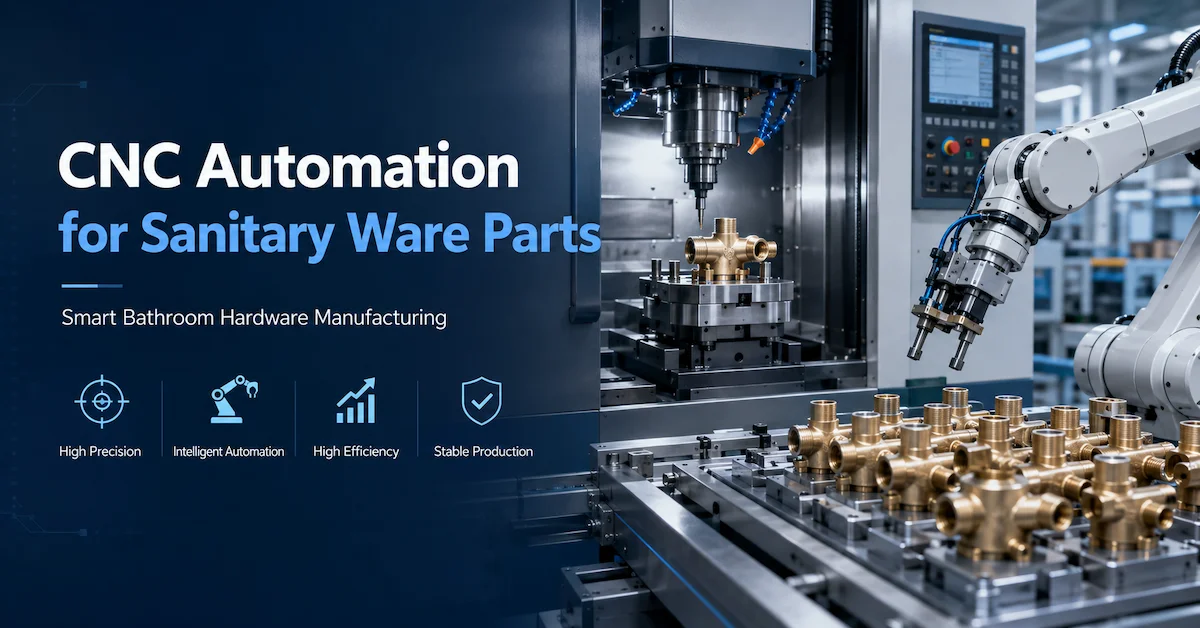
| CNC and robot integrated line | Coordinated machining and handling | Repeatable automated production | Integration, recovery, and line balancing |
When Is a Multi-Spindle Machine the Better Choice?
Multi-spindle equipment can be attractive when several machining operations are compatible with simultaneous or coordinated processing.
For example, a standardized angle-valve body may require multiple repeated hole-machining operations.
If the workpiece geometry permits suitable spindle access, a multi-spindle configuration may reduce machining time.
However, additional spindles do not guarantee higher production output.
Fixture loading, tool life, machine indexing, part transfer, and downstream operations must also be considered.
5. How to Balance CNC Machining Stations for Higher Output
Station balancing is one of the most important steps in planning a sanitary ware CNC production line.
A production line is frequently limited by its slowest essential station.
Adding faster machines to already efficient stations may not increase total output if the bottleneck remains unchanged.
Example: Three-Station Faucet Body Production
Consider a hypothetical production line with three machining stations.
| Station | Process | Complete cycle time |
|---|---|---|
| Station 1 | Primary drilling and datum machining | 72 seconds |
| Station 2 | Secondary boring and tapping | 95 seconds |
| Station 3 | Final machining and part transfer | 64 seconds |
Assume each station processes one workpiece per cycle and the line has sufficient transfer capacity.
The nominal maximum output is determined by Station 2:
Theoretical line output = 3,600 ÷ 95 = approximately 37.9 parts/hour
The other stations may spend time waiting because Station 2 cannot accept or release components quickly enough.
What Happens If the Bottleneck Is Improved?
One possible engineering option is to provide two equivalent parallel operations for Station 2.
Under ideal alternating loading and adequate transfer capacity, its combined effective interval could approach 47.5 seconds.
The new theoretical bottleneck would then be Station 1:
Theoretical line output = 3,600 ÷ 72 = 50 parts/hour
This is an illustrative improvement in nominal capacity, not a guaranteed production result.
Actual performance depends on whether the parallel operations can run independently, share resources without interference, and maintain the required quality.
Calculate Accepted Production Capacity
For a preliminary line-level estimate:
Accepted output ≈ Available operating time ÷ Bottleneck cycle time × Availability × First-pass yield
For example, assume:
-
Planned operating time: 420 minutes.
-
Bottleneck cycle time: 72 seconds.
-
Operating availability: 85%.
-
First-pass yield: 98%.
Estimated accepted production:
(420 × 60 ÷ 72) × 0.85 × 0.98 ≈ 292 parts/shift
The values above are hypothetical planning assumptions, not XINMEI performance measurements.
Operating time, availability, and quality losses must be defined consistently to avoid counting the same downtime twice.
ISO 22400-2:2014, Automation systems and integration — Key performance indicators (KPIs) for manufacturing operations management — Part 2, provides established definitions and descriptions of manufacturing performance indicators.
The lesson is straightforward: production capacity should be calculated from the complete manufacturing system, not the fastest individual CNC machine.
6. How Do Fixtures and Material Handling Affect Production Stability?
A well-balanced machining sequence can still perform poorly if workpieces are loaded inconsistently.
Bathroom hardware often includes cast, forged, or machined blanks with different external shapes.
These characteristics affect fixture design and automated handling.
Essential Fixture Requirements
Production fixtures should provide:
-
Repeatable location against defined datums.
-
Adequate clamping rigidity.
-
Access to cutting tools.
-
Protection of critical and visible surfaces.
-
Reliable chip evacuation.
-
Compatibility with the intended loading method.
For faucet and valve components, incorrect clamping can affect bore alignment, thread position, or surface appearance.
XINMEI's CNC Fixtures and Workholding Guide explains the importance of fixture stability in repeatable machining.
Should Workpiece Transfers Be Automated?
Robotic loading can reduce repetitive handling and support consistent workpiece orientation.
However, automation must account for real blank variations, gripper contact, fixture confirmation, and recovery from loading errors.
XINMEI provides Robot Loading and Unloading Lines for compatible manufacturing processes.
The robot should be selected after defining the workpiece and machining sequence, not before.
7. What Quality-Control Stations Should a Sanitary Ware CNC Line Include?
Quality control should be integrated into the process plan rather than added after equipment installation.
A reliable production line must identify defects early enough to prevent unnecessary downstream processing.
Recommended Inspection Plan
| Inspection point | What to verify | Why it matters |
|---|---|---|
| Incoming blank inspection | Material, dimensions, visible defects | Prevents unsuitable blanks entering production |
| First-piece inspection | Critical dimensions after setup | Confirms process readiness |
| In-process checks | Tool condition and critical features | Detects dimensional drift |
| Thread inspection | Required thread geometry | Supports assembly compatibility |
| Deburring inspection | Internal and external burrs | Reduces assembly and cleanliness problems |
| Final dimensional inspection | Drawing-defined tolerances | Confirms component conformity |
| Functional verification, where applicable | Sealing or assembly performance | Verifies requirements not established by dimensions alone |
Not every inspection needs a dedicated automated station. The appropriate approach depends on the risk, inspection frequency, measurement method, and production volume.
Machine Accuracy Is Not the Same as Finished-Part Accuracy
ISO 230-2:2014, Test code for machine tools — Part 2, defines methods for evaluating positioning accuracy and repeatability of numerically controlled machine-tool axes.
These measurements are useful for machine acceptance and verification.
However, actual faucet-part accuracy also depends on cutting tools, fixtures, material conditions, thermal effects, and machining processes.
A buyer should therefore request both relevant machine-test evidence and dimensional reports for actual production workpieces.
8. What Technical Specifications Should Buyers Request?
Before purchasing a sanitary ware CNC production line, buyers should define their technical requirements.
A useful specification should cover both individual machines and system-level performance.
Production Line Technical Specification Checklist
| Specification | Requirement to define |
|---|---|
| Applicable components | Faucet bodies, angle valves, valve housings, etc. |
| Workpiece materials | Brass alloy, stainless steel, or other grade |
| Maximum workpiece size | Based on approved drawings and blanks |
| Critical tolerances | Drawing-specific dimensions and measurement methods |
| Required operations | Drilling, tapping, boring, milling, or turning |
| Machine configuration | Vertical, horizontal, multi-spindle, or special-purpose |
| Target cycle time | Complete cycle per component or station |
| Accepted output | Required good parts per shift |
| Fixture configuration | Dedicated, modular, or automatic |
| Automation level | Manual, semi-automatic, or robotic |
| Transfer method | Operator, conveyor, robot, or other system |
| Inspection scope | In-process and final acceptance requirements |
| Factory conditions | Available space, power, air, and safety provisions |
| Product changeover | Supported variants and required setup time |
These are project-definition requirements, not universal performance specifications for XINMEI machines.
The actual configuration and achievable results must be confirmed during engineering evaluation.
9. How to Validate a Production Line Before Bulk Manufacturing
A factory acceptance test (FAT) should demonstrate that the proposed production line can perform the agreed manufacturing operations under defined conditions.
For sanitary ware applications, buyers should use representative production blanks instead of unrelated demonstration parts.
Recommended FAT Procedure
Step 1: Verify the equipment configuration.
Confirm the agreed CNC machines, control systems, fixtures, tooling, automation interfaces, and safety provisions.
Step 2: Run representative machining operations.
Machine approved faucet or angle-valve samples using the intended production process.
Step 3: Inspect critical dimensions.
Measure the required holes, threads, bores, and sealing-related features against the drawing.
Step 4: Test integrated material flow.
Verify loading, unloading, transfer, part orientation, and rejected-part handling.
Step 5: Measure production performance.
Record complete station cycles, interruptions, line output, and the number of accepted components during an agreed test period.
Step 6: Verify fault recovery.
Check how the system responds to relevant alarms, missing workpieces, fixture errors, and controlled stoppages.
Step 7: Review technical documentation.
Confirm the agreed operating instructions, maintenance requirements, electrical documentation, and training scope.
Acceptance criteria, sample sizes, test conditions, and responsibilities should be agreed before FAT begins.
This reduces disputes and gives buyers a measurable basis for evaluating the completed line.
10. What Determines the Cost of a Sanitary Ware CNC Production Line?
The cost of an integrated machining line depends on the number and type of machines, automation scope, fixture complexity, inspection requirements, and project integration work.
A quotation for three standalone CNC machines is not directly comparable with a complete automated machining system.
Major Cost Factors
| Cost factor | Commercial consideration |
|---|---|
| CNC machine selection | Standard versus customized equipment |
| Number of stations | Required machining operations and line balance |
| Spindle configuration | Single versus multi-spindle processing |
| Fixtures and tooling | Custom workholding and cutting requirements |
| Robot integration | Grippers, interfaces, guarding, and programming |
| Material handling | Conveyors, buffers, and workpiece orientation |
| Quality control | Measurement equipment and inspection integration |
| Engineering and commissioning | Design, programming, testing, and installation |
| Maintenance | Consumables, tools, spare parts, and service |
Should Buyers Choose a Fully Automated Line?
Not always.
A semi-automated machining cell may be more economical when production volumes are moderate or product designs change frequently.
A fully integrated production line may become attractive when the manufacturing process is stable, demand is sufficient, and repetitive handling creates a measurable bottleneck.
Compare alternatives using total cost of ownership, accepted output, production flexibility, and operational risk—not purchase price alone.
11. Customized Sanitary Ware CNC Production Lines from XINMEI
XINMEI Intelligent, operated by Fujian Xinmei Machinery Technology Co., Ltd., provides CNC machine tools, special-purpose equipment, and manufacturing automation solutions.
Its published product portfolio includes CNC machining centers, robot loading systems, and CNC-plus-robot integrated automation lines.
For faucet and valve manufacturers, an application-specific engineering evaluation can consider:
-
Component drawings and machining requirements.
-
Material and blank characteristics.
-
Machine and spindle configuration.
-
Fixture and tooling design.
-
Station allocation and production-line balance.
-
Robotic loading and material transfer.
-
Quality inspection and acceptance requirements.
-
Future production expansion.
Buyers can review XINMEI's CNC + Robot Integrated Automation Lines and Bathroom Hardware Machining Capabilities when developing a production-line proposal.
Specific equipment availability, customization scope, cycle times, project schedule, and acceptance commitments must be confirmed against the actual manufacturing requirements.
Request an Engineering Evaluation
Are you planning a new faucet production line, increasing angle-valve output, or replacing disconnected CNC operations?
Provide your component drawings, material specifications, target production volume, existing machining process, and automation requirements.
Contact XINMEI to Discuss Your Sanitary Ware CNC Production Line
12. How to Prepare an RFQ for a Sanitary Ware CNC Production Line
A well-prepared request for quotation helps equipment manufacturers assess the project and provide comparable proposals.
For accurate evaluation, include:
-
Workpiece drawings: 2D or 3D drawings for representative components.
-
Material requirements: Brass grade, stainless steel grade, and blank condition.
-
Critical features: Threads, bores, sealing interfaces, and dimensional tolerances.
-
Existing process: Current machines, cycle times, and production problems.
-
Production target: Required accepted components per shift or day.
-
Product range: Current and expected future component models.
-
Automation requirements: Loading, unloading, transfers, sorting, and inspection.
-
Factory layout: Available installation area and utility conditions.
-
Testing requirements: Samples, measurements, production trials, and FAT criteria.
-
Project schedule: Desired installation and production-start milestones.
Suppliers should explain what is included, what is optional, and which specifications require further engineering confirmation.
Project lead time should also be separated from production cycle time. The former concerns engineering, manufacturing, integration, testing, delivery, and commissioning; the latter concerns the rate at which the completed line produces components.
A complete RFQ reduces avoidable specification changes and improves the quality of procurement decisions.
Frequently Asked Questions About Sanitary Ware CNC Production Lines
1. What is a sanitary ware CNC production line?
A sanitary ware CNC production line is an integrated manufacturing system that coordinates CNC machining and related handling or inspection processes for bathroom hardware components, including faucets, angle valves, and valve housings.
2. Which CNC machines are suitable for faucet manufacturing?
Depending on component geometry and production volume, suitable equipment may include CNC drilling and tapping machines, vertical machining centers, horizontal machining centers, multi-spindle equipment, and special-purpose CNC machines.
3. How can manufacturers improve CNC production line efficiency?
Manufacturers should identify the slowest station, reduce unnecessary handling, optimize machining sequences, improve fixture repeatability, and measure accepted production output. Upgrading a non-bottleneck machine may provide little additional line capacity.
4. Can one production line manufacture different sanitary ware components?
Yes, when the selected equipment, fixtures, tooling, and transfer systems support the required product families. However, unrelated components may need separate fixtures, programs, or manufacturing cells.
5. Is robotic loading necessary for sanitary ware CNC machining?
No. Robotic loading is an option when workpiece handling is repetitive and technically suitable. Manual or semi-automatic loading may be more appropriate for smaller batches, unstable processes, or frequent product changes.
6. What determines the production capacity of a CNC machining line?
Capacity depends on the bottleneck cycle time, available operating time, downtime, changeovers, quality losses, and material-flow constraints. Buyers should evaluate accepted components per shift, not simply the advertised speed of individual machines.
7. How are brass faucet components inspected during CNC production?
Inspection may include first-piece verification, thread gauges, bore and hole measurements, surface-condition checks, burr inspection, and final dimensional testing. Functional requirements such as sealing should be evaluated separately when specified.
8. What is the difference between a CNC machining center and a special-purpose machine?
A machining center generally offers greater flexibility across workpieces and programs. A special-purpose machine is designed around a narrower set of machining requirements and may be advantageous for stable, high-volume production.
9. How should buyers evaluate a sanitary ware CNC production line manufacturer?
Assess the manufacturer's equipment range, application knowledge, fixture engineering, automation capabilities, testing procedures, technical documentation, and support arrangements. Request a proposal based on actual drawings and measurable acceptance conditions.
10. How can I request a customized CNC production line from XINMEI?
Submit your component drawings, materials, production targets, current process, factory layout, and desired automation scope through the XINMEI Contact Us page. These details provide a basis for evaluating suitable CNC machines and line configurations.
Conclusion
A successful sanitary ware CNC production line depends on the coordination of machining processes, fixtures, material handling, inspection, and production capacity—not simply purchasing more CNC equipment.
For faucet, angle-valve, and bathroom hardware manufacturers, the most effective approach begins with actual component requirements. Engineers should define the machining route, identify critical quality characteristics, compare equipment configurations, and balance station cycle times before selecting an automation strategy.
Production capacity should be verified using realistic operating assumptions and accepted output. Factory acceptance testing should then demonstrate that the complete system performs as agreed.
XINMEI Intelligent provides CNC machining equipment, special-purpose machines, and industrial automation solutions for applicable sanitary ware manufacturing requirements.
If your factory is planning a new machining line, expanding bathroom hardware production, or upgrading existing CNC equipment, contact XINMEI with your workpiece drawings and production requirements to discuss a customized manufacturing solution.