+86 13163919000
 info@xinmeiintelligent.com

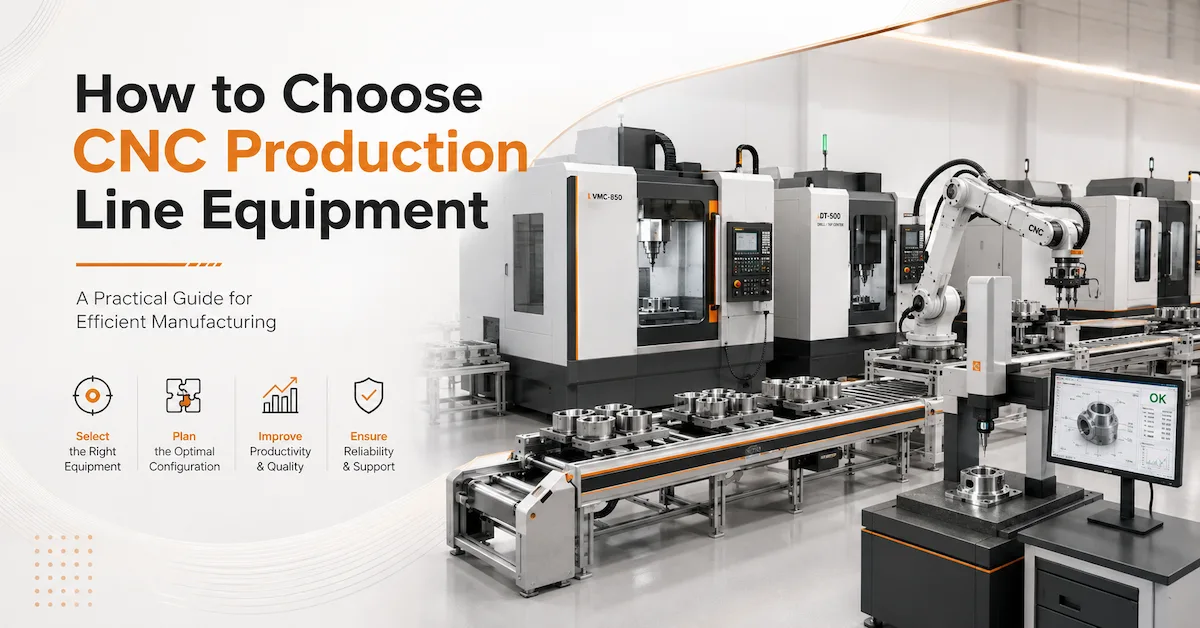
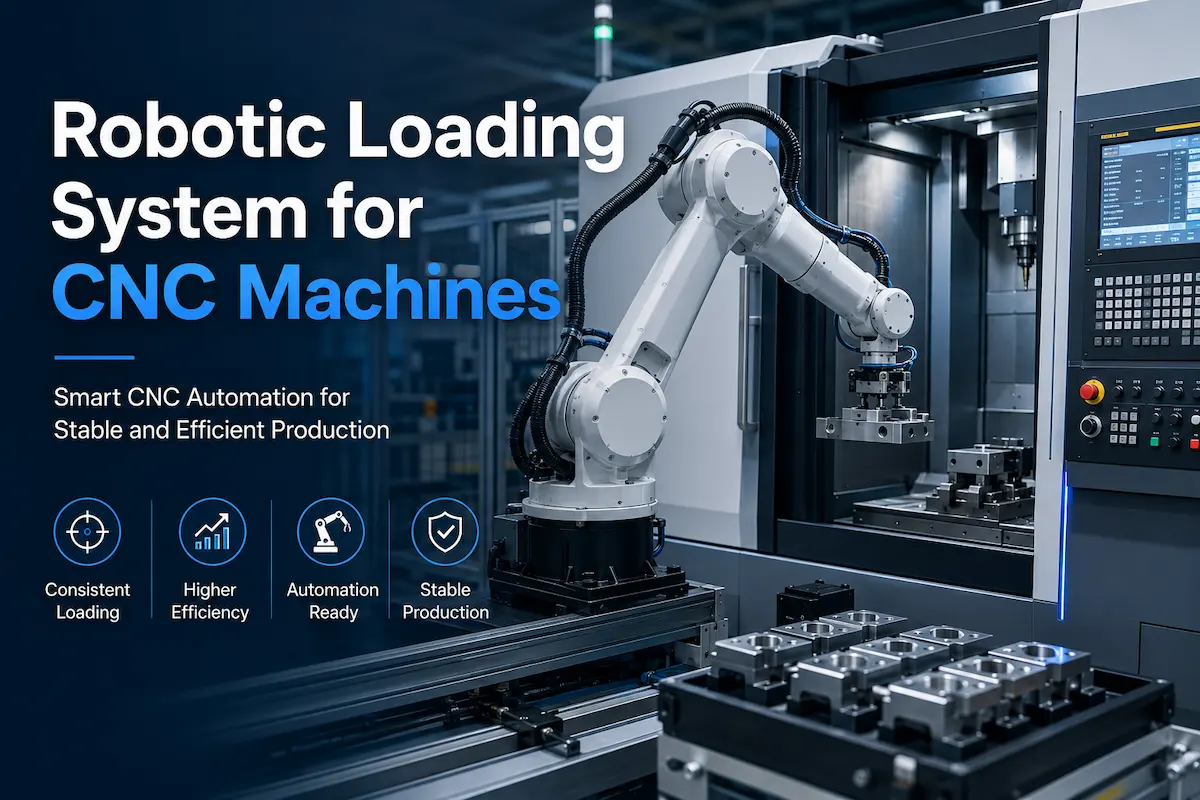
A robotic loading system for CNC machines helps manufacturers automate one of the most repetitive parts of machining: placing raw workpieces into a machine, removing completed parts, and transferring them to the next station.
For factories operating CNC lathes, drilling and tapping machines, machining centers, grinders, or special-purpose equipment, manual loading can become a production bottleneck. Machine capacity may be available, but operators cannot always maintain a consistent loading rhythm across long shifts.
Robotic machine tending creates a more repeatable workflow. However, a successful system involves much more than installing a robotic arm beside a CNC machine. The robot, gripper, fixture, machine interface, raw-material storage, finished-part handling, safety system, and production cycle must work together.
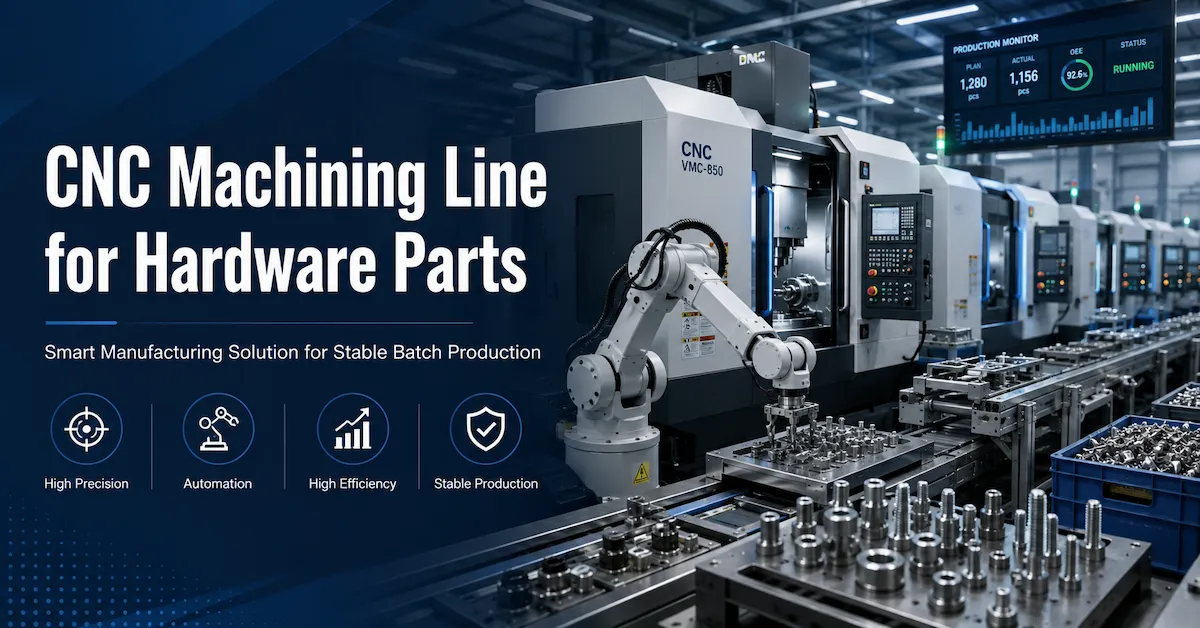
Xinmei Intelligent provides a dedicated robot loading and unloading line for CNC integration and continuous automated production.
Quick Answer: What Is a Robotic Loading System for CNC Machines?
A robotic loading system for CNC machines is an automated machine-tending solution that loads workpieces into CNC equipment and unloads them after machining.
A typical system includes:
- Industrial robotic arm
- Mechanical, pneumatic, or hydraulic gripper
- Raw-workpiece tray, rack, conveyor, or feeder
- CNC machine interface
- Automatic door or access system
- Fixture and clamping confirmation
- Finished-part collection area
- Safety fencing, light curtains, or sensors
- Central control and alarm system
- Optional inspection, cleaning, or marking station
The system can serve one CNC machine or coordinate multiple machines within a production cell.
Its purpose is not simply to reduce manual labor. It should also minimize machine waiting time, standardize workpiece positioning, support longer operating hours, and improve production predictability.
Why Manual CNC Loading Becomes a Bottleneck
Manual loading is flexible and remains suitable for prototypes, frequently changing parts, and small-batch production. Problems begin when order quantities rise and the machining process becomes repetitive.
Common limitations include:
- CNC machines waiting for an available operator
- Different loading speeds between workers
- Incorrect workpiece orientation
- Inconsistent clamping confirmation
- Production slowdowns during breaks or shift changes
- Operator fatigue during repetitive handling
- Higher safety risk with heavy, sharp, hot, or oily parts
- Difficulty maintaining night-shift production
- Unstable output across the day
- Excessive labor assigned to simple machine-tending work
When machining time is short, even a small delay between cycles can reduce total daily output. A robot can follow the same loading sequence repeatedly, helping the CNC machine spend more time cutting and less time waiting.
Which CNC Machines Can Use Robotic Loading?
Robotic loading can be integrated with many types of CNC and automated processing equipment.
| CNC equipment | Common robotic task | Typical application |
|---|---|---|
| CNC lathe | Load blanks and unload turned parts | Shafts, connectors, valve parts |
| Vertical machining center | Place parts into fixtures and remove finished components | Housings, hardware, automotive parts |
| Horizontal machining center | Load pallets or workpieces for multi-face machining | Valve bodies, bearing housings |
| Drilling and tapping machine | Load repeat parts for hole and thread processing | Faucet bodies, brake pump parts |
| Grinding or polishing machine | Transfer parts and maintain production flow | Metal hardware and surface finishing |
| Special-purpose CNC machine | Handle dedicated repeat components | Door closers, floor springs, valve parts |
| Multi-machine CNC cell | Transfer parts among several processes | High-volume automated manufacturing |
Before integration, the supplier should inspect the CNC machine’s door, control interface, fixture, available space, signal system, and cycle time.
Older machines may still support automation, but additional door actuators, sensors, control relays, or communication modules may be required.
Main Components of a Reliable Robotic Loading System
Industrial Robot
The robot must match the required payload, reach, speed, mounting direction, operating environment, and cycle time.
An undersized robot may struggle with the workpiece and gripper weight. An oversized robot may increase cost and occupy unnecessary workshop space.
The supplier should calculate the total moving load, including:
- Workpiece weight
- Gripper weight
- Hoses and cables
- Safety margin
- Required acceleration
- Reach at the furthest loading position
Robot Gripper
The gripper creates direct contact with the workpiece and is one of the most important components in the cell.
Possible designs include:
- Two-jaw grippers
- Three-jaw grippers
- Internal expanding grippers
- Vacuum grippers
- Magnetic grippers
- Custom-profile fingers
- Double grippers for simultaneous unloading and loading
A double gripper can reduce machine idle time by removing the completed part and immediately inserting the next raw part.
Gripper design should consider workpiece shape, surface finish, oil contamination, temperature, dimensional variation, and orientation.
CNC Fixture and Workholding
The robot can position a part accurately, but the fixture must locate and clamp it repeatably.
A good fixture should:
- Provide clear locating surfaces
- Accept the workpiece without interference
- Prevent incorrect orientation
- Clamp consistently
- Confirm that clamping is complete
- Avoid part deformation
- Allow cutting-tool access
- Release chips and coolant effectively
Automating an unstable manual fixture usually transfers the same problems into the robotic cell.
Raw-Part Feeding
Raw workpieces must be presented to the robot in a predictable position.
Common options include:
- Fixed trays
- Drawer systems
- Pallets
- Conveyors
- Rotary tables
- Vibratory feeders
- Bin-picking systems
- Stacked material racks
Simple trays are often reliable for stable batch production. Bin picking offers greater flexibility but usually requires more advanced vision, programming, and part-separation control.
Finished-Part Handling
Completed components may be placed into:
- Finished-part trays
- Conveyors
- Inspection fixtures
- Washing stations
- Deburring stations
- Marking stations
- Packaging containers
- A second CNC machine
Finished-part handling should avoid collision, surface damage, mixed batches, and uncontrolled stacking.
Safety and Control System
A robotic cell requires coordinated safety logic. Depending on the layout, this may include:
- Safety fencing
- Interlocked access doors
- Light curtains
- Area scanners
- Emergency stops
- Robot safe-speed functions
- CNC door confirmation
- Fixture clamping sensors
- Part-presence sensors
- Alarm and recovery logic
The system should stop safely when a door is opened, a part is missing, clamping fails, or the CNC machine sends an alarm.
Robotic Loading vs Manual Machine Tending
| Comparison | Manual loading | Robotic loading |
| Initial investment | Lower | Higher |
| Flexibility for changing parts | High | Depends on programming and tooling |
| Cycle consistency | Operator-dependent | Repeatable |
| Long-shift performance | Affected by fatigue and breaks | Suitable for extended operation |
| Labor requirement | Higher | Lower after setup |
| Heavy-part handling | Greater operator risk | More suitable with correct payload |
| Data and process control | Limited | Easier to monitor |
| Scale-up potential | Requires more operators | Can expand into multi-machine cells |
| Best application | Small batches and frequent changes | Repeatable medium- or high-volume production |
Automation should be selected according to the actual order structure. A robot is not automatically the best solution for every CNC machine.
How to Calculate Whether Robotic Loading Is Suitable
A buyer should examine several factors before requesting a proposal.
Production Volume
Stable and repeatable orders provide the strongest foundation for automation. The higher the number of repeated loading cycles, the more opportunity there is to reduce manual handling.
CNC Cycle Time
If the machining cycle is long, one robot may be able to serve multiple machines. If the machining cycle is very short, the robot must load quickly enough to avoid becoming the bottleneck.
Workpiece Stability
Parts with consistent shape, dimensions, and orientation are easier to automate. Highly variable castings, tangled components, or unstable blanks may require vision or additional locating systems.
Product Changeover
Factories producing several models should evaluate:
- Gripper change time
- Fixture change time
- Program selection
- Tray replacement
- Robot path adjustment
- Error-proofing requirements
Quick-change grippers and modular fixtures can improve flexibility.
Labor Conditions
Automation may provide greater value when the current task involves:
- Heavy parts
- Hot components
- Sharp edges
- Oil or coolant exposure
- High repetition
- Night-shift staffing problems
- Difficult operator recruitment
Future Capacity
The layout should consider whether the system may later serve additional machines, inspection stations, or transfer processes.
Single-Machine Tending vs Multi-Machine Automation
Single-Machine Robotic Loading
One robot serves one CNC machine.
This configuration is suitable when:
- The machining cycle is short
- The component is heavy
- The machine requires frequent handling
- The cell needs a compact layout
- The process is dedicated to one product family
One Robot Serving Multiple CNC Machines
A centrally positioned robot tends two or more machines.
This configuration can improve robot utilization when machine cycle times are long enough. However, scheduling, reach, safety, and machine-alarm recovery become more complex.
CNC and Robot Integrated Production Line
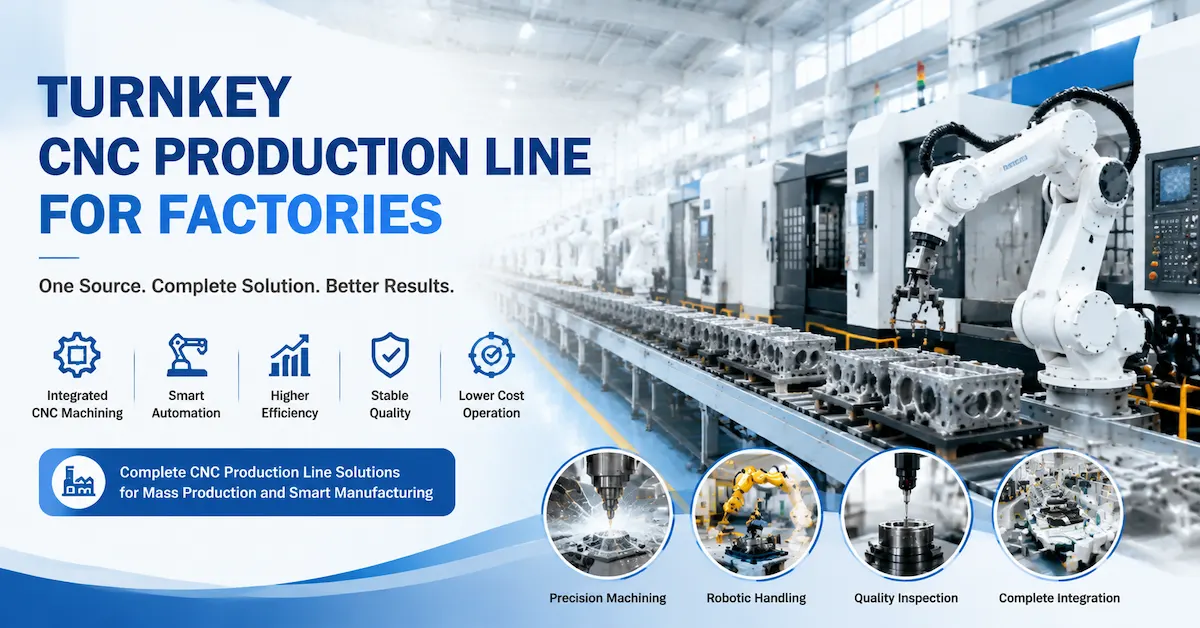
Multiple machines, robots, conveyors, fixtures, and inspection stations operate as one system.
This approach is suitable for stable, high-volume products that require several machining stages. It provides stronger process integration but requires more detailed planning and commissioning.
How Cycle-Time Analysis Should Be Performed
A supplier should separate the total cycle into clear steps:
- Pick the raw workpiece
- Move to the CNC machine
- Open the machine door
- Remove the completed part
- Clean or inspect the fixture if required
- Insert the raw part
- Confirm positioning
- Activate clamping
- Close the machine door
- Start the CNC cycle
- Place the completed part in the next location
The robot cycle should be compared with machining time.
For example, when machining requires 180 seconds and robotic handling requires 20 seconds, the robot may have enough available time to serve another machine. When machining requires only 25 seconds, handling speed becomes much more important.
A realistic proposal should state what is included in the cycle-time estimate.
What Buyers Should Ask an Automation Supplier
| Evaluation point | Question to ask |
| CNC compatibility | How will the robot communicate with our machine? |
| Workpiece handling | What gripper is recommended and why? |
| Fixture design | Can the fixture confirm correct location and clamping? |
| Loading accuracy | How is part position controlled? |
| Cycle time | What assumptions are included in the calculation? |
| Product changeover | How long does a model change require? |
| Safety | Which guards, sensors, and interlocks are included? |
| Fault recovery | What happens after a missing part or CNC alarm? |
| Future expansion | Can the robot serve more equipment later? |
| Training | Will operators learn programming and recovery? |
| Service | How are spare parts and technical support provided? |
Buyers should request a clear system boundary. The quotation should identify which machines, robots, fixtures, conveyors, guards, programs, installation work, and training services are included.
Common Mistakes in CNC Robotic Loading Projects
Choosing the Robot Before Studying the Process
Robot brand and payload matter, but the complete machining process should be evaluated first.
Ignoring Fixture Problems
A robot cannot reliably automate a fixture that requires manual judgment or repeated adjustment.
Using an Inappropriate Gripper
The gripper must tolerate coolant, chips, surface variation, and long production cycles.
Underestimating Raw-Material Presentation
The robot needs parts in predictable locations. Poor tray or feeder design can interrupt the entire cell.
Overlooking Changeover
An automated cell may perform well for one product but lose efficiency when product changes require several hours.
Focusing Only on Labor Savings
The business case should also consider:
- Machine utilization
- Output consistency
- Scrap reduction
- Safety improvement
- Extended operating hours
- Capacity growth
- Delivery reliability
Industries That Benefit from CNC Robotic Loading
A robotic loading system can be used for:
- Automotive and motorcycle components
- Valve bodies and manifolds
- Faucet and sanitary hardware
- Door closer components
- Bearing housings
- Aerospace connectors
- High-voltage electrical connectors
- Fire-protection components
- Gas-appliance parts
- Precision industrial hardware
The system must still be customized around the specific workpiece rather than the industry name alone.
Why Choose Xinmei Intelligent?
Xinmei Intelligent provides CNC machines, robotic loading and unloading systems, and intelligent production-line solutions for industrial manufacturers.
Project support can include:
- Workpiece and drawing review
- CNC compatibility analysis
- Robot payload and reach selection
- Gripper development
- Fixture planning
- Tray and conveyor design
- Safety-system integration
- CNC and robot communication
- Cycle-time evaluation
- Installation and commissioning
- Operator training
- Future automation expansion
For projects requiring several machines, Xinmei also provides CNC and robot integrated automation lines.
Information Needed Before Requesting a Proposal
Prepare the following materials:
- Workpiece drawings and samples
- Workpiece material
- Raw and finished part weight
- Part dimensions
- CNC machine model
- Machine-door dimensions
- Fixture information
- Current machining cycle
- Current loading time
- Required output
- Number of product models
- Workshop layout
- Available power and air supply
- Safety requirements
- Future expansion plans
Photos and videos of the current process are also useful. They allow the engineering team to understand operator movement, loading direction, chip conditions, and available space.
FAQ
What is a robotic loading system for CNC machines?
It is an automated machine-tending system that uses an industrial robot to load raw workpieces, unload machined parts, and transfer components between CNC equipment or production stations.
Can a robot be added to an existing CNC machine?
Often yes. The supplier must evaluate the machine interface, automatic door, fixture, signals, available space, safety system, and cycle time.
Can one robot serve multiple CNC machines?
Yes, when the robot has sufficient reach and the machine cycle times allow coordinated loading without excessive waiting.
What parts are suitable for robotic CNC loading?
Repeatable components with stable shape, weight, orientation, and production volume are the easiest to automate. Custom grippers and vision can support more complex parts.
How does the robot know whether the part is clamped correctly?
The system can use fixture sensors, pressure confirmation, part-presence sensors, CNC signals, and control logic to verify correct loading and clamping.
What affects the cost of a robotic loading system?
Key factors include robot payload, reach, gripper complexity, fixture modification, feeding system, machine quantity, safety equipment, vision, inspection, programming, and installation.
How long does product changeover take?
It depends on the gripper, fixture, tray, robot program, and number of models. Quick-change designs can reduce the changeover time.
Is robotic loading only suitable for mass production?
It provides the strongest value in repeatable medium- and high-volume production, but flexible cells can also support several product models when changeover is properly designed.
Does automation guarantee better machining accuracy?
No. Machining accuracy still depends on the CNC machine, fixture, tools, program, and process control. Automation mainly improves loading consistency and production rhythm.
What should buyers provide before requesting a quotation?
Provide drawings, samples, workpiece weight, CNC machine information, current cycle time, fixture details, target output, product variety, workshop layout, and safety requirements.
Conclusion
A robotic loading system for CNC machines can reduce machine waiting, standardize workpiece handling, improve safety, and support longer, more predictable production cycles.
The best system is not necessarily the one with the largest robot or the highest automation level. It is the solution that matches the workpiece, CNC machine, fixture, cycle time, production volume, changeover needs, and factory layout.
Before investing, manufacturers should review the complete workflow—from raw-part feeding to finished-part collection—and require the supplier to explain gripper design, CNC communication, safety, cycle time, and fault recovery.
Explore Xinmei’s robot loading and unloading line, compare additional equipment through the product center, or submit your drawings and CNC information through the Contact Us page to request a customized automation proposal.