+86 13163919000
 info@xinmeiintelligent.com

The bathroom hardware industry requires high machining accuracy, stable appearance quality, and reliable production consistency. Products such as faucets, angle valves, water meter components, shower fittings, and stainless-steel sanitary parts often require multiple machining processes before final assembly.
For manufacturers producing sanitary ware components in large quantities, traditional manual processing or disconnected CNC operations can create challenges:
- Unstable machining quality
- Excessive manual handling
- Longer production cycles
- Difficult quality control
- High labor dependency
- Increasing manufacturing costs
A professional CNC automation for sanitary ware parts solution helps factories integrate CNC machining equipment, fixtures, robotic loading systems, and production processes into a more efficient manufacturing workflow.
Xinmei Intelligent provides CNC equipment and intelligent production solutions for bathroom hardware manufacturers, helping factories achieve higher precision, stable production, and scalable automation.
Explore related manufacturing capabilities through the Xinmei Bathroom Hardware CNC Machining solution.
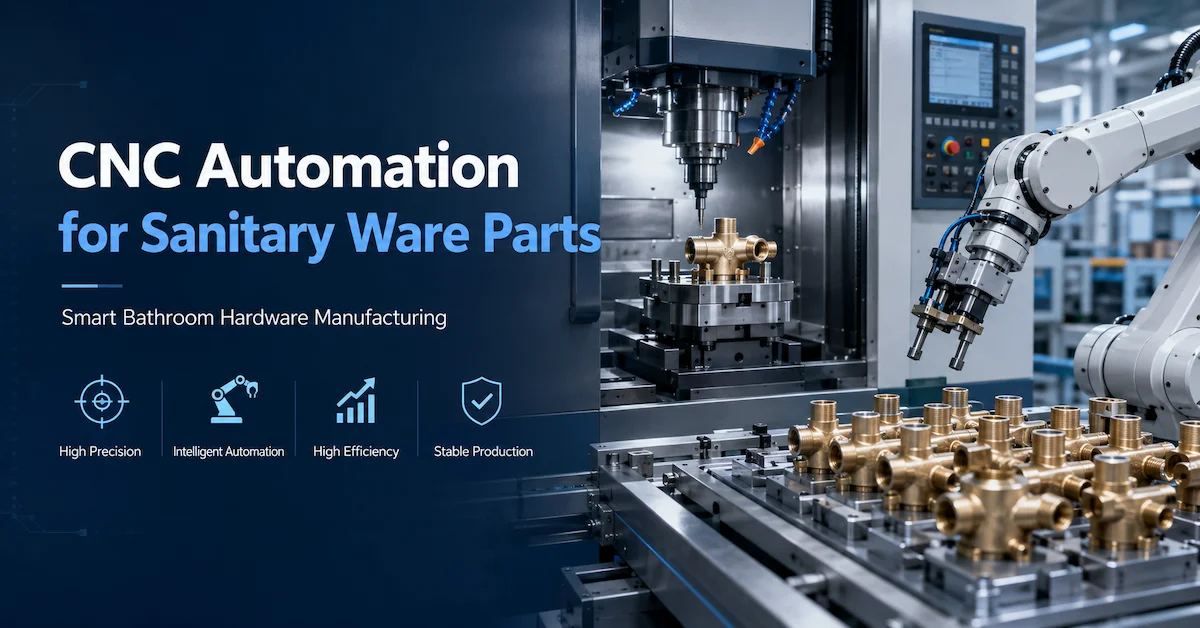
What Is CNC Automation for Sanitary Ware Parts?
CNC automation for sanitary ware parts refers to the use of CNC machines, automation systems, robots, fixtures, and process control technologies to manufacture bathroom hardware components with higher efficiency and consistency.
Unlike traditional production methods, CNC automation focuses on improving the complete manufacturing process, including:
- Automatic workpiece loading
- CNC drilling and tapping
- Milling and boring
- Surface preparation
- Robotic transfer
- Fixture positioning
- Quality inspection
- Production data management
For sanitary ware manufacturers, automation is not only about replacing manual operations. The main goal is to create a repeatable production system where every component meets the same quality standard.
Why Sanitary Ware Manufacturers Need CNC Automation
Bathroom hardware products often require strict dimensional control because they directly affect installation, sealing, water flow, and product appearance.
A faucet body, for example, may require:
- Internal water channels
- Threaded connection points
- Valve installation areas
- Sealing surfaces
- Mounting holes
- Surface finishing
Small machining variations can lead to:
- Water leakage
- Assembly difficulty
- Poor sealing performance
- Customer complaints
- Increased rework
For manufacturers producing thousands of components monthly, manual processes make it difficult to maintain consistent quality.
A CNC automation for sanitary ware parts solution improves production stability by controlling machining parameters, fixture positioning, and handling processes.
Common Sanitary Ware Parts Suitable for CNC Automation
Sanitary ware manufacturers produce many metal components that benefit from CNC automation.
| Product | Common CNC Processes | Automation Benefit |
|---|---|---|
| Faucet body | Drilling, tapping, milling, boring | Stable sealing and thread accuracy |
| Angle valve | Turning, drilling, tapping | Consistent connection dimensions |
| Water meter parts | Milling, hole processing | Better batch repeatability |
| Shower components | Turning, drilling, finishing | Improved appearance consistency |
| Stainless steel fittings | Milling, polishing, deburring | Reduced manual finishing |
| Brass hardware parts | Drilling, tapping, machining | Higher production efficiency |
Different components require different machining strategies. The correct automation system should be designed according to the part structure, material, tolerance, and output requirement.
Key CNC Processes for Sanitary Ware Manufacturing
CNC Drilling and Tapping
Many bathroom hardware components require accurate threaded holes for assembly and connection.
CNC drilling and tapping improves:
- Hole position accuracy
- Thread consistency
- Production speed
- Tool management
- Batch stability
This is especially important for faucet bodies and valve components where connection reliability affects final product performance.
CNC Milling
Milling is commonly used for:
- Flat surfaces
- Installation areas
- Valve mounting positions
- Structural features
Stable CNC milling helps maintain consistent dimensions across large production batches.
CNC Boring
Boring improves internal hole accuracy and surface quality.
For sanitary hardware components, accurate internal machining can influence:
- Valve installation
- Water flow performance
- Sealing reliability
Robotic Loading and Unloading
Automation becomes more valuable when production volume increases.
A robotic loading system can:
- Load raw components
- Remove finished parts
- Reduce operator dependency
- Improve production rhythm
- Support continuous operation
For factories with stable products and repeat orders, robotic handling can significantly improve machine utilization.
CNC Automation vs Traditional Sanitary Ware Production
| Comparison | Traditional Production | CNC Automation |
| Machining consistency | Depends on operator skill | Controlled by CNC program |
| Labor requirement | Higher | Lower |
| Production speed | Variable | More predictable |
| Quality control | Mostly after production | Integrated process control |
| Repeatability | Difficult for large batches | Stable batch output |
| Data management | Limited | Easier monitoring |
| Scalability | Requires more workers | Supports automation expansion |
For small custom orders, manual methods may still provide flexibility. However, for stable sanitary ware production, CNC automation provides stronger long-term advantages.
How to Choose the Right CNC Automation Solution
Before investing in automation, manufacturers should evaluate several factors.
1. Product Structure
Different sanitary ware parts require different machining methods.
The supplier should analyze:
- Product drawings
- Material
- Machining surfaces
- Hole locations
- Thread requirements
- Surface finish
2. Production Volume
Automation level should match output demand.
| Production Situation | Recommended Solution |
| Small batch | Flexible CNC equipment |
| Medium batch | CNC cell with partial automation |
| Large batch | Integrated CNC automation line |
3. Fixture Design
Fixtures directly affect machining accuracy.
A good fixture should:
- Position parts accurately
- Prevent deformation
- Reduce loading time
- Protect finished surfaces
- Support repeat production
For sanitary ware components with irregular shapes, customized fixtures are especially important.
4. Future Expansion
A good automation solution should allow future upgrades:
- Additional CNC machines
- More robots
- Automatic inspection
- Production tracking
- Expanded product capacity
Factories should consider long-term production goals instead of only current needs.
Common Challenges in Sanitary Ware CNC Automation Projects
Complex Product Shapes
Faucet bodies and sanitary components often have curved surfaces and irregular structures.
Solutions require:
- Customized fixtures
- Proper clamping methods
- Optimized machining paths
Surface Protection
Bathroom hardware often has high appearance requirements.
Automation design should prevent:
- Scratches
- Collision damage
- Incorrect handling
Multiple Product Models
Many manufacturers produce several faucet or hardware models.
Flexible automation requires:
- Quick-change fixtures
- Modular tooling
- Efficient program switching
Quality Control
A complete solution should include:
- First-piece inspection
- Dimensional checking
- Process monitoring
- Final quality verification
Why Choose Xinmei Intelligent for Sanitary Ware Automation?
Xinmei Intelligent focuses on CNC equipment and intelligent production solutions for industrial manufacturers.
For sanitary ware factories, Xinmei provides:
- CNC drilling and tapping equipment
- CNC machining solutions
- Robotic loading systems
- Special-purpose CNC machines
- Automated production planning
- Fixture and process optimization
The company supports manufacturers from initial product evaluation to mass production implementation.
For more company information, visit the Xinmei About Us page.
How to Prepare Before Requesting a CNC Automation Proposal
Before contacting a supplier, prepare:
- Product drawings
- 3D models
- Material information
- Current production process
- Required output
- Quality requirements
- Existing CNC equipment
- Factory layout
- Automation goals
This allows engineers to design a solution based on real production conditions.
You can submit your project requirements through the Xinmei Contact Us page.
FAQ
What is CNC automation for sanitary ware parts?
It is an integrated manufacturing approach using CNC machines, robots, fixtures, and production systems to automate bathroom hardware machining.
Which sanitary ware products can use CNC automation?
Common applications include faucet bodies, angle valves, water meter parts, shower fittings, stainless steel hardware, and brass components.
Why do sanitary ware factories need automation?
Automation improves machining consistency, reduces labor dependency, shortens production cycles, and supports stable large-volume manufacturing.
Can CNC automation handle different sanitary ware models?
Yes. With flexible fixtures, tooling systems, and CNC programming, automation can support multiple product models.
What information is needed for automation planning?
Manufacturers should provide drawings, materials, output requirements, current processes, factory layout, and quality requirements.
Can robotic loading be added to existing CNC machines?
In many cases, yes. The supplier needs to evaluate machine compatibility, fixture design, cycle time, and safety requirements.
Conclusion
A CNC automation for sanitary ware parts solution helps bathroom hardware manufacturers achieve more stable quality, higher efficiency, lower labor dependency, and scalable production.
For factories producing faucets, valves, water meter components, and sanitary hardware parts, automation is becoming an important way to improve competitiveness.
The best CNC automation solution should match the product design, production volume, machining requirements, and future growth plan.
Xinmei Intelligent provides CNC machining equipment and automation solutions designed for stable sanitary ware manufacturing. Contact Xinmei Intelligent to discuss your bathroom hardware production requirements and build a customized CNC automation solution.