+86 13163919000
 info@xinmeiintelligent.com

Manufacturers are facing increasing challenges in modern production, including rising labor costs, higher quality requirements, shorter delivery times, and the need for more stable output. For factories relying on CNC machining, simply adding more machines is not always the most effective solution.
Many manufacturers are now upgrading toward automated production systems that combine CNC equipment, robots, fixtures, inspection systems, and intelligent process control.
So, what is a CNC automation solution?
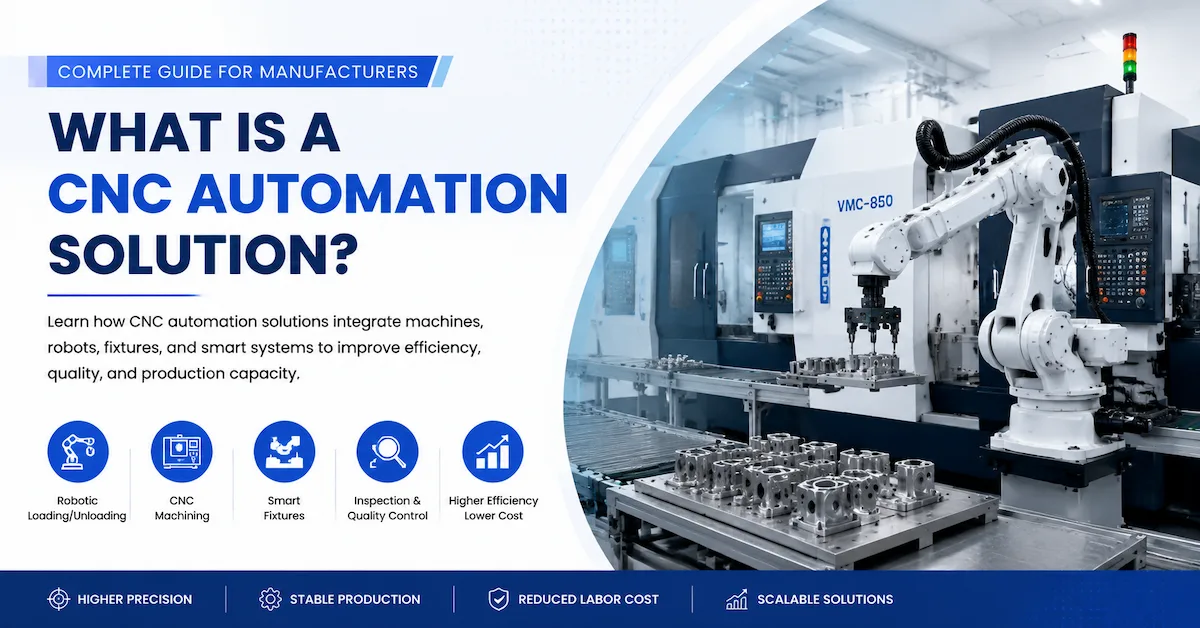
A CNC automation solution is an integrated manufacturing system that uses CNC machines, automation equipment, robots, fixtures, and control technologies to reduce manual operations and improve production efficiency, consistency, and scalability.
Unlike a single CNC machine, an automation solution focuses on the complete manufacturing workflow, from raw material handling to finished part output.
Xinmei Intelligent provides CNC automation equipment and intelligent production solutions for manufacturers in automotive parts, valves, sanitary hardware, door control products, connectors, and precision metal components.
Explore related CNC equipment through the Xinmei products page.
What Is a CNC Automation Solution?
A CNC automation solution is a complete production system designed to automate CNC machining processes.
It usually combines several elements:
- CNC machining equipment
- Robotic loading and unloading
- Automatic fixtures
- Material feeding systems
- Production transfer systems
- Inspection equipment
- CNC and robot communication
- Process monitoring systems
The purpose is to create a more stable manufacturing process with less dependence on manual operation.
For example, a traditional CNC process may require an operator to:
- Load the raw workpiece
- Position the part manually
- Start the machining cycle
- Remove the finished component
- Transfer it to the next process
A CNC automation solution replaces many repetitive steps with automated handling and intelligent control.
This allows factories to improve:
- Production efficiency
- Machine utilization
- Product consistency
- Worker safety
- Manufacturing scalability
Why Are Factories Investing in CNC Automation?
Many manufacturers already own CNC machines but still experience production limitations.
The problem is often not machining capability itself, but the surrounding workflow.
High Labor Dependency
Traditional CNC production often requires operators for:
- Loading parts
- Unloading finished products
- Moving materials
- Checking dimensions
- Managing machine interruptions
As production volume increases, labor becomes a bottleneck.
Automation reduces repetitive manual work and allows operators to focus on production monitoring and process improvement.
Unstable Production Rhythm
Manual operations can create differences between shifts and operators.
Common issues include:
- Different loading methods
- Different positioning accuracy
- Uneven cycle times
- Operator fatigue
- Production delays
A CNC automation system creates a more repeatable production process.
Low Machine Utilization
A CNC machine may spend valuable time waiting for:
- Material loading
- Operator availability
- Manual inspection
- Part transfer
Automation allows machines to spend more time performing actual machining.
Difficulty Scaling Production
When orders increase, hiring more operators is not always the best solution.
A CNC automation solution allows factories to increase capacity through:
- Better process integration
- Higher equipment utilization
- Reduced manual handling
- Continuous operation capability
Key Components of a CNC Automation Solution
CNC Machining Equipment
The CNC machine remains the core of the production system.
Depending on the application, factories may use:
- CNC drilling and tapping machines
- Vertical machining centers
- Horizontal machining centers
- Multi-spindle CNC machines
- Special-purpose CNC machines
The machine selection depends on:
- Product structure
- Material
- Required accuracy
- Production volume
- Machining process
Robotic Loading and Unloading System
Robotic handling is one of the most common parts of CNC automation.
A robotic loading system can:
- Pick raw materials
- Load CNC machines
- Remove finished parts
- Transfer components between processes
- Support continuous production
Robotic loading is especially useful for repeatable products with stable dimensions.
Xinmei provides robotic loading and unloading solutions that can be integrated with CNC equipment for automated production.
Learn more about the robot loading and unloading line.
Automatic Fixtures
Fixtures directly affect machining accuracy.
A good automated fixture should:
- Position parts accurately
- Maintain stable clamping force
- Reduce loading time
- Prevent deformation
- Support robotic operation
For complex parts such as valve bodies, faucet bodies, door closer components, and automotive parts, fixture design is a critical part of automation success.
Inspection and Quality Control
Modern automation systems often include inspection processes.
Examples include:
- Dimensional measurement
- First-piece inspection
- Online monitoring
- Final inspection
- Quality tracking
Integrating inspection helps detect problems earlier and reduces batch-quality risks.
Types of CNC Automation Solutions
Different factories require different automation levels.
| Solution Type | Suitable Application | Main Advantage |
|---|---|---|
| CNC automatic loading cell | One CNC machine | Reduce manual loading |
| Robotic CNC cell | Medium batch production | Improve efficiency and consistency |
| Multi-machine automation | Several CNC machines | Increase equipment utilization |
| Turnkey CNC production line | Large-scale production | Complete manufacturing integration |
A professional supplier should recommend the correct automation level according to production needs rather than selling the most complex system.
CNC Automation Solution Applications
A CNC automation solution can be customized for many industries.
| Industry | Typical Products | Automation Benefits |
|---|---|---|
| Automotive | Brake components, steering parts, housings | Stable mass production |
| Valve Manufacturing | Valve bodies, manifolds | Improved machining consistency |
| Bathroom Hardware | Faucets, angle valves | Better thread and sealing quality |
| Door Control | Door closers, floor springs | Efficient batch production |
| Electrical Components | Connectors, terminals | Precision manufacturing |
| Industrial Hardware | Brackets, shafts, mechanical parts | Reduced labor dependency |
The automation design should always start from the actual workpiece and production process.
How to Choose the Right CNC Automation Solution
Before investing, manufacturers should evaluate several factors.
Production Volume
Automation is most valuable when:
- Products are stable
- Orders are repeatable
- Production quantity is high
- Manual handling limits capacity
Product Characteristics
Consider:
- Workpiece size
- Weight
- Material
- Surface requirements
- Machining complexity
Current Production Problems
Identify:
- Long cycle time
- Labor shortage
- Quality variation
- Machine waiting time
- Frequent manual handling
The right solution should solve actual production problems.
Future Expansion
A good automation system should allow future upgrades:
- Additional CNC machines
- More robots
- Automatic inspection
- Expanded production capacity
CNC Automation Solution vs Traditional CNC Production
| Comparison | Traditional CNC Production | CNC Automation Solution |
|---|---|---|
| Labor requirement | Higher | Lower |
| Production consistency | Operator dependent | More stable |
| Machine utilization | Limited | Higher |
| Output scalability | Requires more workers | Easier expansion |
| Quality control | Mostly manual | More integrated |
| Continuous operation | Difficult | Possible |
For factories with stable production requirements, automation provides stronger long-term value.
How to Select a CNC Automation Supplier
When evaluating what is a CNC automation solution and choosing a supplier, buyers should consider more than equipment price.
Important evaluation points include:
Engineering Capability
The supplier should understand:
- Machining process
- Fixture requirements
- Cycle time
- Automation planning
Integration Experience
Ask whether the supplier can integrate:
- CNC machines
- Robots
- Fixtures
- Inspection systems
- Production lines
Testing and Commissioning
A professional supplier should provide:
- Trial production
- Accuracy verification
- Cycle-time confirmation
- Operator training
After-Sales Support
Important services include:
- Installation
- Technical support
- Spare parts
- Maintenance guidance
Why Choose Xinmei Intelligent?
Xinmei Intelligent focuses on CNC equipment and intelligent manufacturing solutions for industrial factories.
The company provides:
- CNC machining equipment
- Special-purpose CNC machines
- Robotic loading systems
- Automated production lines
- Process optimization
- Manufacturing solutions
Xinmei supports industries including:
- Automotive parts
- Valves
- Bathroom hardware
- Door control
- Precision metal components
Learn more through the Xinmei About Us page.
Information Needed Before Requesting a CNC Automation Proposal
Before contacting a supplier, prepare:
- Product drawings
- Material information
- Current production process
- Required output
- Quality requirements
- Factory layout
- Automation expectations
This helps engineers design a solution based on actual manufacturing conditions.
Submit your requirements through the Xinmei Contact Us page.
FAQ
What is a CNC automation solution?
A CNC automation solution is an integrated manufacturing system combining CNC machines, robots, fixtures, and control systems to automate machining processes.
Why do factories need CNC automation?
Factories use CNC automation to reduce labor dependency, improve production consistency, increase machine utilization, and support larger production volumes.
What equipment is included in a CNC automation solution?
It may include CNC machines, robots, automatic fixtures, conveyors, inspection systems, and production-control equipment.
Can existing CNC machines be automated?
In many cases, yes. The supplier needs to evaluate machine compatibility, loading space, fixtures, signals, and safety requirements.
Is CNC automation only suitable for large factories?
No. Small and medium factories can also benefit from automation cells designed around specific production needs.
How much does a CNC automation solution cost?
Cost depends on machine quantity, robot configuration, fixture complexity, inspection requirements, and automation level.
Conclusion
Understanding what is a CNC automation solution helps manufacturers make better decisions when upgrading production systems.
A CNC automation solution is not simply adding a robot beside a machine. It is a complete manufacturing strategy that connects CNC equipment, handling systems, fixtures, inspection, and process management.
For factories producing automotive parts, valves, sanitary hardware, door control products, and precision components, automation can improve productivity, quality stability, and long-term competitiveness.
Xinmei Intelligent provides customized CNC automation solutions designed around real factory requirements. Contact Xinmei Intelligent to discuss your machining process and build a more efficient manufacturing system.