+86 13163919000
 info@xinmeiintelligent.com

CNC workshops are under increasing pressure to improve productivity, maintain stable quality, and control manufacturing costs. While CNC machines can provide high machining accuracy, many factories still depend heavily on manual operations for loading, unloading, material transfer, inspection, and machine monitoring.
As production volume increases, manual operations can become a limiting factor.
Understanding how to reduce manual labor in CNC workshops is not about replacing skilled workers. Instead, it is about using automation technologies to remove repetitive tasks, improve machine utilization, and allow employees to focus on higher-value production activities.
Modern CNC automation solutions combine CNC machines, robots, fixtures, sensors, and intelligent production systems to create a more stable and efficient manufacturing environment.
Xinmei Intelligent provides CNC automation solutions including robotic loading systems, special-purpose CNC machines, and integrated production lines for industries such as automotive parts, valves, bathroom hardware, door control components, and precision metal manufacturing.
Explore related solutions through the Xinmei products page.
Why CNC Workshops Still Depend on Manual Labor
Many CNC factories already use advanced machining equipment but still rely on operators for daily production activities.
Common manual tasks include:
- Loading raw workpieces
- Removing finished parts
- Checking part positioning
- Moving materials between machines
- Performing repeated inspections
- Adjusting production during machine cycles
These tasks may appear simple, but they consume significant labor time when repeated hundreds or thousands of times every day.
Manual Loading and Unloading
One of the largest labor requirements in CNC workshops is machine tending.
Operators often spend most of their time:
- Opening machine doors
- Placing parts into fixtures
- Confirming positioning
- Removing completed components
- Preparing the next cycle
This reduces the amount of time CNC machines spend cutting material.
Repetitive Material Handling
Factories producing hardware parts, automotive components, valves, or sanitary products often require continuous movement of workpieces.
Manual transfer can create:
- Production delays
- Higher labor requirements
- Inconsistent workflow
- Increased operator fatigue
Operator-Dependent Production Variation
Human operation may create differences between:
- Different workers
- Different shifts
- Different production periods
This can affect:
- Loading consistency
- Cycle time
- Product handling
- Production rhythm
How Automation Helps Reduce CNC Labor Requirements
When discussing how to reduce manual labor in CNC workshops, automation should focus on repetitive and time-consuming operations.
The goal is to create a more efficient production process rather than simply remove workers.
Robotic Loading and Unloading
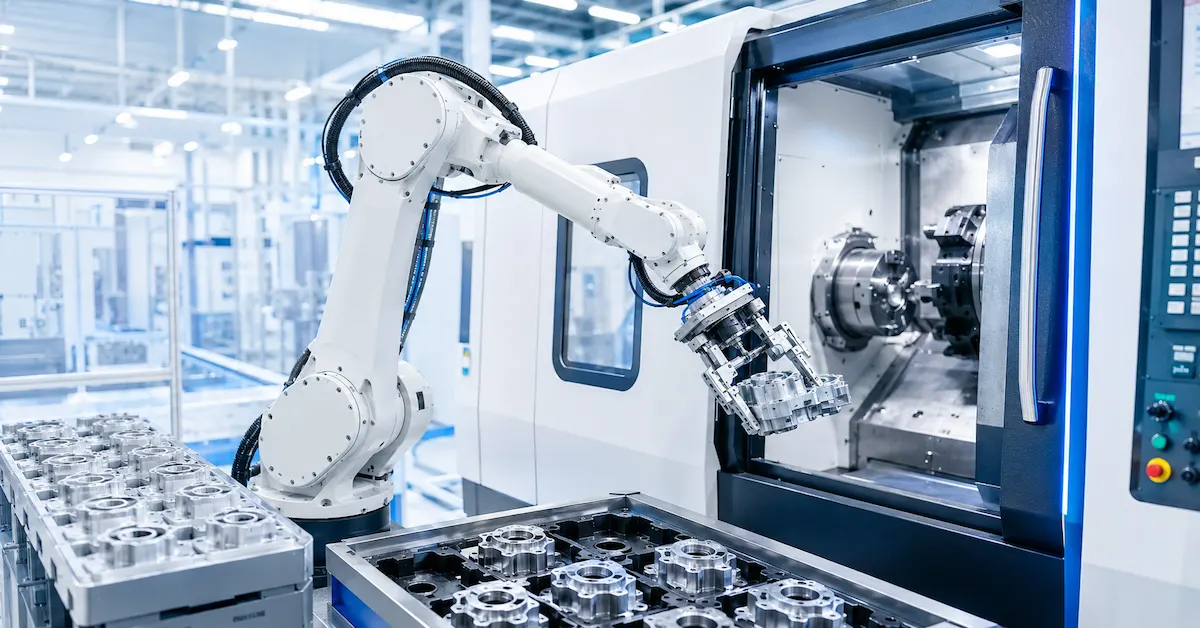
Robotic loading systems are one of the most common CNC automation upgrades.
A robot can:
- Pick raw parts
- Load CNC machines
- Remove finished components
- Transfer parts between processes
- Maintain consistent cycle timing
Benefits include:
- Reduced repetitive labor
- Higher machine utilization
- More stable production rhythm
- Longer unattended operation
Xinmei provides robot loading and unloading solutions designed for CNC machining applications.
Automatic Fixture Systems
Fixtures determine how accurately and efficiently parts are positioned.
Automated fixtures help:
- Reduce manual adjustment
- Improve clamping consistency
- Shorten loading time
- Support robotic operation
For complex components such as valve bodies, faucet bodies, door closer parts, and automotive housings, fixture design is a critical automation factor.
Multi-Machine Robot Tending
A single operator traditionally may monitor several CNC machines.
Automation can allow one robotic system to serve multiple machines depending on:
- Machining cycle time
- Robot reach
- Workpiece weight
- Production layout
This improves equipment utilization while reducing repetitive handling.
Automated Inspection
Inspection automation helps reduce manual measurement tasks.
Possible solutions include:
- Online measurement
- Dimensional checking
- Part verification
- Quality data collection
This allows operators to focus on process management instead of repeated manual inspection.
CNC Workshop Automation Solutions
A complete automation strategy may include several levels.
CNC Machine Loading Automation
The first step for many factories is automating loading and unloading.
Suitable for:
- Stable products
- Repeat machining processes
- Medium and high-volume production
Typical equipment includes:
- Robot arm
- Gripper
- Fixture
- CNC communication system
- Safety enclosure
Robotic Material Handling
Material handling automation reduces unnecessary movement between processes.
It can include:
- Part transfer
- Conveyor systems
- Tray systems
- Automatic feeding
This creates smoother production flow.
Intelligent Production Monitoring
Modern CNC workshops increasingly use data-based management.
Monitoring systems can track:
- Machine operation status
- Production quantity
- Downtime
- Maintenance requirements
- Quality information
This helps managers identify bottlenecks faster.
Manual CNC Production vs Automated CNC Workshop
| Comparison | Manual CNC Workshop | Automated CNC Workshop |
|---|---|---|
| Labor requirement | Higher | Lower |
| Loading consistency | Operator dependent | More stable |
| Production rhythm | Variable | Predictable |
| Machine utilization | Limited | Improved |
| Night operation | More difficult | Easier |
| Quality consistency | Depends on workers | More controlled |
| Production expansion | Requires more labor | Easier scaling |
Automation does not eliminate the need for skilled workers. Instead, it allows workers to focus on programming, maintenance, quality improvement, and production management.
Steps to Reduce Manual Labor in CNC Workshops
Step 1: Analyze Current Production Flow
Before automation, factories should review:
- Current operator tasks
- Machine waiting time
- Material movement
- Quality issues
- Production bottlenecks
This identifies where automation creates the greatest value.
Step 2: Identify Repetitive Tasks
The best automation targets are usually:
- Repeated loading
- Unloading
- Transfer operations
- Inspection tasks
- Material handling
These activities consume labor but require limited decision-making.
Step 3: Select Suitable Automation Equipment
Depending on production needs, solutions may include:
- Robotic loading systems
- Automatic fixtures
- Multi-machine automation
- Complete CNC production lines
The solution should match the factory’s production volume and product stability.
Step 4: Optimize the Production Process
Automation works best when combined with:
- Proper fixture design
- Optimized CNC programs
- Stable tooling
- Standardized processes
Automation should improve the entire workflow, not only add a robot.
Factors Affecting CNC Automation Investment
When evaluating how to reduce manual labor in CNC workshops, factories should consider long-term production value.
Important factors include:
Production Volume
Automation provides stronger benefits when:
- Products are repeatable
- Orders are stable
- Machines operate continuously
Workpiece Characteristics
Consider:
- Size
- Weight
- Material
- Shape
- Handling difficulty
Labor Cost
Factories with high repetitive labor requirements often achieve faster returns from automation.
Future Expansion
A scalable automation system allows factories to add:
- More CNC machines
- Additional robots
- Inspection systems
- Production stations
How to Choose a CNC Automation Supplier
Selecting the right supplier is an important part of automation success.
Manufacturers should evaluate:
Engineering Experience
The supplier should understand:
- CNC machining processes
- Fixture design
- Robot integration
- Production planning
Similar Project Experience
Ask:
- Have you automated similar CNC processes?
- Can you support our industry?
- Can you provide practical examples?
Integration Capability
A reliable supplier should manage:
- CNC machines
- Robots
- Fixtures
- Sensors
- Safety systems
Technical Support
Important services include:
- Installation
- Commissioning
- Training
- Maintenance guidance
- Spare parts support
Why Choose Xinmei Intelligent?
Xinmei Intelligent focuses on CNC equipment and intelligent manufacturing solutions for factories seeking higher efficiency and stable production.
The company provides:
- CNC machine automation
- Robotic loading systems
- Special-purpose CNC machines
- Intelligent production lines
- Fixture optimization
- Manufacturing process improvement
Xinmei supports industries including:
- Automotive parts
- Valve manufacturing
- Bathroom hardware
- Door control components
- Precision metal products
Learn more through the Xinmei About Us page.
Information Needed Before Requesting an Automation Proposal
Before contacting a supplier, prepare:
- Product drawings
- Workpiece samples
- Material information
- CNC machine models
- Current production process
- Labor requirements
- Production volume
- Factory layout
- Automation goals
This information helps engineers design a practical automation solution.
Submit your project requirements through the Xinmei Contact Us page.
FAQ
How to reduce manual labor in CNC workshops?
Factories can reduce manual labor by introducing robotic loading, automatic fixtures, material handling systems, inspection automation, and optimized production workflows.
Does CNC automation replace skilled workers?
No. CNC automation reduces repetitive tasks and allows skilled workers to focus on programming, maintenance, quality control, and production improvement.
What CNC tasks can be automated?
Common automated tasks include loading, unloading, part transfer, inspection, fixture operation, and machine tending.
Is CNC automation suitable for small workshops?
Yes. Small and medium workshops can start with targeted automation solutions such as robotic loading for one CNC machine.
What is the biggest benefit of CNC automation?
The biggest benefits are improved machine utilization, stable production quality, reduced repetitive labor, and easier production scaling.
How much does CNC workshop automation cost?
Cost depends on robot configuration, machine compatibility, fixture design, production requirements, safety systems, and automation level.
Conclusion
Understanding how to reduce manual labor in CNC workshops helps manufacturers build more efficient and competitive production systems.
The most effective approach is not simply reducing workers. It is using automation technology to remove repetitive operations, improve machine utilization, stabilize quality, and create a smarter manufacturing workflow.
For factories producing automotive parts, valves, bathroom hardware, door control products, and precision components, CNC automation can reduce labor pressure while supporting long-term production growth.
Xinmei Intelligent provides customized CNC automation solutions designed around real factory requirements.
Contact Xinmei Intelligent to evaluate your CNC workshop and develop a suitable automation strategy.