 +86 13163919000
 info@xinmeiintelligent.com

A valve body may appear to be a compact metal component, but it usually contains several features that must work together: internal flow passages, threaded ports, sealing surfaces, mounting holes, bores, and mating faces.
A small machining error in one of these areas can affect assembly, leakage performance, valve movement, or the consistency of the finished product. That is why choosing valve body CNC machining equipment requires more than comparing machine size and spindle speed.
The correct equipment should match the valve design, material, machining sequence, tolerance requirements, production volume, and future automation plan.
For manufacturers producing ball valves, filter valves, globe valves, manifolds, air-conditioning valves, fire-protection valves, or plumbing components, the real goal is not simply to machine one acceptable sample. It is to maintain the same process quality across repeat production.
Xinmei Intelligent provides CNC equipment and automated production solutions for valve and metal component manufacturers. Buyers can review available equipment through the Xinmei product center and explore the company’s valve machining capabilities.
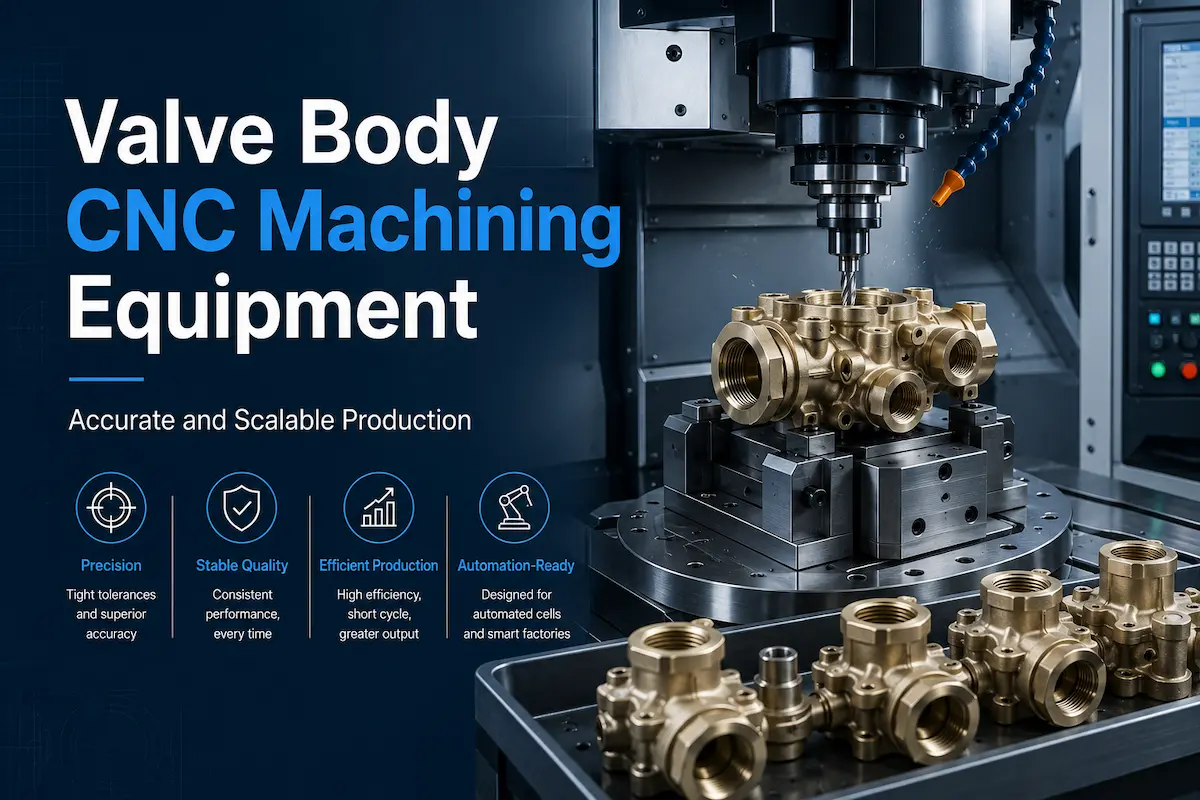
What Equipment Is Used for Valve Body CNC Machining?
Valve body CNC machining equipment refers to the machines, fixtures, tooling, loading systems, and inspection methods used to manufacture the functional features of a valve body.
Depending on the component, the production system may include:
- CNC turning equipment
- Vertical drilling and tapping machines
- Horizontal machining centers
- Multi-spindle combined machines
- Special-purpose CNC machines
- Rotary or multi-station machining systems
- Robotic loading and unloading
- Automatic fixtures and clamping
- Deburring and cleaning stations
- Dimensional inspection equipment
There is no single machine configuration that suits every valve body.
A small brass plumbing valve may prioritize fast drilling, tapping, and turning. A larger industrial valve housing may require rigid multi-face machining, accurate boring, and heavy-duty fixtures. A manifold may need multiple ports and intersecting passages machined from several directions.
The equipment choice should therefore begin with the workpiece—not with a standard machine catalogue.
Why Valve Body Machining Is Difficult to Standardize
Valve bodies combine several machining risks in one component.
Bore and passage alignment
Internal bores and flow passages must align with connected components. Misalignment may restrict flow, create assembly problems, or require additional rework.
Sealing surface quality
Sealing areas must be machined consistently. Surface flatness, geometry, and finish influence how reliably the valve seals after assembly.
Thread accuracy
Valve bodies often contain several internal or external threads. Thread depth, position, diameter, and cleanliness affect fitting installation and sealing performance.
Multi-face machining
Many valve components require machining from different directions. Repeated repositioning increases setup time and introduces another source of location error.
Burr control
Intersecting holes and internal passages can create burrs that are difficult to see and remove. Uncontrolled burrs may interfere with assembly or contaminate the valve system.
Material variation
Brass, stainless steel, cast iron, aluminum, and other materials behave differently during cutting. Tooling, speed, feed, cooling, and chip removal must match the material.
A suitable machining solution must address these risks as one complete process.
Matching the Equipment to the Valve Body Process
The table below shows how common production requirements influence machine selection.
| Valve machining requirement | Suitable equipment direction | Main selection concern |
|---|---|---|
| External turning and concentric features | CNC turret lathe or turning center | Chucking stability and concentricity |
| Multiple drilled and tapped ports | CNC drilling and tapping machine | Hole position, tapping control, and cycle time |
| Multi-face milling and boring | Horizontal machining center | Fixture access, rigidity, and chip evacuation |
| High-volume repeat production | Special-purpose or multi-station CNC machine | Integrated processes and takt time |
| Several processes in one setup | Combined CNC machine tool | Tool arrangement and process sequence |
| Reduced manual loading | Robotic loading and unloading system | Gripper, fixture, safety, and machine interface |
| Multiple valve models | Flexible CNC machining cell | Changeover time and fixture modularity |
The most expensive machine is not automatically the best choice.
A general machining center may offer flexibility, but it can be inefficient when one valve model is produced continuously. A special-purpose machine may deliver a faster production rhythm, but it may not be suitable for frequent product changes.
The correct decision depends on the factory’s order structure.
Critical CNC Processes for Valve Bodies
Turning
Turning is commonly used for external diameters, circular sealing areas, threaded connections, and concentric features. Stable chucking is important because incorrect clamping can affect roundness and alignment.
Drilling
Drilling creates mounting holes, connection ports, oil or water passages, and preparation holes for tapping or boring. Tool deflection and chip evacuation become more important as holes become deeper.
Tapping
Tapping produces threaded connections for pipes, fittings, covers, and assembly components. The CNC system must coordinate spindle movement and feed accurately to reduce damaged threads and broken taps.
Milling
Milling is used for mounting faces, sealing surfaces, flats, slots, and other external features. Fixture rigidity directly affects surface consistency.
Boring
Boring improves the size, alignment, and finish of existing holes. It is particularly important for valve seats, internal chambers, and components that must align during assembly.
Chamfering and deburring
Chamfering supports assembly and thread entry. Deburring removes sharp edges and material left around intersecting passages. These operations should be included in the process plan rather than treated as an afterthought.
Why Fixture Design Is as Important as the Machine
A powerful CNC machine cannot compensate for an unstable fixture.
Valve bodies often have irregular cast or forged surfaces, several ports, and limited clamping areas. The fixture must locate the workpiece repeatably without causing deformation or blocking tool access.
A practical valve-body fixture should:
- Establish reliable locating points
- Hold the component securely during cutting
- Avoid deformation of thin or functional areas
- Provide access to required faces and holes
- Reduce loading and unloading time
- Support chip and coolant removal
- Allow convenient inspection
- Maintain repeatability across the batch
For higher-volume production, hydraulic or pneumatic clamping may improve loading consistency. For several valve models, modular or quick-change fixtures can reduce changeover time.
When comparing suppliers, buyers should ask to see the proposed locating and clamping logic—not only the machine exterior.
Equipment Selection by Production Volume
Small batches and multiple models
A flexible CNC machining center may be the better choice when the factory processes many valve types in lower quantities. The priority is fast programming, adaptable fixtures, and convenient tool changes.
Stable medium-volume orders
An automated CNC cell can combine one or two machining centers with robotic loading. This reduces manual handling while keeping reasonable flexibility.
Long-term high-volume production
Special-purpose, multi-spindle, rotary-table, or multi-station equipment may provide stronger production efficiency when the valve design and order volume are stable.
Mixed production with future growth
A modular line allows the manufacturer to begin with essential CNC equipment and add loading, inspection, transfer, or additional machining stations as capacity increases.
Buyers should avoid building a fully automated line around an uncertain product forecast. Automation should match confirmed production demand and realistic future growth.
General CNC Machine or Special-Purpose Valve Machine?
| Comparison | General CNC equipment | Special-purpose valve equipment |
| Product flexibility | Higher | Focused on defined valve families |
| Initial process development | More programming and fixture work | Process is designed around the component |
| Cycle efficiency | Suitable for mixed production | Stronger for repeat high-volume production |
| Changeover | Usually easier | Depends on machine and fixture design |
| Multi-process integration | Possible but machine-dependent | Can be optimized for required operations |
| Automation potential | Suitable for flexible cells | Suitable for dedicated production lines |
| Best use | Multiple models and changing orders | Stable products and predictable volume |
A professional supplier should explain the trade-off clearly instead of automatically recommending the most complex system.
Material Considerations for Valve Machining
Brass and copper alloys
These materials are widely used in plumbing and sanitary valve products. They generally offer good machinability, but chip control, burr formation, thread finish, and surface protection still require attention.
Stainless steel
Stainless steel provides corrosion resistance but can create more demanding cutting conditions. Equipment rigidity, tool selection, cooling, and process stability become more important.
Cast iron
Cast-iron valve bodies may require rigid equipment, effective dust or chip management, and stable boring or milling operations.
Aluminum and zinc alloys
These materials can support lightweight or cost-sensitive components. Clamping pressure and surface protection must be controlled to avoid marks or deformation.
Material confirmation should happen before the supplier recommends spindle power, cutting tools, coolant strategy, and estimated cycle time.
How Automation Changes Valve Production
Automation can improve production consistency, but it should solve specific workflow problems.
A robotic system may:
- Load raw valve bodies into the machine
- Confirm workpiece orientation
- Transfer components between processes
- Unload completed parts
- Place parts into trays or conveyors
- Support continuous or reduced-attendance operation
However, automation must be coordinated with machining time, fixture clamping, door operation, inspection, and material replenishment.
A robot that moves quickly does not improve output if the fixture takes too long to clamp or the machine remains the primary bottleneck.
The complete cycle should be evaluated before the line is designed.
What Buyers Should Check Before Ordering
When comparing valve body CNC machining equipment, evaluate the complete solution rather than isolated specifications.
| Evaluation area | Questions for the supplier |
| Workpiece understanding | Have you reviewed our drawing, material, and blank condition? |
| Process planning | Which operations can be completed in one setup? |
| Fixture design | How will the valve body be located and clamped? |
| Machine rigidity | Is the structure suitable for our material and cutting load? |
| Tooling | Which tools are recommended for bores, threads, and sealing surfaces? |
| Cycle time | What assumptions are used in the estimated cycle? |
| Burr and chip control | How are internal chips and intersecting-hole burrs managed? |
| Quality inspection | Which dimensions should be checked during production? |
| Automation | Can loading, unloading, or transfer be added later? |
| Service | Who handles installation, commissioning, training, and maintenance support? |
A useful quotation should explain machine configuration, included tooling, fixtures, estimated output, automation scope, and buyer responsibilities.
Quality Control for Valve Body Production
Inspection should focus on the dimensions that affect valve function.
Typical checkpoints include:
- Bore size and alignment
- Thread dimensions and depth
- Sealing surface geometry
- Port position
- Mounting-hole location
- Part concentricity
- Burr condition
- Overall dimensional consistency
- Fixture repeatability
- First-piece and in-process inspection
Checking only the finished batch creates unnecessary risk. In-process checks help identify tool wear, fixture movement, or process drift before a large quantity is affected.
Xinmei’s broader manufacturing approach includes CNC equipment integration, machining process planning, and quality-control support. Buyers can learn more about the company through the About Us page.
Information Needed for an Accurate Equipment Proposal
Prepare the following information before requesting a quotation:
- 2D and 3D valve body drawings
- Physical samples, if available
- Raw material and blank type
- Critical dimensions and tolerances
- Thread specifications
- Sealing-surface requirements
- Required machining operations
- Current production process
- Current cycle time
- Daily or monthly output target
- Number of valve models
- Available workshop space
- Preferred automation level
- Local electrical and installation conditions
This information allows the supplier to evaluate the machine, fixture, tooling, process sequence, and automation scope as one system.
Why Work With Xinmei Intelligent?
Xinmei Intelligent develops CNC machines and intelligent production solutions for industries including valves, sanitary hardware, automotive parts, door control components, and precision metal manufacturing.
For valve projects, the engineering discussion can cover:
- Workpiece and drawing evaluation
- General or special-purpose machine selection
- Turning, drilling, tapping, milling, and boring
- Multi-spindle and multi-station machining
- Fixture and tooling planning
- Robotic loading and unloading
- Production-line layout
- Inspection planning
- Installation and operator training
- Long-term technical support
The aim is to match the equipment configuration to the customer’s actual valve design and production conditions.
FAQ
What is valve body CNC machining equipment used for?
It is used to turn, drill, tap, mill, bore, chamfer, and finish valve bodies and related valve components with controlled accuracy and repeatability.
Which CNC machine is best for valve bodies?
The best machine depends on the valve size, material, required processes, production volume, and number of models. Options include turning centers, drilling and tapping machines, horizontal machining centers, combined machines, and special-purpose equipment.
Can one machine complete several valve-body processes?
Yes. A combined or special-purpose CNC machine may integrate drilling, tapping, milling, boring, and other operations in one setup, depending on the workpiece design.
Why is fixture design important in valve machining?
The fixture controls workpiece location, stability, deformation, tool access, and repeatability. Poor fixturing can reduce the accuracy of even a high-quality machine.
Can valve body production be automated?
Yes. Robotic loading, automatic fixtures, conveyors, inspection stations, and multi-machine cells can be added when production volume and process stability justify automation.
What materials can valve CNC equipment process?
Common materials include brass, copper alloys, stainless steel, cast iron, aluminum, and zinc alloys. Machine and tool configuration should be selected for the specific material.
What causes valve-body machining costs to increase?
Major cost factors include workpiece complexity, number of setups, tight tolerances, material difficulty, tooling, fixture complexity, inspection requirements, automation level, and required output.
What should I provide before requesting a quotation?
Provide drawings, samples, material, blank condition, critical tolerances, thread details, production volume, existing process, cycle-time target, and automation requirements.
Conclusion
Choosing valve body CNC machining equipment is not simply a question of machine size or purchase price. The equipment must support accurate bores, reliable threads, consistent sealing surfaces, effective chip control, stable fixtures, and the required production rhythm.
Factories producing several changing models may benefit from flexible machining centers. Manufacturers with stable, high-volume valve orders may gain more value from special-purpose, multi-station, or automated systems.
The right solution begins with a detailed review of the workpiece, process, quality risk, and output target.
Explore Xinmei’s ball valve manufacturing solutions, compare equipment through the product center, or submit your drawings through the Contact Us page to request a customized valve machining proposal.